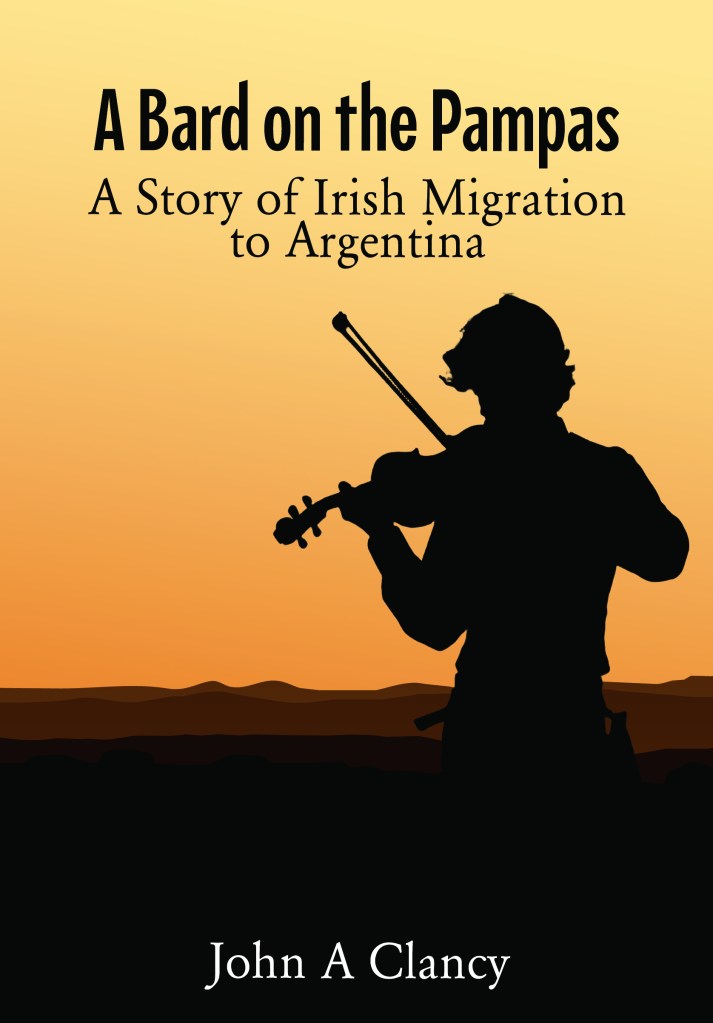
A Bard on the Pampas: A story of Irish migration to Argentina, Immortalise, pp.438.The
ISBN: 9781763831025
RRP: Available here $29.99
By John A. Clancy
A JOURNEY FROM IRELAND TO ARGENTINA
A Bard on the Pampas is told in three parts, an unfolding tapestry traversing history and geography. The first takes us to post-Famine rural Ireland, the second introduces us to life on the Argentine Pampas, and the third turns towards the destruction of Argentina’s Indigenous peoples.
At the heart of the story is Richard Barron, the foster brother of the author’s grandfather. There is a little mystery providing the backdrop here, as family history tells that Richard was sent to Australia in the 1870s, although there is no record of him ever living there. From this intriguing starting point, the novel takes us on a journey from rural Ireland to the vast plains of Argentina, exploring migration, music, culture and tradition along the way.
FROM COUNTY KILKENNY TO THE PAMPAS
We first meet Richard in 1852, in a modest farmhouse in County Kilkenny. He is just five years old and suffering from cholera. The emotional weight of the scene is palpable, perhaps reflecting the lingering trauma of the Famine years. Richard’s mother remarks, ‘You know if God were to take him, mightn’t it be for the better.’ There is no spoiler here, of course: Richard survives. Despite initial resistance, a Protestant nurse saves him and, in deference to her religion, only the Lord’s Prayer is said before the celebratory dinner marking his recovery.
The importance of language as cultural identity is introduced early, the dialogue between Richard’s parents is peppered with Irish words. Language becomes the foundation for establishing connections throughout the rest of Richard’s journey. Richard’s ability to learn new languages and adapt to different cultures is no doubt enabled by his interest in languages and music. He receives a good education, learns Latin and develops an aptitude for the fiddle. His musical ability becomes particularly apparent during the telling of ‘going on the wren’ on St Stephen’s Day in 1858.
During the group’s final performance, Richard is asked to perform solo, accompanying the host’s singing. It is here that his talent is recognised — and, almost casually, we are introduced to Irish immigration when he overhears conversations about Argentina.
Language, music and tradition are recurring themes throughout the novel.
A KALEIDOSCOPE OF CULTURES
When Richard arrives in Argentina, he is well equipped to adapt to an entirely different landscape. He is initially welcomed into the estancia of David Sutton, a wealthy Irish expatriate who describes the Pampas as gradually weaving a magical spell over those who experience it. We are transported from the familiar Irish countryside to breathtaking plains and a climate that is almost its complete opposite.
There are new languages to navigate, too. Richard quickly familiarises himself with Spanish and begins forming relationships with the people around him. He immerses himself in the culture, language and traditions of the Indigenous peoples, continuing the novel’s exploration of cultural exchange.
As the book puts it, ‘Music has a way of breaking down racial barriers.’
That idea is beautifully illustrated when David Sutton suggests that Richard organise a concert featuring ‘some songs, instrumental pieces, a few poems, a kaleidoscope of cultures.’ Richard responds by organising a meitheal celebration, bringing together an impressive ensemble of Irish musicians to accompany the ceili dancers: an accordion player, two fiddle players, three tin whistle players, an uilleann piper, two guitar players and a drummer.
Quite the band.
Like many readers, I had no idea that Argentina was such an important destination for Irish immigrants. This impromptu ensemble of Irish musicians seems to confirm Argentina’s place as one of the major destinations of the Irish diaspora, while also demonstrating how music could preserve cultural identity far from home.
THE BARD ON THE PAMPAS
Richard is a sensitive soul. Music and poetry flow throughout his journey, eventually earning him the title of the ‘bard on the Pampas.’ He develops a strong emotional connection to both the land and its people, consistently showing respect for culture and tradition.
There is, perhaps, a tendency to paint Richard in an almost excessively virtuous light. He is always giving of himself to others. One can hardly find fault with him: he eats his vegetables and doesn’t partake in too much alcohol. At one point he muses, ‘My feelings of love must remain my dark secret.’ And so it does. It is perhaps the one occasion when Richard’s moral compass veers slightly from due north — but only ever so slightly, none would be any the wiser.
BEAUTY AND A DARKER HISTORY
The adventure doesn’t end on the Pampas. Richard travels further south, and his romantic attachment to the country continues. We are treated to vivid poetic descriptions of harsh summer drought and the beauty of the Andes, including ‘Sparkling dew-drops like precious jewels in valley and plain.’
But beneath this beautiful landscape lies a much darker political reality. The menace of Roca and the Campaigns of the Desert become increasingly apparent as the army advances into Patagonia and the threat to the Indigenous population becomes impossible to ignore.
This contrast between the beauty of the land and the violence unfolding upon it gives the final part of the story considerable weight.
A QUESTION THAT NEEDS NO ANSWER
The epilogue takes us back to Ireland in 1918, where we meet a young woman named Margaret. She asks her uncle, the author’s grandfather, about Richard:
‘Uncle Patrick, did Richard have a sympathy for the hungry, the downtrodden, the dispossessed?’
It is a question that perhaps doesn’t need to be asked. In many ways, it is the premise of the entire novel.
THE VERDICT
A Bard on the Pampas is an adventure story, a history lesson and a geography lesson all in one. It offers an interesting glimpse into Irish migration to Argentina while exploring the enduring importance of music, language, culture and tradition. I for one will now think of the Pampas in a far broader perspective than the feather duster plant that featured in the rockery in the front garden of our family home.
I rate this novel highly. It is well researched, interesting and, ultimately, an engaging read.
‘Music has a way of breaking down racial barriers.’
★ ★ ★ ★ ★
RECOMMENDED

