A Book Review by Frances Devlin-Glass
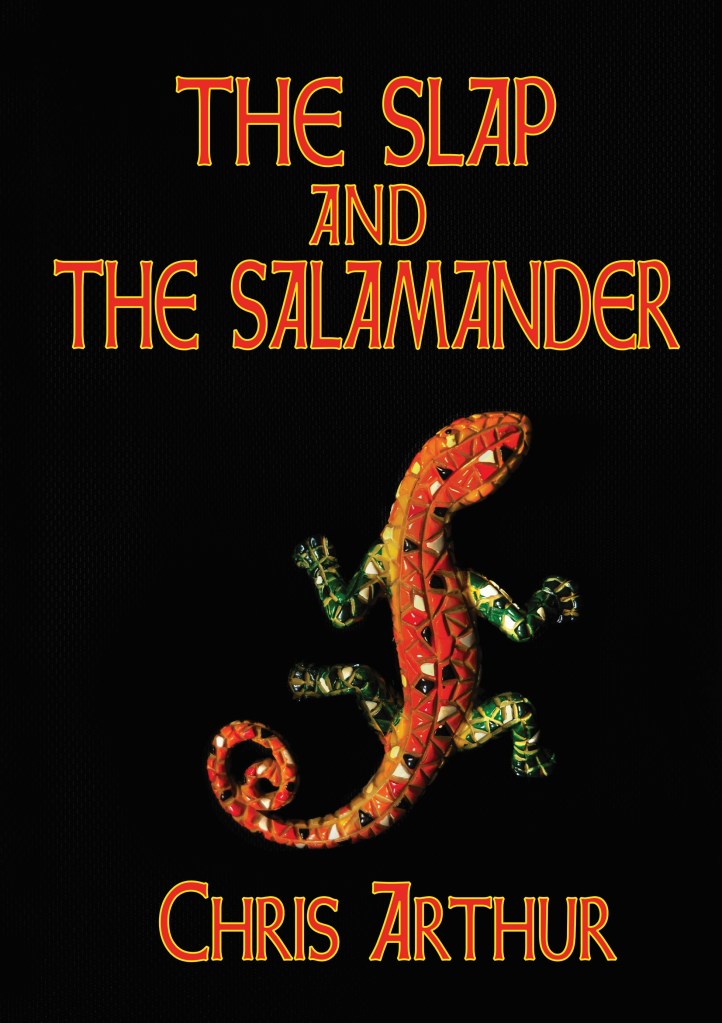
Chris Arthur: The Slap and the Salamander, Essays, Serving House Books, Raleigh, North Carolina, 2026
ISBN: ISBN, 1972482211, 9781972482216
The twenty-first century literary essay is somewhat of an anomaly, as it builds on a genre that has sadly fallen into disuse. However, I have to thank Irish writer Chris Arthur for reviving my interest in a form that I enjoyed as a very young woman. And Maggie O’Farrell likewise whose I Am I Am I Am is also a go-to. I enjoy Chris Arthur’s meditative, questioning approach, his attentiveness to the real and to the personal, and the way he typically zooms out from the personal to larger, sometimes philosophical and cosmic implications of his thematics, often pivoting back to the mundane spark that generated the long but never tedious way around, and typically leaving issues open.
I’ve reviewed several of his essay collections, but this one is more self-revealing and self-conscious about his writing processes. It addresses in particular his reasons for leaving Northern Ireland during the Troubles, and the ongoing ambivalences of that decision. He commits to not resting in his questioning, and does not disappoint.
The Slap and the Salamander begins with an unusually violent image (for Chris Arthur) of a father slapping a child to impress on him the extraordinariness of finding a salamander within a domestic hearth fire. He explains it is not a form of parenting he condones or an allusion to nothing more than a mythic occurrence, but it functions in two ways, to explain an odd title, and more germanely as a metaphor of his intentions to find the extraordinary in the ordinary. He succeeds in startling the reader often. As in the first formal essay of the collection which celebrates a haiku about the hototogisu’s song written by man imminently to be decapitated:
The rest of your song
I’ll hear in the other world
Oh sweet cuckoo bird.
The meditation that follows is extraordinary. He cannot know the historicity of the event, the man’s crime (whether major or political, or minor, or even non-existent), and he does not spare us his imagined vision of the violence visited on the condemned man, or his research into macabre books (like Frances Larsen’s Severed: A History of Heads Lost and Heads Found). This book, inspired by the invention of the guillotine which killed so efficiently and suddenly, looks into such gruesome considerations as whether or not the loss of consciousness was indeed instantaneous at the point of execution. Arthur’s essay, by contrast, is a meditation on the transition between life and death, on religious beliefs about an afterlife and his radical doubts about the ‘solutions’ offered by religious belief for life beyond death. He segues to the Japanese cultural protocols of writing a farewell to life at the point of death, and thence to considerations of Montaigne, one of his touchstone essayists, and to his sense of the uncertainties that attend life, dying and dying patiently and well. The image of Montaigne attending his garden and thinking of neither gardening nor pruning but simply concentrating on the practical task at hand, takes me back to the end of Voltaire’s Candide. I had never thought of Candide cultivating his garden as a Zen practice, but more as a retreat from senseless violence, but welcome Chris Arthur’s gentle challenge to my understanding of a masterpiece inspired by Montaigne’s hopes for his own death written 100 years earlier. It is the yoking of disparate worlds that is so energising in Chris Arthur’s work. It is a fine example of Religious Studies in action, and all the more stimulating because it is not looking for stasis or certainty, and abjures dogma.
At a human level, I’m drawn to the stories he tells of himself. He does not foreground himself, unless it’s to meditate on the provisionality of his thinking and uncertainties about where it leads him. In ‘A Reading List for Laura’, he tells of his daughter, a precocious reader, abruptly giving up books for several years in favour of screens, and the dilemmas it posed for him. Not being doctrinaire, and realising the pitfalls of imposing his values on her, he expresses relief when she finally tires of her device and returns to books, requesting of him lists of recommended books, only to have her request books he felt would rob her of her innocence prematurely. This is, of course, a dilemma with many hydra heads familiar to parents and teachers. He will deal with a similar issue in ‘Same House, Different Worlds’ when he asks why do heron’s pale blue/green eggs have a powerful and irresistible aesthetic charge for Chris Arthur and not for a macho nameless schoolboy in his class who even shared an inspirational biology teacher, Arnold Benington of the Friends School, Lisburn, with him. He avoids judgment about his fellow student’s choices, and this leads him to an understated grasp of why for some climate change is a matter of indifference and for others it is existential.
There are several accounts in this collection of why he needed to leave Northern Ireland as a result of the Troubles. In ‘Sparrowhawk Theology’, the influential teacher Benington surfaces again. After Arthur left school, his former teacher became a friend and they engaged in various activities as naturalists, raising suspicions on one occasion of their being terrorists while they were searching for caterpillars. They had accidentally stumbled on ‘the spoor of terrorist training’ (p.176). This segues into a meditation on sparrow hawks which is poetic in the ways he admires in the writers about birds he esteems. He remembers using climbing irons to reach high into a spruce tree with Benington to view three eggs in a nest. Citing J A Baker’s The Peregrine, he notes a passage which casts light on the politics of the North:
Sparrowhawks were always near me in the dusk, like something I meant to say but could never quite remember. Their narrow heads glared blindly through my sleep. I pursued them for many summers, but they were hard to find and harder to see, being so few and so wary. They lived a fugitive, guerrilla life. In all the overgrown neglected places the frail bones of generations of sparrow hawks are sifting down now into the deep humus of the woods. They were a banished race of beautiful barbarians, and when they died they could not be replaced. p.179
I’m not sure how literally Baker’s quotation can be taken, and he certainly did not have the troubles in his mind when he wrote about Peregrines: it is undoubtedly more metaphoric than that. However, Arthur’s commentary is suggestive of his despair at the ‘toxic tribalism’ and religious apartheid (p.137) of the Northern Troubles and his hopes for a cessation of hostilities and for a more inclusive and less dualistic culture in the North:
I like the idea of a secret ossuary of sparrow hawk bones, a wooded sepulchre in some wild, neglected place where the relics of the hawks are slowly absorbed into the ground, the ashes of their fire returning to the earth….
What do hawks suggest about the nature of the world?
For me, these beautiful raptors tore to shreds the old, simplistic concepts of deity that were propagated with such aggressive naivety when I was growing up in Northern Ireland. Jab [Benington, his teacher] was one of the propagators. … He was a deeply religious man who believed in a traditionally conceived Christian God – all powerful, omniscient, and loving. He saw sparrow hawks, like every other element of the natural world, as evidence of God’s creation. His reading of nature somehow managed to take an ‘All things bright and beautiful’ approach. How he squared the nature of the hawks with this outlook is something I’ve never understood. To me, a hawk’s perfectly attuned lethality stands shoulder-to-shoulder with parasites, famine, earthquake, war, disease – part of the unassailable army of objections to the kind of deity Jab believed in.
I never voiced such doubts to Jab. It would have pained him to know that what he saw as a magnificent part of God’s design was, in my eyes, a torpedo fired into the certainties he cherished…. Jab’s worldview and mine were irreconcilably different in their reading of the evidence. What causes individuals to reach such different verdicts? I’m as unsure about this as I am about what sets the register of our interest in nature. (pp.179-81)
Chris Arthur keeps in play within himself the scholar of religion, the sceptic, the naturalist and the friend. The violence of the raptor does not prevent his appreciating its beauty, grace, skill, lethal speed and efficiency. Difference of views does not relationships imperil.
This is a masterful collection of contemplative essays, with much to say about the birds he has studied and passionately loves, about a homeland from which he’s an exile, about making new homes as a refugee, some more settled than others, and about the mysterious workings of the mind. He’s a living exemplar of how the heart’s impulses can be deepened by study. And a man who thinks in subtle and challenging ways about the sacred in its destructive and inclusive workings, and about what it is to be curious about religion without being sectarian. I strongly recommend them.
Frances Devlin-Glass
Frances is a member of the Tinteán editorial collective, and a convert to reading literary essays.

