A Review of TESTIMONY by Karen Lochhead
Testimony (1925), Director, Writer and Executive Producer – Aoife Kelleher; Producers – Rachel Lysaght and Farah Abushwesha; Cinematographer – Eleanor Bowman. Featuring Dr Maeve O’Rourke, Philomena Lee and Michael O’Brien, and other contributors.
This confronting documentary tells the story of the fight for justice for the women and children who were survivors of the Magdalene Laundries or Mother and Baby Homes. It also covers their determination to hold the Irish Government accountable for its sanctioning of their treatment.
The Magdalene Laundries were operated in Ireland from the 18th to the late 20th century by Roman Catholic orders. ‘Fallen’ women were held there under the pretence of moral rehabilitation and were forced to do laundry to earn money for the order. They were unpaid and imprisoned. Single pregnant women were often taken there and had their babies, without consent, adopted out (or trafficked) to other countries, including the UK, USA and even Australia. They were dehumanised and treated appallingly, physically and emotionally. They were also used for illegal vaccine trials. The Laundries work was supported by the Irish State.
The film centres on the campaign by the Justice for Magdalenes (JFM) advocacy group who refused to accept the stonewalling from the Irish government. It dismissed the overwhelming number of accounts from survivors, excluding them from redress. Under immense pressure from the UN, it finally admitted to its role in 2013. The film also deals with the fight for compensation, the State apology, public support, the emotional effect on survivors, the fight for recognition, the world response and the denial and lack of remorse from the religious orders involved.
The director, Aoife Kelleher, puts together home videos, news clips, promotional visual material from the institutions themselves and re-enactments to give a collective context to the stories of the survivors and advocators. When they speak to camera, it is an intimate focus on what they have to say, allowing their dignity and bravery to come across. An award-winning original score from Tom Hodge gives depth to the visual elements. The music is evocative and haunting, giving the dark subject matter gravity. However there is lightness too in both visual and audio with a sense of optimism and hope in the end, even though the cause is ongoing.
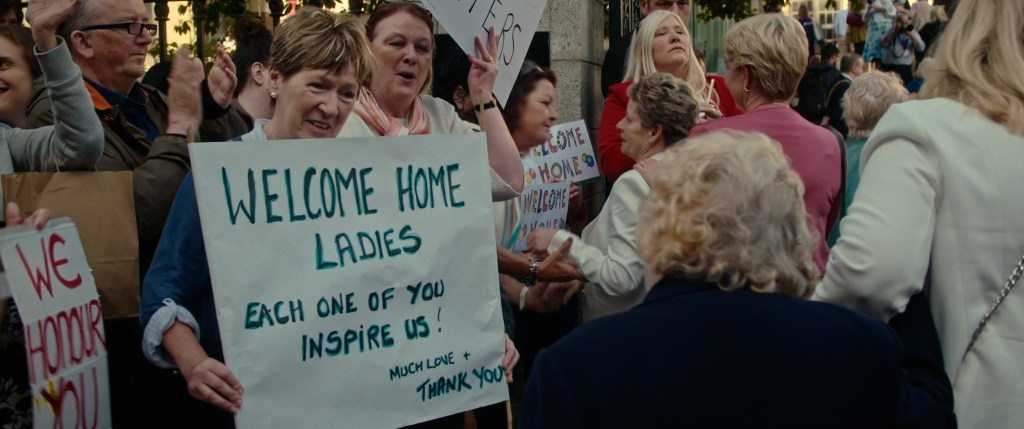
This is an honest and transparent account of its subject matter. There is no attempt to shy away from the brutality that the women and children suffered and the lasting and profound impact it has had on their lives. Footage of the many sites of the Laundries, mass grave sites, and stills of the women, children and nuns, are shown as survivors tell their stories. Interviews are with both mothers and those trafficked out of the country as infants, as well as with the JFM advocates. Other footage includes the formal state apology from the Irish Taoiseach, the ‘Dublin Honours Magdalenes’ event, and presentations at the United Nations.
Written by Aoife Kelleher and Rachel Lysaght, and directed by Kelleher, the documentary takes the viewer on an intimate and harrowing journey with the survivors through their despair and frustration, anger and pain, going from what happened to them to their fight for recognition by the authorities. The film applauds their resilience and that of the JFM and gives them back their dignity and their right to be heard. It shows how determination and bravery can prevail over dishonesty and brutality. It is a significant testimony to this shameful part of Irish history.
Karen Lochhead
The Classic Setup for a Family Drama

A Review of Horseshoe by Mandy Maroney Rasmussen
Horseshoe , 2025, Directed by Edwin Mullane and Adam O’Keeffe, Written by Adam O’Keeffe, and Director of Photography: Mark O’Rourke.
Horseshoe (2025) has everything you’d want in an Irish film. It’s set on the west coast of County Sligo, in the stunning area of Mullaghmore, against the backdrop of the breathtaking Gleniff Horseshoe mountains, and with the cinematography to match. This landscape is mirrored and complemented by the lilting music of Irish composer, Anna Mullarkey, and the fine traditional singing of John Francis Flynn.
It has the classic setup for family drama, as four estranged siblings reunite in their childhood home in the wake of their father’s death, in anticipation of the reading of the will. The siblings are played by well-credentialed actors: Jer by Jed Murray (Love/Hate), Niall by Neill Fleming (Kin), Cass by Carolyn Bracken (Oddity, The Gone, You are not my mother) and Evan by Eric O’Brien, well supported by Lalor Roddy (That they may Face the Rising Sun) and Mary Murray (Love/Hate).
It’s also very funny. The drama is perfectly balanced by razor-sharp comic wit, so it’s no surprise it’s written and co-directed by the multi-award-winning Irish writer Adam O’Keeffe. The siblings love to trade insults, and the Irish knack for swearing is well-employed – the solicitor’s ‘sorry for your loss’ is countered by ‘Oh, he was a terrible old ****’.
The siblings divide into two groups, the two who live in the home and want to keep it (Jer and Evan) and the two who fled the nest and want to sell it (Cass and Niall). Before long we discover that Cass and Niall’s lives are imploding, making them desperate for the inheritance they are expecting.
We also learn very early on that their father was a nasty and abusive man who taught his children ‘life is hard’ by treating them harshly. The film opens with Jer being insulted by his father’s ghost, who reappears throughout the film to badger each of his children in different ways. The loss of their mother many years earlier had been something their father never got over and had made him bitter.
The story unfolds like a mystery as past wrongs and secrets are gradually revealed. Humour turns to pathos as the older two brothers relapse into old patterns of punching each other, causing Cass to retreat under the table, just as she had as a child. Tension builds when Jer is told the town bully has vowed revenge on Evan, and he desperately searches for the others to help him protect their youngest brother. When he finally finds them in a surreal scene at the New Age yoga retreat run by Niall’s ex, the siblings finally unite in a feelgood, emotionally satisfying ending.
Little wonder that Horseshoe won the Best Irish Feature at the Underground Cinema International Film Festival and Best Debut Irish feature at 2025 Galway Film Fleadh and was nominated for Best Director and Best Lead Actress at this year’s IFTAs. To quote an Australian icon, ‘Do yourself a favour’ and see this one, available online and Cinema release at the Irish Film Festival.
Mandy Maroney Rasmussen
BEO FAOIN BHFÓD / BURIED ALIVE!
Documentary Film Reviewed by Dan Boyle
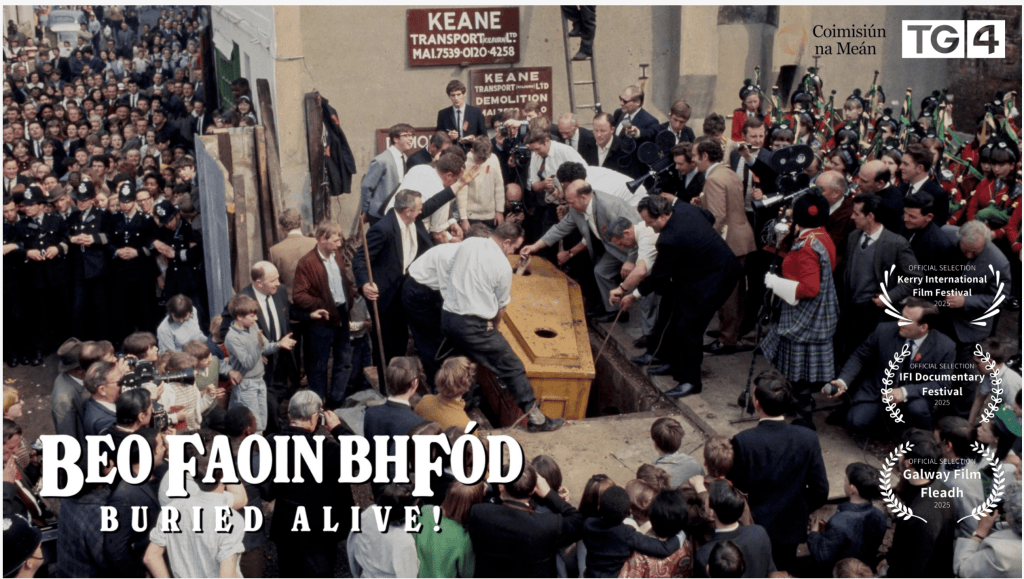
Back in the sixties Andy Warhol predicted that everyone in the future would be famous for 15 minutes. Still in the sixties was the phenomenon of the media’s Nine-Day Wonder. One such as these was hapless Tipperary man, Michael Meaney, who went to London to seek his fortune. His chosen method for success? Buriel Artist!
The history of poverty is the history of get-rich-quick schemes. Michael Meaney piqued the interest of colourful London identity Butty Sugre who organized the World champion Buriel Attempt and exploited Michael Meaney shamelessly as colourful characters are known to do. Butty Sugrue was a keg-toting strongman who owned several pubs and was a promoter of genius. This all took place in April 1968 at the one-handed Lord Nelsen Irish pub in Kilburn. For historical context this was the time of the height of the Vietnam War and the assassination of Martin Luther King Jr.
The idea of the Burial Artist dates to the 1920s along with the ‘They Shoot Horses, Don’t They’ dance marathons, the pole sitters and bed of nails recumbents. Anything that will grab an audience and some quick money.
Just prior to Michael Meaney’s attempt, Cork man Tom Hayes had himself buried alive in a coffin for 100 hours. A bitter rivalry and all sorts of public trash talk ensued between the opposing camps which went on for years. Michael Meaney’s coffin was more an enormous coffin-shaped box, they complained. But Michael stayed down longer, they shot back. It was just as well the two groups were separated by the Irish Sea.
Beo Faoinbh Fód / Buried Alive, is a nicely paced and well constructed historical documentary directed by Daire Collins who also wrote it with Sadhbh Devlin and James O’Brien Moran.Includes interviews with Michael Meaney’s daughter Mary Meaney and others. It is gravely narrated by Macdara O Fatharta. Such coddery!
This can all be blamed on the Guinness book of World Records published 1955 which reignited the craze for bizarre headline catching stunts. So, who was the better man? Michael Meaney or Tom Hayes. It was the ‘sixties. What about sisters doing it for themselves. Wait till you learn about the nun from Skegness!
Dan Boyle

A Film Review by Sian Cartwright
The Lightkeeper (2024), directed by Vic Sarin, written by Ciaran Creagh. Featuring Dominic Cooper, Sarah Gadon, Aidan Quinn, Sarah Bolger, David Pearse, Keith McErlean, Caleb Mulligan, Jaden Rain.
Filmed in County Donegal, The Lightkeeper is a captivating drama set in the mid-1920s, in a north-western Irish seaside town as a man evaluates grief and keeping the memory of his loved ones alive, after people he meets change his perspective on life.
Directed by Vic Sarin, the film uses the rough, weather-beaten landscape to depict a taciturn, middle-aged lighthouse keeper, Seamus Og MacGrianna (Dominic Cooper). While his profession is to light the path for others, to steer them from danger, he keeps to himself and courts his own peril as he grieves his wife and young son, but for a friendship with his housekeeper, Maire (Sarah Bolger). He drinks at the bar but shares no-one’s table. His meals, prepared by Maire, are eaten alone.
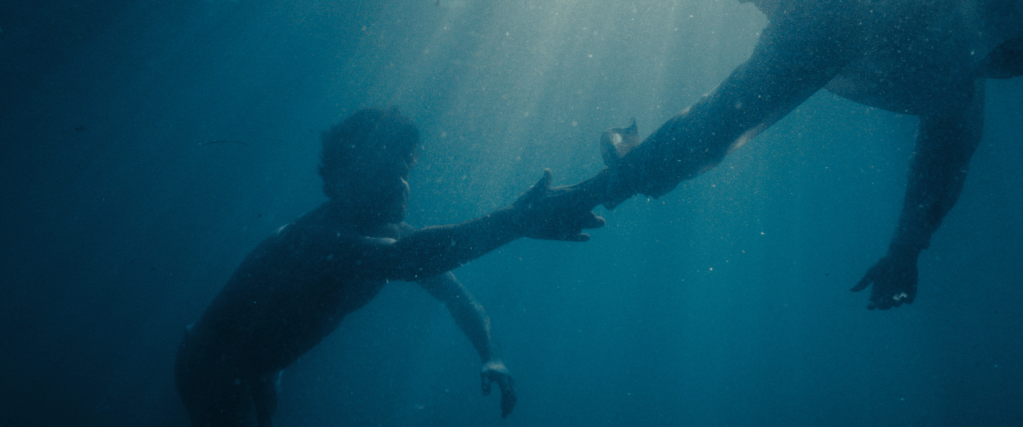
He tends to two gravestones beneath the lighthouse, growing roses in a nearby garden to remember his wife by. He mourns his son’s drowning by rowing out in the bay, gradually dipping his hand deeper in the water to beckon the mythological Celtic water horse, Each-Uisce.
A well-heeled American widow, Edith, arrives by ferry and is welcomed by a young boy, James (Caleb Mulligan) who tells her of his dreams to travel to the Coney Island, New York fairgrounds. Edith explains she’s never been there. She has travelled to Ireland to visit the site of her husband’s passing, a victim of a shipwreck that claimed many lives, testament to the shrine maintained by the local publican.
The town’s headstrong new priest, Father MacGabhann (Aidan Quinn) is unsettled by the lighthouse gravestones, insisting Seamus allow his wife to be respectfully re-buried in the church cemetery. Seamus holds the land title and detests the idea of his wife and son being taken away from him. His anger only strengthens Father MacGabhann’s resolve and impression of him as a heathen. Small-minded, local gossip is quickly stirred against Seamus and Maire – whose relationship is misconstrued.
Meeting Edith, Seamus is drawn out of his gloom as they share a grief for loved ones lost to the ocean. Accompanying Seamus in his boat, Edith almost convinces herself she can hear the call of the Each-Uisce, yet it doesn’t have quite the same pull for her. It’s a custom she can respectfully leave behind as she negotiates her own feelings of loss.
Maire persuades Father MacGabhann that Seamus means no disrespect by tending his family’s graves where they are, before deciding whether to leave town to stay with her sister. Like Edith, Maire is far from home. Seamus must then evaluate his connections to the town and its inhabitants.
This is a tender, thoughtful film with the windswept Donegal coastline mirroring the protagonists’ emotions. Without moralising, it shows dogma can be overcome and encourages allowing the time to heal through friendships while keeping memories of loved ones alive.
Sian Cartwright

