by Dymphna Lonergan
Galah ar sreang
Siar is aniar
anonn is anall
mar ghleacaí amaitéarach
ar líne theileagraif.
Sciathán oscailte
don chith fáilteach
ag nochtadh go bródúil do chleití dearga.
Agus deirtear gur éan amaideach thú.
Galah on a wire
Back and forth
to and fro
like an amateur gymnast
on a telegraph line.
Wings open
to the welcoming shower
proudly revealing your red feathers.
And they say you are a stupid bird.
Dymphna Lonergan has long been recognised as one of Australia’s most dedicated voices in the celebration and preservation of the Irish language. A scholar, storyteller, a retired academic and advocate, she brings to her writing a lifelong commitment to Irish language and a deep love for the linguistic textures that shape Irish identity. This new bilingual collection of short stories and poetry—her third book, published by Immortalise in Australia—continues the work she has championed for decades: making Irish accessible, available and alive for readers faraway from the shores from where it is birthed.
Lonergan’s publishing history reflects a steady and passionate engagement with both language and culture. Her earlier works – including previous bilingual collections – were warmly received for their clarity of expression, cultural insight, and gentle humour. Reviewers for Tinteán magazine have consistently noted her ability to ‘bridge worlds’—bringing Irish and English together not simply as translations, but as companions in meaning. One reviewer praised her ‘unfaltering respect for the Irish tongue,’ while another highlighted her talent for crafting stories that ‘carry the cadence of Irish speech even in English.’ Lonergan is a regular contributor to Tinteán and is part of the Editorial Collective and publishes monthly articles and pieces of interest for the diaspora. This new volume builds on those strengths. Lonergan’s commitment to the Irish language is not academic alone; it is personal, sustained, and deeply felt. She is involved and very committed to the Daonscoileanna in Australia bringing Irish language learning to those as passionate as herself. Her stories often emerge from the lived experience, are gentle and soft, peppered with love and her poetry, too, reflects a writer who listens closely to rhythm, who understands that language is not only a tool of communication but a vessel of memory.
As her third book, this collection marks a continuation of her other books in style and taste, with some lovely poetry thrown in for variety. Lonergan dives into drabble too, a new genre rarely seen in the Irish language. Stories from her youth, her family and her people denote the value she places upon these important things, as well as how Australia has carved her being into a new form. The dual‑language format invites readers to engage with Irish directly, whether as learners, lovers of the language, or simply curious travellers. It also continues Lonergan’s mission to ensure Irish remains present in contemporary Australian literary spaces—a mission that Tinteán reviewers have repeatedly celebrated for its cultural significance.
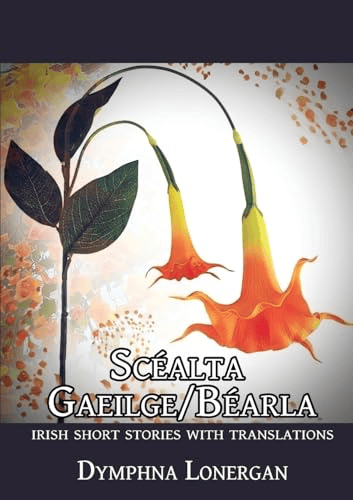
This book, Scéalta Gaeilge/Béarla: Irish Short Stories with translations catches the eye with its colourful cover. The genres included serve to hold the interest of this flitting reader with limited focus rather well. Lonergan’s newest work extends her legacy, her bilingual storytelling continues to evolve, and her devotion and commitment to the Irish language shapes every page.
One of the strengths of each story is the level of simple dialogue, such as would be a normal and natural conversation between family members for example. One could see this as a very useful tool for language learners, seeing language in the context of ordinary conversations. The first two stories are Dad-Daughter engagements, Solas Buí (A Yellow Light) agus Saothar Damhan Alla (A Spider’s Work). It paints a calm and warm relationship. The third story is a dialogue between animals – again one of lightness and warmth and dotted with love. The running dialogue is very useful in its simplicity and ordinariness in the context of family and friends or indeed animals as in An Cara is Fearr (The Best Friend). It is also a gentle read which allows a comfortable flow for a language learner. Memories of love are aroused in Uair Amháin (Once), similar to those in her drabble An Tuiscint (The Awakening). A young love lost it seems, but not faded and sitting comfortable in a little room in the author’s mind.
The effect of immigration is felt through Lonergan’s stories and poems. Immigrants are often stuck between two worlds with time beginning in one often later, and time finishing in the other often earlier, like a world had birthed and a world had died simultaneously. Caoga Bliain ag Fás (Fifty Years a’Growing) is a mellow and supple memory and one that reminds the immigrant of its missing foundation often found in its new home:
‘Chuir sé iontas uirthi tar éis caoga bliain san Astráil nach raibh eolas aici faoí ainmneacha na n-éan, gan trácht ar siúd a bhí ina gairdin féin’
‘It occurred to her that she did not know the names of those birds. Surprisingly after fifty years in Australia she didn’t know the names of the birds, let alone those in her own garden’
‘Fifty Years a’ Growing’ dives into the well of remembrance, gently tracing the soft contours of days long gone. Wandering back through the halls of time, Lonergan unfolds the past gently and softly and with care, gathering the threads of a time to paint a composition full to the brim of memories that have lingered. Tír Eile (Another Country) dances between Ireland and Australia too, one painting a picture of restraint and conformity, the other a picture of freedom. The above poem Galah ar Sreang (Galah on a Wire) is an example of Lonergan observing and certainly making a great effort to understand the nature surrounding her. The poem, as many other poems of hers, denote her desire for a connection with and an understanding of the nature that had surrounded her in her new home.
As a final thought and as a fellow poet with a particular love of Irish language poetry, the poem below, full of warmth and imagery, catches my eye.
Bail Ó Dhia ar an Obair
Táim ag deisiú an poll i mo bhríste
go cúramach, go mall
ag súil go leanfaidh an deisiú
tamall fada,
ag sá agus ag tarraingt
greim i ndiaidh greim
Is tú ag dul faoi scian
Bail ó Dhia ar an obair
inniu san obrádlann siúd.
Bail ó Dhia ar an mháinlia,
ar a shainchúram leighis
ar a lámha cineálta, ar a shúile
géar,
go dtí go dtagann tú ar ais slán chugam
sa seomra feitheamh.
God Bless the work
I am mending the hole in my trousers,
carefully, slowly,
hoping the repair will last
a long time.
Thrusting and pulling
stitch after stitch.
And you going under the knife.
God bless the work in the operating room
this afternoon.
God bless the surgeon, his expert care,
his kind hands, his sharp eyes,
until you come back safely to me
in the waiting room
This is a deeply moving and intimate poem. The core strength of the piece lies in the beautiful, tense parallel it draws between two types of ‘mending’—the quiet, domestic act of sewing trousers and the high-stakes, clinical act of surgery. The tone balances mundane domesticity with profound vulnerability. The contrast between the ordinary object (a pair of trousers) and the stark reality of someone ‘ag dul faoi scian’ (going under the knife) heightens the emotional impact. It shows how regular life continues even during moments of immense fear and love.
The poem ends on a note of longing and hope, anchored by the word ‘safely.’The ultimate goal of both the sewing and the surgery is the same: restoration and reunion.There is a discipline in Lonergan’s stories and poems which indicates reflectiveness and a life that is driven by love and connection.
It is another lovely book with a cup of tea and a biscuit.
Julie Breathnach-Banwait
Meán Fómhar 2026/September 2026

