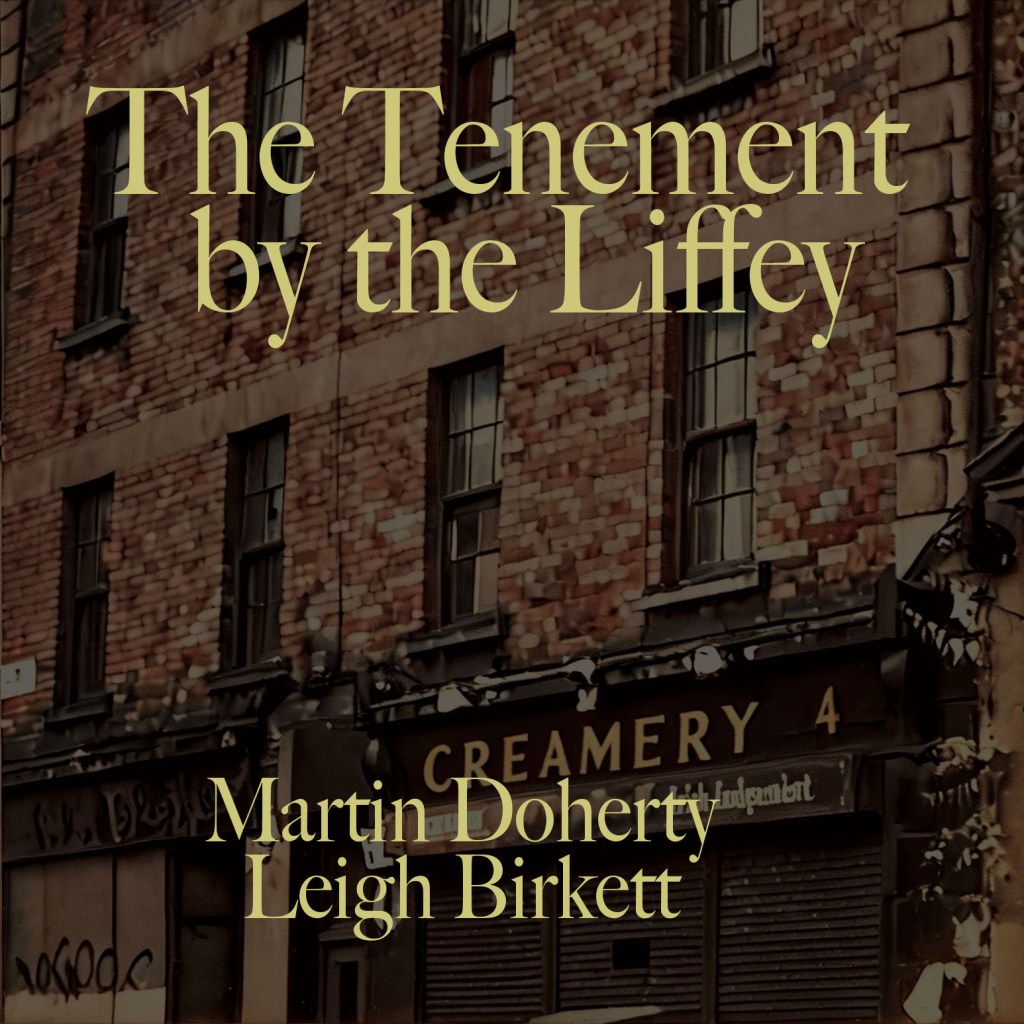
Martin Doherty and Leigh Birkett The Tenement by the Liffey
Reviewed by Tony Smith
This is the sixth album by Doherty and Birkett and it emerges from the Bray’s Lane Studio at Wallerawang. The sense of ensemble between the two has strengthened over the years so that their musical understanding is finely tuned indeed.
For this 2026 offering of eighteen tracks, Martin (lead vocals, guitar) and Leigh (backing vocals, guitar, mandolin, bouzouki) are joined by Alan Doherty on whistles, Simon Watts on fiddle and Ian McKenzie on Uilleann pipes. Leigh did the artwork and Alan provided the cover image. The album is dedicated to friend Jim Donnelly.
Not surprisingly, the tracks are mainly but not entirely Irish in origin. Martin moved to Australia in the early 1970s and was active in bands both in Ireland and here, most recently ‘Roisin’. He has also sung with international stars such as Mary Black and Mick Jagger and performed in the New South Wales Parliament when Sinn Fein leader Gerry Adams visited.
The title track has lyrics by Lyn Doherty set to music by Martin. Many of the people born into poverty in Dublin would later become ‘liberty boys’ and ten pound migrants. Meanwhile excavation of the tenement at Ushers Dock near Rings End docks reveals a deeper history. This particular boy inquired into his country’s past by singing its songs. The Lyn and Martin partnership has produced a powerful ballad that asks ‘In dreams do the lanterns still flicker on the Liffey below? Are such secrets better left unspoken?’ The tenement is akin to a time capsule.
‘The Blue Feather’ has similar arrangements and once again, Lyn shows that her songwriting is as good as that of any of her contemporaries. ‘Dream little emu dream, dream of the islands that bore you’. This song, inspired by a story of Blackheath writer Pauline Conolly, tells of European scientists treating newly ‘discovered’ lands as laboratories. The fate of the stolen bird reminds us of the many sacred objects still awaiting return to our Indigenous peoples.
Martin provided both lyrics and music for ‘The Travelling Man’, ‘Freedom’s Gate’ and ‘My Song for You’. He also set Henry Lawson’s ‘The Duty of Australians’ to music.
Other writers credited include Brendan O’Reilly for ‘Michael Collins’, P.O. O’Neill for ‘The Foggy Dew’, Gordon Lightfoot for ‘Early Morning Rain’, Billy Edd Wheeler for ‘Coal Tattoo’, Phil and June Colclough for ‘Song for Ireland’, Stan Rogers, who died tragically young in an aircraft fire, for ‘The Field Behind the Plough’ and ‘California’, Bono and U2 for ‘All I Want Is You’ and John Denver for ‘Leaving on a Jet Plane’.
‘Come Up the Stairs’, ‘The Croppy Boy’ and ‘Dark Island’ are traditional airs. Martin’s sings ‘The Croppy Boy’ unaccompanied and I have to express a liking for this treatment. The other arrangement that seems gentle and especially appropriate is on Martin’s ‘My Song for You’.
Martin has been a long term member of the CFMEU and Lyn and he and collaborator Birkett are committed to social justice issues. Martin has been honoured by the Choctaw people for his advocacy of their cause. Despite decimation on the ‘Trail of Tears’ – or perhaps because of it – the Indian nation sent aid to the Irish suffering during the famine.
Martin’s phrasing is quite distinctive. There are clear pauses between lines and phrases. So even those songs which have been covered numerous times by famous solo singers and groups have a freshness about them. This is particularly so on ‘Song for Ireland’ – a version which avoids the over-sentimental treatments by some singers. Coincidentally the instrumental backing seems a little more subtle on this track. The fiddle which is generally nicely understated, is especially fine here and on ‘Dark Island’.
‘All I Want Is You’ is something of a revelation in Martin’s hands and he sings it with a compelling clarity and directness.
The final song makes a nice link between the Irish material and Australian content and is a morale booster. Martin’s ‘Travelling Man’ is a fiddler who plays Donegal style, but is restless and moves on. The songs on this album emphasise yearning, patriotism and migration and so will appeal not only to the Irish diaspora but all people who have strong memories of lands left behind. What better theme is there for the people of Australia with our diverse origins?
Tony Smith
Dr Tony Smith is a former academic who has reconstructed himself as a folk musician. He writes songs (see ‘the sheep teacher’ on soundcloud.com), busking with melodeon, whistle, harmonica and jig doll, writing articles and reviews of CDs, most regularly for the magazine Trad & Now.
Tony and his Irish wife Gene live near Bathurst NSW not far from the Wallerawang home of Martin and Lyn Doherty. The four have occasionally performed on the same stages and co-operated on CDs.
The album is pending on digital platforms, but the CD is available from leighbirkett@gmail.com. Eighteen tracks for $20 (and postage) is excellent value. Doherty and Birkett have planned a concert at Lithgow Workies on Saturday 19 December,

