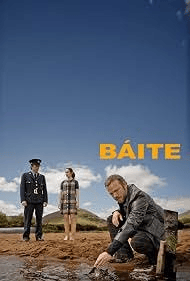
A review of Báite by Dymphna Lonergan
Director Ruán Magan, acclaimed for his historical documentaries, brings us this murder mystery Báite, The Drowned (2025) available online as part of Australia’s 2026 Irish Film Festival and much appreciated by those who are unable to attend screenings in Brisbane, Canberra, Melbourne, Perth, and Sydney. The screenplay is by Sheena Lambert adapted from her 2015 novel The Lake. Both Magan and Lambert are from Irish-speaking Dublin families which may have influenced the selection of a cast whose Irish sounds more urban than rural, and therefore more accessible to Irish speakers across the spectrum. The script is also subtitled in English.
Ireland’s duality in being mostly English-speaking but holding on to the native language, Irish, can be seen as a metaphor for Báite, The Drowned. Set in 1975, a time of high emigration, especially from rural Ireland, the film’s protagonist Peggy Casey is trying to hold on to the family business in Connemara in the face of opposition from her siblings who are mostly Dublin and London based. The townspeople too are concerned about the prospect of losing Casey’s pub, the town itself having been lost entirely twenty odd years earlier to technology that would bring electricity to Connemara, mostly, as some locals saw it, ‘for the Dubliners’.
Before the enforced flooding and resettlement of the original town, the occupants of the old cemetery had to be removed one by one, blessed by the priest, and re-interred in the new cemetery. When a body is found in the lake that formed from the power station dam, the question is whether it is from the old cemetery or the result of something more recent. To solve this question comes Detective Frank Ryan from Dublin, a ‘Jackeen’ speaking Irish. He relies on the local Garda O’Dowd for his knowledge. It is O’Dowd’s first posting, and he has difficulty in gaining respect for that reason. While Ryan is an outsider, Garda O’Dowd struggles with his own identity and role in the community, and of course his lack of experience in solving what may be a crime. Obstacle number one for Dublin Detective Ryan.
Obstacle number two is Peggy Casey who is determined to protect the locals from the prying Dublin eyes while at the same time trying to keep up her excellent service in the pub itself and the other side of the family business, the bed & breakfast, known as The Angler’s Rest. She is clearly attracted to Frank Ryan but must fight this.
The story is revealed at a leisurely pace, with the heart stopping Connemara landscape segmenting plot points as history catches up with the current situation; a 70s style soundtrack with Rory Gallagher adds to the nostalgia along with the perennial sean nós. Parallel themes of lost love, emigration, rural depopulation, the insider and the outsider are borne out by the presentation of both languages as being now at ease with one another. Urban Irish is on the rise and no longer seen as not native enough. Connemara folk live in Dublin and London and commute back to Connemara regularly. Others stay and hold on to traditions as best as they can.
There is much to be appreciated in the well-acted, well-scripted, and well-directed Báite, The Drowned, and of course, overall, it is a satisfying murder mystery for those who appreciate the genre.
Other Irish language online Festival films are
Ag Taisteal Siar (Travelling Back); Beo Faoin Bhfód (Buried Alive) and Gealtra (Wild Bunch)
and these which feature Irish language:
- Daniel O’Connell The Emancipator
- Listen To The Land Speak
- Hush-A-Bye Baby
- James Connolly: We Only Want The Earth
- Irish-Australian Short Film Program
Civil Rights Colossus of the Nineteenth Century
Daniel O’Connell: The Emancipator, Directed by Ruán Magan for RTE, 2025.
Reviewed by Frances Devlin-Glass
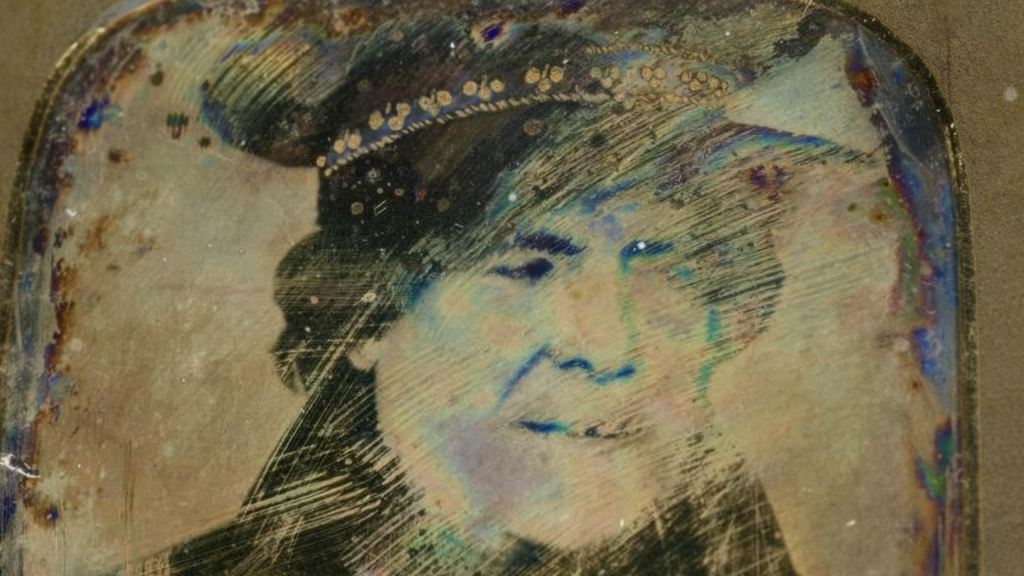
This documentary opens with the only existing photographic image of Daniel O’Connell, a heavily compromised early daguerreotype, taken in 1844. It is badly damaged, flaking and faded in places. It’s a challenge for a film documentary maker to have to work with such deficits of visual imagery, and the route that this documentary takes is to rely on images of the alluring Irish countryside (sometimes linked to the biographical focus, but often not explained), cartoons and etchings (some mildly animated) which exist in abundance (as Dan the Liberator attracted as much of a cultish following as he did enemies), and some very impressive talking heads, among them former President, Mary McAleese, Declan Kiberd and academics from around the globe.
The documentary has a somewhat hagiographical flavour. However, despite its unguarded enthusiasm for its subject, I found myself drawn into what made him the exceptional leader that he was. He had many advantages: born into money (some of it made by smuggler antecedents like his uncle, Maurice ‘Hunting Cap’ O’Connell, who would after some drama, leave him Derrynane and much of his estate), and into a prosperous landlord class that was very rare, indeed only 5% of the Catholic population owned land at the time of his birth, in colonised Ireland. His class horizons were undoubtedly extended by a period of fosterage, in the ancient Celtic manner, with a family of herdsmen during the Penal era when Catholics were deprived of many rights (for example, to education, to property, to the practice of their religion, and the right to enter a profession). In addition, he was educated by the Jesuits in France, before escaping the bloody horrors of the French Revolution where he was in danger as an ‘aristocrat’, and completing his legal education in London. The documentary made much of his horror of violence, a values-commitment that explains much of his subsequent moral positioning, and his longevity as a leader prepared to negotiate and compromise with his British ‘overlords’. And also of his commitment to religious and civil rights. The film-makers drew out these liberalising influences on his life, making him seem to be of our times more than his own.
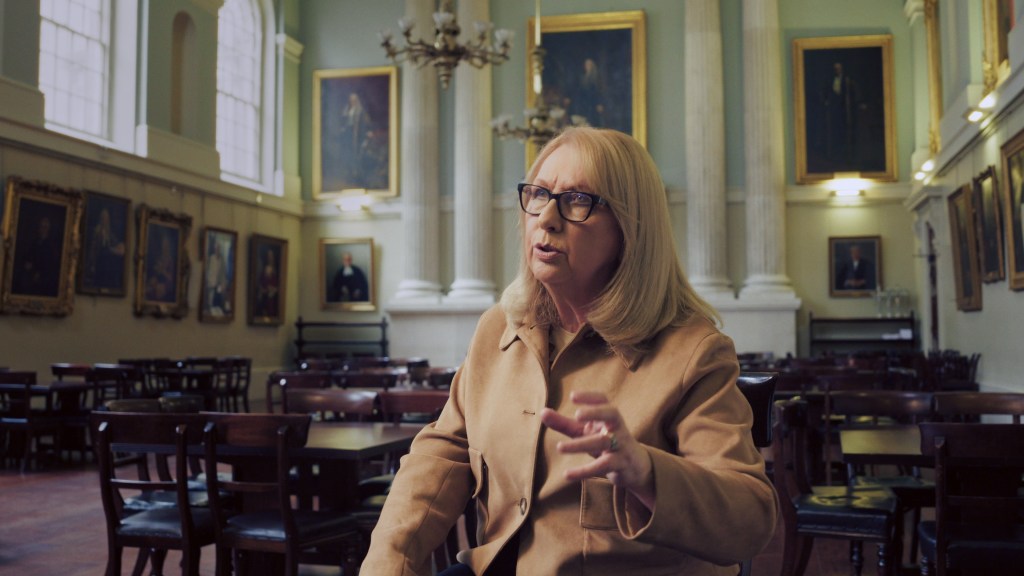
Mary McAleese makes much of his skills as a barrister, but does not sugar-coat his tendencies to be a bully, arrogant and vindictive. Others would accuse him of showmanship. One wonders how much this emanated from his sense of being held back as a Catholic, and frustration at seeing lesser men promoted above him. As a Catholic, he could never aspire to be a King’s Counsel or a Judge. Even once elected to Westminster, he had to cope with a House that did not trust his kind. It did not stop him, however, from an alliance with the Whigs and from learning how to make the most of the cross-bench.
He is a very fine example of the pacifist tradition in Irish nationalism which valued words as the best weapons of a disarmed people. In addition to seeing violence in action in France during the Reign of Terror, he was also horrified by bloodshed of the 1798 Rebellion. And it perhaps explains why, after 1916 and the de Valera era, he was not the major hero and leader he had been in the early to mid-nineteenth century, achieving over many decades and by tiny increments Catholic Emancipation in 1829. I knew of his commitment to building the nation through the Young Ireland and Catholic Association, and of his powerful voice and rhetorical skills, well deployed for Monster Meetings which attracted up to half a million followers (at Tara and Mullaghmast, both sites of historical significance), and eventually led to threats of armed violence against his followers. It was good to be reminded of his strategic retreat at Clontarf to protect his people from imperial guns. The documentary is salutary in reminding us of this pacifist tradition, more in favour today than it was in the difficult and costly Decade of Revolutions. Mary McAleese is strong on his role in persuading the Irish to believe in themselves and their culture and teaching them that there are better ways to be revolutionaries than violence.
In addition to mapping his political life in detail, we are given quite a lot of detail about his private life, and his early marriage to his distant cousin, Mary. Although the love of his life, the film does not airbrush his dalliances with other women and his chronic financial crises. He lived beyond his means, greatly irritating the Anglo-Irish gentry, for example, by choosing to live in Merrion Square.
Discounting the film’s romanticising moments and grand claims for the Liberator, I nonetheless found it uplifting in its advocacy of his pacifism and informative about the political events that influenced him. It also makes a case for his transnational significance – the impact he had on Frederick Douglas (the African American human rights reformer who visited him in Ireland) and on the Civil Rights movement in the USA. The documentary makes much of him as the first Irishman to enjoy a global reputation. He had an impact on the take up of universal suffrage in many constituencies; and he was an early supporter of Home Rule, long before it was a popular movement. He was colourblind, championing the rights of Maoris and Aborigines, and of Jews, in an era when they were reviled. A true man of the Enlightenment.
I recommend this documentary thoroughly for its modern take on a remarkable and much-loved and admired late eighteenth and early nineteenth century politician with great gifts. It gives him a human face and all-too-human failings.
Frances Devlin-Glass is part of the Editorial team of Tinteán.
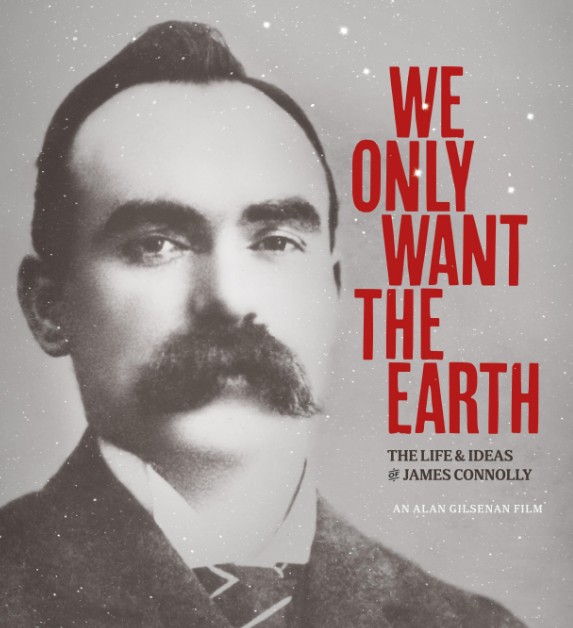
We Only Want the Earth. The Life & Ideas of James Connolly
A Film Documentary Review by Steve Carey
We Only Want the Earth, Directed and Written by Alan Gilsenan, 2025, A Yellow Asylum Films Production for the James Connolly Foundation for Educational Equality Ireland.
We Only Want the Earth. The Life & Ideas of James Connolly is not comfortable watching, nor does it set out to be. Connolly is a towering figure of Irish republican and social history, and the standard treatment of such icons is to recount (and perhaps to dramatize) their life and times, accompanied by footage of the period, giving us a cosy sense of distance from the subject. That is not what this film does. Instead, it looks at his continued relevance, and how his struggle for equality and social justice still matters, which is to say that his demands have not been met. The film’s title comes from Connolly’s 1907 poem, sung to the tune of A Nation Once Again:
Some men, faint-hearted, ever seek
Our programme to retouch,
And will insist, whene’er they speak,
That we demand too much.
‘Tis passing strange, yet I declare
Such statements cause me mirth,
For our demands most modest are:
We only want the Earth.
Hence long, lingering shots of the underbelly of today’s Dublin, not least the poignant and jarring sight of a rough sleeper lying on the very base of Connolly’s memorial statue in Beresford Place, directly opposite Liberty Hall. One is reminded of Robert Emmet’s speech from the dock: ‘Let no man write my epitaph… when my country takes her place among the nations of the earth, then, and not till then, let my epitaph be written.’ In Connolly’s vision his country must be free and workers must control the means of production: the former is his achievement, while the latter is no closer.
This unusual focus on 2013 and 2026 rather than 1916 is due to the film’s independent funding model, being financed entirely through trade unions such as SIPTU, Fórsa, and Unite, without state or commercial backing (though it was shown on RTE One this past August). Thus the film becomes a polemic, an angry objection to continued inequality, an inequality which if anything is growing as a handful of weird tech bros promise (threaten?) to make us all redundant, and perhaps blow us all to smithereens. They have found ways to avoid taxes, not least of all by basing themselves in Ireland, a blatant dereliction of their civic duty that one can imagine would have infuriated Connolly.
The danger, perhaps, is of preaching to the choir: the union figures who describe Connolly’s fighting for what is just may verge on losing focus on the enigmatic figure of Connolly himself. (At the same time hardcore socialists find the film guilty of downplaying his radicalism.) Although we hear of his extraordinary sacrifices over decades in service of the cause, personally I could have stood to hear more, or at least something, about his long-suffering and loyal wife Lillie and their seven children and their many addresses in Scotland, Ireland and the United States. What fires a man and a woman with such unquenchable desire for change? We feel no closer to knowing at the end of the film than at the beginning.
Steve Carey is Treasurer of Bloomsday in Melbourne and President of Kingston Writers Centre
The Spectacular Scenery Deserves its own Credit
‘Trad’, Reviewed by Dan Boyle
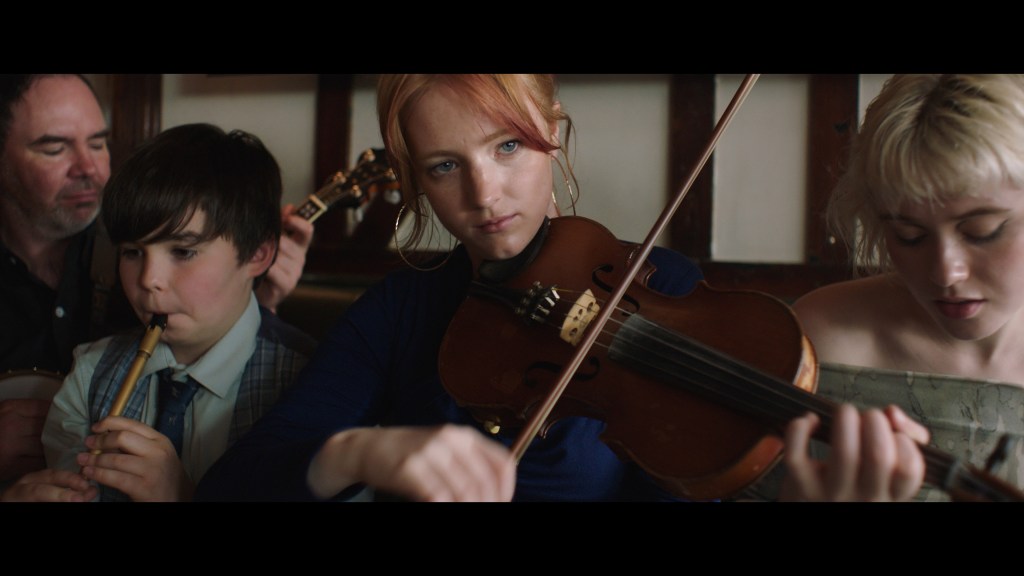
Shona McAnally has spent most of her eighteen years mastering the Irish fiddle. Today she is fed up with everything. Her life. Her mother (Sarah Green). Home life. Even the breathtaking coast of Donegal fails to rouse her spirit. ‘Trad’, that is traditional Irish music has become a creative straight jacket for her. This is not an unusual viewpoint. Trad with its endless reels and paradiddles can delight or annoy. For Shona something has to give.
While hitch hiking with her younger brother, Mickey (Dallan Woods), she encounters a group of travelling musos who have the prerequisite alternative view of society. Cell phones are banned. They have actually nailed their cell phones to the dashboard of their mystery van. They are led by middle-aged non-conformist ‘Harky’ (Aiden Gillen, Little Finger, Game of Thrones), Aadubious guru of middle-class rebellion.
Shona played with almost unrelenting surliness (by Megan Nic Fhionnghaile) goes off for an adventure with her new friends with her younger brother in tow. You can leave home. But home in the form of distraught parents soon sends the law after you.
‘Trad’ is competently directed by Lance Daly from his script. The film holds few surprises but resists over-playing the feel-good formula. The spectacular coastal scenery deserves is own credit. Cinematography is by Keith Pendred.
I’m sure many would relate to Shona’s predicament and journey to adulthood.
Dan Boyle

