by Michael Boyle, Newfoundland

Seamus Heaney the teacher
In the early 1960s, I applied to train as a teacher in the Physical Education programme at St. Joseph’s College of Education in Belfast. The programme was oversubscribed, and I failed to get a place; I was bitterly disappointed. I transferred to a regular teaching programme, which forced me to change my geography major for English. However, that was a twist of fate, because for the next three years I had a young Seamus Heaney from Bellaghy as my literature teacher.
To be clear, my personal history isn’t just an introduction, but a lens — an autoethnography — through which I try to understand Heaney’s poetic choices. A member of Heaney’s Belfast group, Philip Hobsbaum, has said: ‘No one who has not seen Heaney as a teacher really knows him.’
My years in Heaney’s classroom were formative. From them I retain an irreplaceable trove of stories, anecdotes, and poems from the early career of a writer who would go on to define an era. Back in November 1963, I had a three-week practice-teaching block with a Grade Five classroom on the Glen Road in Belfast. On Friday morning I had my first-ever lesson observed by a Mr Heaney. I jumped straight into the lesson without making eye contact, and without explaining anything. I recall having a great art lesson with the five students in the front row; the other thirty students could have been swinging from the rafters in this disastrous cat’s breakfast of a lesson.
After this class I met with Seamus Heaney in a tiny book room. He paused, and then, with a distinctive Heaney voice, said, prophetically: ‘Mickey. You must always let the silence speak.’ This early lesson in letting the silence speak was not merely pedagogical advice but a key now for me to unlocking Heaney’s poetic treatment of farming tools. Consequently, I want to pose a question about Heaney scholarship that is rarely asked: what happened to the flail? Seamus Heaney wrote many poems about farming tools, but seems to have silenced the flail.
The farming flail is a farming implement used in threshing to separate grains from a husk. It would seem to lead to poetic metaphorical use, but not for Heaney whose enduring metaphor is the spade and digging. The flail’s silence, however, can be seen as as a powerful absence, anchoring the old threshing flail deeply within the reader’s memory. In a literal sense, Heaney practised what he preached to me in that book room, allowing the silence to speak. Now as I reconsider specific poems alongside threshing practices, I am intrigued by the anomaly.
As a retired high-school teacher now living in Newfoundland, my perspective is informed by an unwritten archive of personal, local knowledge and memory. I grew up on a small farm in the townland of Drummuck, in the neighbouring parish of Lavey. I knew the Heaney brothers when Lavey played football against Bellaghy. I saw the ruddy-faced Paddy Heaney with his yellow cattle boots. Back then, after the sale was made, farmers would have a celebratory drink in Breslin’s Bar. Sometimes you could observe dealers counting a wad of large English white five-pound notes to complete a sale. These shared farming experiences did more than shape my youth — they defined it. I trod the same landscape as Heaney and for me there is a glaring omission of the flail that I have not seen discussed elsewhere.
My approach to solving my question is to provide a brief history of the old-time threshing flail and detail its place within the material culture of Ireland. Secondly, I explore whether the Troubles dissuaded Heaney from using the flail as a poetic image. Thirdly, I speculate on the link between the word ‘drashel’ as both a farming tool and a specific site. Finally, I examine the connections between digging and the flail.
Farming Flail: History
The flail was an ancient wooden farming tool for hand threshing grain. Heaney was an etymologist, interested in the origins of words. A brief study of the farming flail shows a fascinating microcosm of the linguistic history of Northern Ireland. The flail has been passed down for centuries to farmers, who not only shared land but had a rich vocabulary of Old English, Ulster Scots and Irish-language words.
For the poorest farmer in pre-modern Ireland, the flail was an absolute necessity. In the process of hand-threshing with two sticks, the chaff was separated from the wheat. The flail (Ir. suiste) consisted of two sticks joined together, with the heavier stick beating the grain. First, the hand staff (collop (Ir. or helve) was about five feet long, usually made of hazel or oak. The beater (soople) was a heavy swing-stick, three feet in length, made of holly wood or blackthorn so that it could withstand the physical impact. These two pieces were joined with a gad (mid-kipple), which could be leather or eel-skin. It has been suggested that the use of the beater (the second stick) increases the effectiveness of the flail’s physical force.
It was strenuous work. The rhythmical sounds of the flails slapping, thumping, and walloping on a barn floor could be heard, as the barn doors would be left open to give a draught. Heaney’s poetry mentions farming tools such as the pitchfork, sledgehammer, billhook, scythe, and the spade — but not the flail. How familiar was he with the flail in his local parish of Bellaghy? Here is a personal recollection that I hope answers this question to some extent.
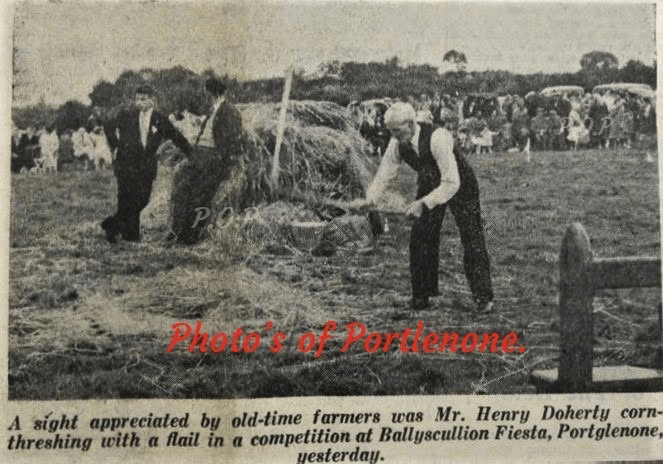
Seamus Heaney acted in drama productions and called out dances on the microphone in the local Gaelic Hall. Father John McGaughey was the curate in Ballyscullion parish from 1962–67. Every summer, in aid of the Bellaghy Parochial Fund, Fr McGaughey organised a Ballyscullion Games and Fiesta at the end of August. Some of the events were Children’s Sports, Donkey Derby, Tug of War and Irish dancing. However, the flail-threshing competition, held on an improvised wooden platform, drew the largest crowds. There were two competitive sections — individual flail and double flail — with a prize of five pounds. There was no entry fee; you simply registered your name in advance on the sports field.
As an eyewitness to the early 1960s Ballyscullion Sports, I offer a localised perspective that written archives may have overlooked. This author observed a tall, lanky, young Seamus Heaney on the microphone. Local farmers were re-enacting in their display the ancient threshing and swinging their flails in time. On reflection years later, I realised that Heaney’s doing a ‘stroke-by-stroke’ commentary was much more than a magical moment: indeed, it was revelatory. Symbolically, this was a moment where specificity intersected with a space between two eras — the documentation of a medieval way of farming meeting and a modern communication age. Prophetically, Heaney’s voice on the microphone was a threshold or boundary linking them both.
This is not to say that Heaney omits the word ‘flail’ entirely: he refers to losing his temper, ‘flailing around like a man berserk’ in ‘Glanmore Revisited No.3’, and to ‘ash tree flails’ in ‘September Song.’ Bt this Sports day in far Ballyscullion, Heaney saw the flail raised high in the air and heard the thwack, smack of the downward motion of the flail hitting the threshing floor. However, when he sat down to write his poetry and developed ‘threshing’ as an idea, the flas stripped out as an object. Not knowing the mind of Seamus Heaney, it may be that political instability of his homeland was a factor in silencing the flail.
The Flail and the Troubles
Heaney grew up in the divided society of Northern Ireland when tensions were brewing in the early sixties. He would have known that, throughout history, the agricultural flail was associated with more than threshing grain: it could easily be turned into a fighting flail, as happened in the Hussite Wars. Farmers realised the swinging motion of the flail could hit an enemy with massive force. To get ready for battle, iron bars, spikes, nails or chains could be attached to the flail.
The swing of the flail could be erratic, uncontrollable, and hence its connotation with violence, division, separation, terror, thrashing, judgement, whipping and punishment. So, Heaney, in the context of the Troubles, may have omitted the flail in case it could be misinterpreted.
Heaney encountered a dilemma with the poem ‘Requiem for the Croppies,’ from the collection Door into the Dark (1969). This poem recalls the 1798 Rebellion in Wexford that inspired future nationalistic aspirations. However, the history of this event records that pikemen were also joined by farmers who carried their threshing flails into battle, the flail as a rebel’s weapon. A safer poetic image for Heaney is the scythe as a martyr’s tool:
‘Until, on Vinegar Hill, the final conclave/ Terraced thousands died, shaking scythes at cannon.’
Drashel
Threshing took place inside barns of a ‘breezeway design’, with opposite doors for ventilation. To keep grain inside and prevent it from escaping, a wooden barrier or sill was built at each barn doorway (sill or threshold), called a ‘drashel’. Historically, people once trod or hand-threshed the grain with their feet on a step outside the barn.
Heaney separates the meanings into two words (or artefacts), so that readers can experience, firstly, the actual action of threshing and, secondly, the place where the grain was threshed. Indeed, the concept of the threshold looms large in his poetry, taking Heaney across boglands, riverbanks and the landscape of South Derry — though that connection is well beyond the scope of this discussion.
To return to the ‘flail.’ The fundamental question remains as to what happened to the flail in Heaney’s poetry: neglect it, or did he perhaps transform it? To attempt to answer that conundrum, I return to digging.
In ‘Digging’, Heaney uses the spade as a symbol to acknowledge his own heritage and roots. He knew the physical labour involved in planting and harvesting crops. It might be reasonable to pose the question: are there references in Heaney’s poetry where the spade does the work of, or mimics the actions of, the flail? Paradoxically, even in his poem, ‘Digging’, his grandfather is in Toner’s bog, swinging his spade upwards in the air, ‘heaving sods over his shoulder.’ In the same poem there is a flail-like separation and slicing of deep roots: ‘The curt cuts of an edge through living roots’.
But for Heaney, the spade is a tool that digs down into the soil to find roots and memories. Meanwhile, the flail that once swung high in the air threshing the grain has been consigned to a bygone age. For centuries, the spade and the threshing flail complemented each other in the struggle to survive. Birth, youth and struggle are represented by the spade, while the flail represents death, old age and the end of the journey. The spade digs and prepares the soil before life begins, while the threshing flail pounds the plant after life is finished. A farmer needed both: without digging, no grain would grow; and without the flail, the chaff could not be separated.
Conclusion
Heaney’s poetry is full of surprises. It would appear that he knew everything about the flail, but he seemed to refuse to give it a poetic voice. The contrast is deliberate: the spade was a steady, established, safe poetic image, whereas the flail posed a distinct threat — a problematic hindrance to his established ‘digging’ brand, and a subconscious ‘phantom limb’ from his South Derry heritage. So, in a Heaneyesque way, the flail remains in memory as an absent presence.
Threshing serves as the ultimate metaphor for the editing process, where the chaff is separated from the grain. Prophetically, Heaney, in ‘letting the silence speak’, leaves the literal farmyard to become a threshing flail himself. Alone in his quiet study, Seamus Heaney is a two-handed ‘thresher of words, hewing and sounding them out to make music.
Michael Boyle is a native of Lavey, Derry, Ireland, residing in Newfoundland. His poetry and prose writing have appeared regularly in Tinteán. He has recently returned from a promotional tour of his autobiography, On New Turf, that included a talk at Queen’s University, Belfast.

