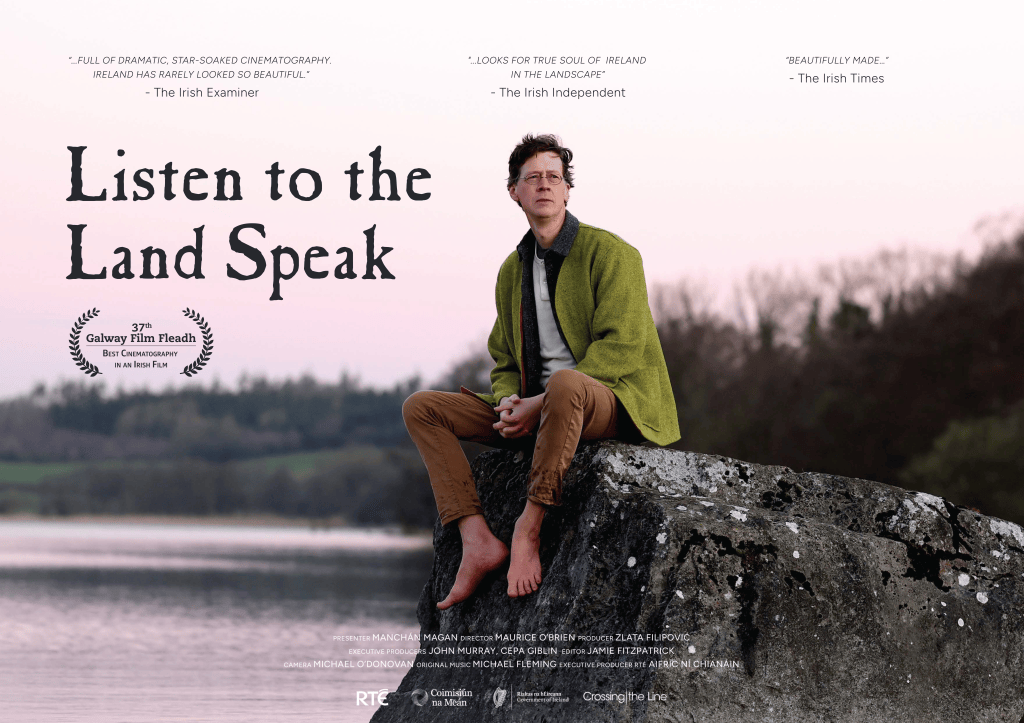
A Review of Listen to the Land Speak by Bruce Beswick
Around the world, post-colonial societies are discovering, or rediscovering, the wisdom of the cultures they previously conquered and, in many cases, sought to destroy. A hugely significant part of that process of rediscovery is a new recognition of the relationship of the conquered peoples to the land they inhabited – the natural world, or what we would now call ‘the environment.’ The colonists invariably sought to dominate the land and exploit it for material gain, dismissing or simply ignoring the wisdom of those who had inhabited, sustained and lived in harmony with the land for thousands of years. The climate crisis confronting the modern world has led to a re-evaluation and a renewed appreciation of those ancient peoples and their cultures.
In Australia, for example, the English introduced hooved animals that destroyed the flora that had flourished under the padded feet of the native wildlife. They also discontinued the Indigenous practice of firestick farming that had created the ‘park-like’ Australian landscape and drastically reduced the incidence of catastrophic wildfires. Those mistakes have now been acknowledged, and the value of Aboriginal land-management is increasingly being recognised, along with the wisdom of the Aboriginal songlines, which contain enormous amounts of practical knowledge while also capturing the mythological and spiritual relationship of the Indigenous peoples to the land.
In Ireland, the recognition of the country’s ancient culture and its relationship to the land is marked by a terrible irony that has not arisen in Australia. Although both countries were colonised by the English, in Australia the colonisers were so easily distinguished from the colonised that the differences between the two were never questioned. In Ireland, by contrast, the English conquered a land whose inhabitants had much in common with their own ancestors – the ancient peoples of the countries where the English already ruled. The irony is that their brutal occupation and attempted cultural genocide led to a disconnection between the local inhabitants and their own past. The assimilation of the conquered and the conquerors was successful enough for the native population eventually to regard its own ancestors as ‘other’ – as different from themselves.
Overcoming that disconnection between Ireland’s present and its ancient past was the life’s work of Manchán Magan, a popular champion of the revival of ancient Irish culture whose many books, documentaries, broadcasts and public appearances made him a household name and brought the movement he championed into the mainstream. Listen to the Land Speak – the film adaptation of his best-selling book of the same name – was the culmination of his work and came to serve as his epitaph when he died of prostate cancer within months of its premiere at the 2025 Galway Film Fleadh, where it won Best Cinematography.
More a film essay than a documentary, this revelatory work uses striking aerial photography and heartfelt narration by Magan to convey its message of hope and renewal at a time when it is desperately needed. Magan learned of his cancer diagnosis during filming and shared it as part of the film’s narrative, adding deep pathos to his journey to find meaning through his relationship to his country’s ancestral culture and land. The finished work has been highly praised by critics and immensely popular with the public and will serve as a poignant and lasting testament to the work of a remarkable and much-loved champion of Irish history and culture.
Bruce Beswick
An Acclaimed Film about a Trans Woman
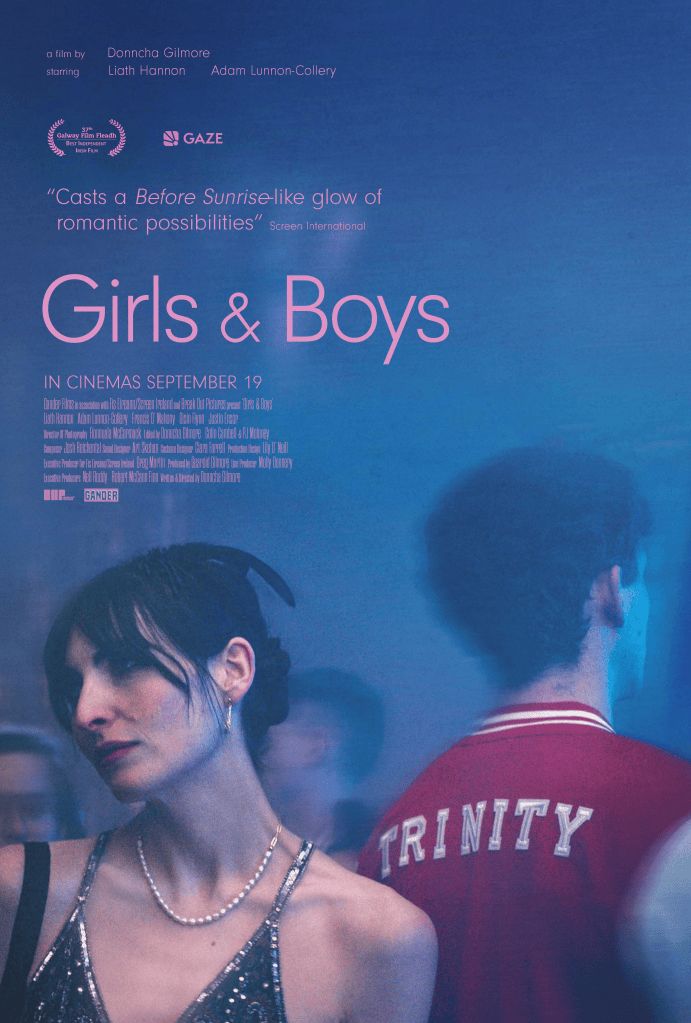
GIRLS & BOYS, written and directed by Donncha Gilmore and produced by Gearóid Gilmore for Gander Films, with
backing from Fís Eireann/Screen Ireland. Featuring Liath Hannon and Adam Lunnon-Collery. 2025.
Ten years in the making, this low-budget, self-financed, moody film made by first-time practitioners and brothers, Director Donncha Gilmore and Producer Gearóid Gilmore, took out the Independent Film award at the Galway Film Fleadh. It is a gentle and honest exploration of the challenges of five millennia of male privilege. It gives many reasons for celebrating those who refuse to comply with gender norms.
As a cis-gendered man, the Director has been canny and mindful in his casting. He has learned the gender politics of his subject from Trans actors who sometimes work contrary to their gender identity and who were consulted progressively in the making of the project, and it shows. Such a collaboration is imperative in a world which may need time for its gender binaries to open up and be responsive to the brave and difficult opportunities deconstructing gender entails. However, it’s a film that is neither preachy nor downbeat. Indeed it’s heartening as we watch Jason’s understandings of gender rigidities slowly metamorphose. Another daring aspect of the film is that some of its trans actors agreed to play cis-gendered roles, against their elective gender identity.
The story is told in a way that celebrates what sympatico humans can offer one another without needing to move into the ideological zone. They are first and foremost people in search of happiness and comradeship before they are gender-defined. It’s a radical choice. And it’s a finely crafted film: the final plot twist is meticulously prepared for from the start, and it was a delight to witness its unfolding.
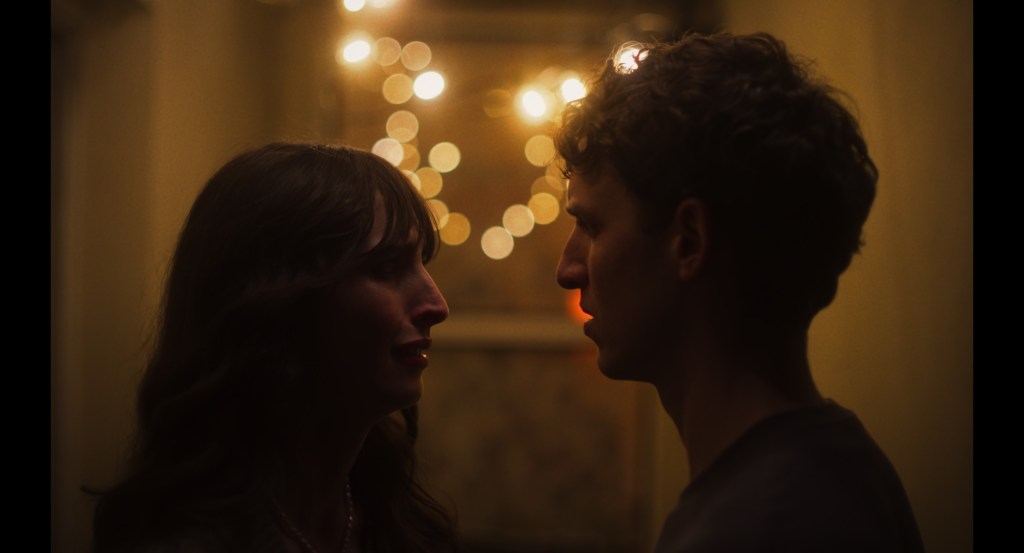
house where the after party is taking place. Filmed at Windsor Avenue, Fairview, Dublin 3.
The palette of the film is dark and moody, but punctuated by recurring images of the Samuel Beckett Bridge in its rainbow livery, by fireworks to celebrate , which are a visual counterpart to the grungy lanes where much of the action happens. But the really luminescent moments belong to trans actor Liath Hannon, who is enormously patient in pursuing Jas’s friendship and who allows him space to find his own way into the brave new word of Trans. The female lead, Liath Hannon, commands the screen and the camera work is delicate, especially in scenes where she despairs. The director crosscuts to Charlie’s serious, laughing or weeping face often. Her male counterpart is touchingly boyish and very much reliant for his version of manliness, at least early in the film, on his peers. His slowly developing romance is, of course, an affront to the Trinity rugby jocks whose friendship he has prioritised over his own interests in the Arts. He even gives up a lead role in a musical because he’s been led to think it’s ‘abnormal’ for a male to engage in such pastimes, and has to confront a repressed memory. The pace is deliberately slow – mindful of the high stakes and the damage she’s endured as a brave and determined young man intent on a radical change. But the road is by no means smooth for either, and Charlie’s stalwart friendship with Alice is critical to her survival.
The musical choices for key moments in the film are inspired, and add a lot of nuance to its thematics. And joy as well.
I loved this film for what it reveals about the challenges confronting non-conventionally gendered people, and was pleased that they weren’t patronised, or represented as victims, and that we were invited to be allies.
Frances Devlin-Glass
Gealtra
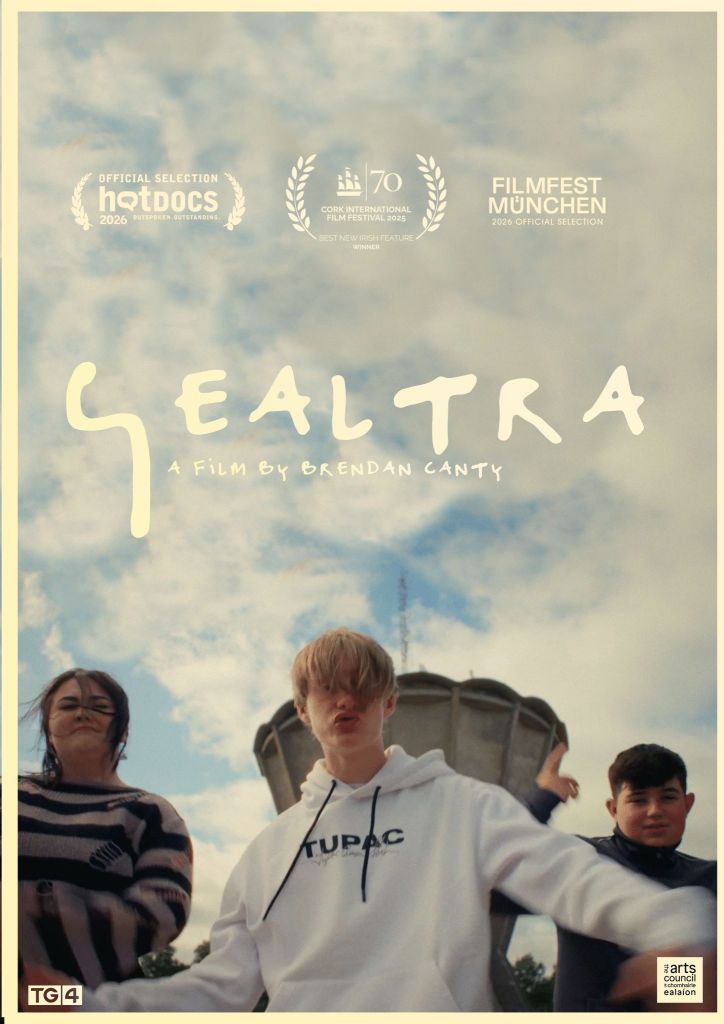
A review by Dymphna Lonergan
He won Best Director for Christy at The Irish Film and Television Awards in February 2026, and his documentary Gealtra, is now part of the Irish Film Festival in Sydney.
‘Gealtra, (Gang of) wild, mischievous, children’ as described in Niall Ó’Donaill’s Foclóir Gaeilge-Béarla does not quite match the group of young people featured in the documentary directed by Brendan Canty. They are not so much wild or mischievous, as simply young and mostly different.
For a start, they live in the Knocknaheeny estate to the north of Cork City. Developed in the 1970s and 80s to house and rehouse families from older parts of the city, Knocknaheeny soon became highly populated with young people. Over time, however, houses fell into neglect and plans were made to rebuild sections of the estate that required demolition of some houses, some Corporation owned but others private owned. Knocknaheeny is also remarkable in having a prominent water tower that features in the documentary.
Gealtra opens languidly with a girl in a blue dress and long plaits roller shoe skating on the footpath in Knocknaheeny. This is Sophia. We hear her voice reciting in Irish, over a ghostly music, track subtitles in English provided:
Cloisim é gach áit i gcathar Corcaigh
I hear it everywhere in Cork City
Ag teacht as Kabin i Knocknaheeny
Coming out of a Kabin in Knocknaheeny
Mo chairde go léir ag scread is ag spraoi
All my friends shouting and playing
Mise sa lár ag ceapadh vearsaí
Me in the middle shaping verses
Fáilte go Gealtra Welcome to Gealtra
An overhead shot of the Knocknaheeny estate descends to The Kabin Studio, outside is a poster of ‘The Spark’ a Tik Tok hit from 2024 created by young people from The Kabin along with young rappers from Listowel. The Kabin studio was established in 2012 by creative director Garry McCarthy, also known as GMCBeats and has become a place where local youth can gather to learn how to create their own hip hop. Inside, we meet Garry and also ‘Súil Amháin’, a visiting poet, rapper, and musician who is here to help the young rappers write songs in Irish.
Séamus Barra Ó Súilleabháin was born in England to Irish parents. When they returned to Ireland to settle in Kerry, he was a new boy in an Irish school with an English accent, an outsider, and so he can relate to young people who have found their way to The Kabin.
Súil Amháin starts his address in Irish to the gathered rappers and then in English asks them if they have a song that sums up who they are. They sing their rap anthem ‘Yah Boy.’ He then engages them in translating those English lyrics to Irish, keeping the original rhythm. For the refrain ‘Yah Boy’, he offers Is maith ambaist. Next, we see rappers Heidi and Sophia working with Súil Amháin and Garry on the Irish language lyrics, developing a more robust delivery, breaking down the new Irish lyrics into easier-to-learn sound bites.
This is followed by Ellen walking to the studio dressed Emo style, her voice in Irish explaining how she always felt ‘aisteach’, ‘difriúil’, and likes to create lyrics that address her social anxiety- ‘ámhráin faoin imníoch.’ Another young rapper, Aaron, plays the bodhrán and has already achieved fame in writing the English lyrics for ‘Ya Boy.’ He too begins to write rap lyrics in Irish under Súil Amháin’s guidance. An older rapper is introduced to Seán Ó Riordáin’s poetry, Súil Amháin explaining how Ó Riordáin felt like an outsider, ‘an urban person with an Irish-speaking mind.’
The documentary concludes with the individual rappers coming together to deliver their Irish language rap songs to an audience. It is heartwarming and inspiring.
Gealtra’s theme can be seen as a southern answer to Kneecap. Not political in the same sense, but still finding in the Irish language an identity that is not in the English language. The young people in Gealtra, have the advantage of learning Irish in school. Most Irish people leave the language behind once they leave school. It is not part of their identity in an English-speaking world. Gealtra shows that it can be.
Gealtra and other Irish Film Festival online films can be seen until 15 November.
Dymphna Lonergan

For further information about viewing or streaming the films Australia-wide, see the Irish Film Festival website.

