Interview with the Director and Producer about Magdalene Survivors
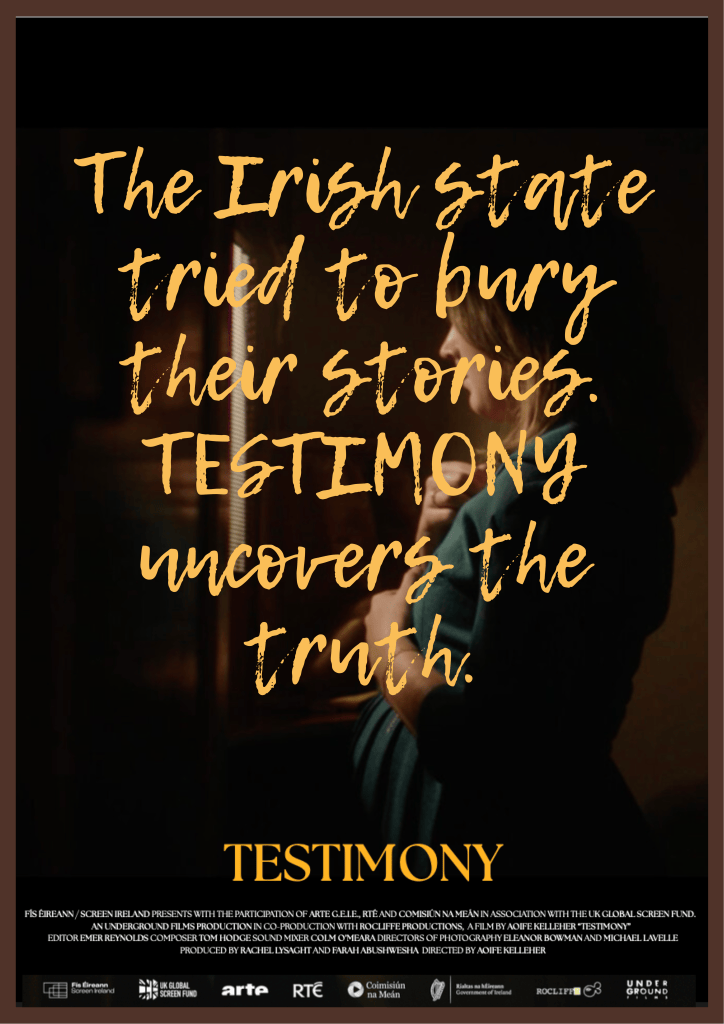
An abridged interview by Professor Erin Brannigan, University of New South Wales, of Aoife Kelleher (Director of Testimony) and Farah Abushwesha (Producer)
EB: I’m delighted to be joined tonight by Director Aoife Kelleher and Producer Farah Abushwesha who are presenting their film Testimony at the Irish Film Festival its premiere in Australia. Thanks for joining me.
How did this film come about, and how did it start for you?
AK: The first documentary feature that I made with Rachel was One Million Dubliners and it was about Glasnevin Cemetery, Ireland’s national cemetery, a site where so many towering figures from Irish history are buried. While we were making that film I heard an extraordinary story about the High Park grave: in 1993 the sisters of our Lady of Charity sold a site at High Park to a property developer which included a plot where 133 women who died in the High Park Magdalen Laundry were buried. So, rather than respect this last resting place of these women who had worked and lived and died in this laundry, the women were exhumed and during the process an additional 22 women were found in this plot. But only 75 death certificates existed for what was now 155 women, so it was very clear that there were women in the plot who haven’t been identified and appropriately recorded, but before that really important work could be done, the bodies were cremated. It was an important insight into how Magdalen women were regarded and their remains treated. I really wanted to include this story as part of the documentary One Million Dubliners but our central contributor died very suddenly and so our final days of filming were devoted to his funeral and burial within the cemetery. He had been a really important driver of the Magdalen story, so it really felt like unfinished business.
At that point, I had met with the group, Justice for Magdalenes Research, which had been centrally involved in advocating on behalf of Magdalen women. We began to develop a relationship with them and with other survivors of the Magdalen laundries. I thought it was really important to create a full feature documentary, so I began work on that but it wasn’t fully up and running and funded for another 10 years. Rachel and Farah came on board as producers and we managed to gather the funding and that’s really how Testimony came about.
EB: Okay so it loops back to a story that you’d come upon earlier, and you had that period between to raise the funds to get the energy behind the film. How long did that take between that original film that you had to exclude that story from and when you got to actually make this film?
AK: It took from 2014 to 2025 or 2024, once we went into production so it was a full decade really to get the funding together and get into production.
EB: Okay so it loops back to a story that you’d come upon earlier, and you had that period between to raise the funds to get the energy behind the film, so that gave you the time to do research and work to build trust with the victims who gave the testimonies that you needed to include in the film. How did you go about building those relationships with those women and gaining their trust?
AK: I met with Justice for Magdalenes and they had been doing a lot of really important work with survivors of the Irish institutions, so not only the Magdalen laundries but also Mother and Baby homes, and also the survivors of industrial schools. It was very valuable to be introduced to survivors in the first instance through Justice for Magdalenes. I had worked with Maeve O’Rourke in particular because she played a consultative role on one of my other documentaries, so she was able to vouch for me and for my work. To have that pre-existing relationship was really important because, understandably, survivors are very resistant to trusting people because of the experiences they’ve had.
Additionally, it was hugely beneficial to be able to say this isn’t something that’s going to happen quickly, and that we’re going to be able to take the time to understand what it is that you’ve been through and what it is that you’d like you’d like from the process of telling your story. We wanted to avoid that sense that we’re going to film a quick interview, and then you’re never going to see us again, but to have them experience the process as collaborative. I think that that was very meaningful for survivors, and we’re still in touch with them to the present day. In these kinds of sensitive documentaries with valuable contributors, that’s very important.
EB: Maeve is one of the big stars of the film, isn’t she? She’s just extraordinary and it’s amazing to see her journey and she’s allowed to tell the story of how it unfolded for her over time, it’s amazing. This is a question for both of you about the tone of the film: it’s such tragic subject matter, and I guess, but despite the heart-wrenching content there’s kind of a feeling that there’s a bit held back from our gaze, so the film feels quite gentle and careful in telling this story. How did you arrive at this particular tone for the film? It’s connected to the way that the archival footage is woven through the interviews. How did you manage to create such a tender and gentle film?
AK: Having the appropriate time was very very important in really knowing what the story was that we wanted to tell and to to focus on the aspects of the laundries and the mother and baby homes that hadn’t yet been told. For example, to learn what aspects of redress, had been undertaken. Also the story of Bessborough Mother and Baby Home graves, where we know that over 900 children and infants started at Bessborough and many of those burial sites are not actually currently known. These stories weren’t in the public domain and hadn’t been explored in any detail. You want to tell the stories as respectfully as possible and be very collaborative: we allowed people to view their footage and if there was anything the survivors found distressing, we were willing to take it out. They didn’t ask for cuts, and that’s because there was so much consultation during the research and development period. I think, we were very clear about the story that we wanted to tell.
FA: You were very clear, Aoife, about getting what they wanted to say about their experiences across. Even with the reconstructions, you were really sensitive about making sure that it was always their voices that we were seeing relayed on screen that it was never the film maker’s perspective or viewpoint. So it was it was very subjective but allowed viewers to hear survivors’ voices coming through. I thought that was really strong and and came from the editing. The film is never salacious and never sets out to shock, just giving the facts as they were. I think that’s its strength: it did happen and what happened was normalised, but it was these women’s experiences and it is really important their voices come through.
EB: Yes, that is incredibly well done and their agency is really present in the film in that way. To go back to the research and development period, Aoife, that you’ve spoken about, I guess the resistance from some of the stakeholders in this story to being involved, particularly the religious orders, was quite a challenge to accept? Could you talk about that and maybe some of the other challenges that you’ve faced in the development of the content of the film? Was some of the archival material hard to access etc?
AK: I suppose, you know, the religious orders who might have made contributions to documentaries like this are more or less non-existent, so it wasn’t really surprising. Obviously, we gave them every opportunity to have their say. Those very extensive statements at the end of the film (arguably too extensive) were legally necessary to keep them long, because, although redress has not been forthcoming from some of the religious orders, nevertheless, in some cases, they have deep pockets and can be quite litigious.
The archive is limited: there is very little footage of the Magdalen laundries. The footage that we used, filmed by Fr Delaney, which the members of Justice for Magdalenes would describe as propaganda, creates a sense of the laundries as a kind of a holiday camp. It’s very eerie but fascinating footage. We tried to use it in a way that was respectful, making it clear that this was commissioned by the curia and by the religious orders with a very specific aim in mind. Because the archive footage is so limited, we filmed reconstructions in order to have a visual component to some stories where no visual evidence existed, for example Angela’s escape, and Elizabeth’s incarceration , for that missing visual element that was so important.
FA: Everything that’s factual has to be checked. We had to ensure that all the photos that we used were from Irish Laundries and Irish Mother and Baby homes because some in the archive were from British, Scottish and non-Irish sources. A lot of these women are now in their 70s and 80s and everything that we have came from them. But when so much of it is hidden, it took much research. You have to be really careful and make sure that you have backup sources the whole way through. So those were the challenges but just further highlights how how wrong all of this is.
EB: You obviously had to take great care in what was in a very fraught context where there were many stakeholders and many concerns from lots of different directions. The film was released in Ireland last year and the reviews have been really great. What responses have you personally had from people seeing the film that have surprised you or warmed your heart? Or maybe there has been some push-back politically? What’s the range of responses that you’ve had, Farah?
FA: What I keep hearing from people is that they thought they knew the story and they just didn’t know how deep it went or how recent it is. Everybody has somebody in their family that has been affected by this in some way. And it’s not just an Irish story: this happened all around the world. So it’s very relatable, but also the injustices of the system are really relatable. It isn’t an easy film to watch but it’s one that we’re exceptionally proud to have told and and the recent TV audiences that we had in Ireland were huge.
EB: And I do think this story is really going to resonate for Australians for lots of reasons. We have the equivalent here in the Stolen Generation and that awful history. There’s also a huge Irish diaspora here as well who I’m sure connect with those kind of stories through the history of forced migration here. And as the film notes, some of the Irish adopted babies came to Australia as well as to other countries.
I wanted to dig a bit deeper into uh the kind of role of the arts in healing these stories of forced migration and of disconnected families. There’s something about the Arts being used to heal and that seems to be a function of how you strike this balance in the film between tragedy and renewal.
AK: It’s really important to note that survivors themselves are resilient and the capacity for joy remains through all of these tragic experiences, and to challenge the perception of survivors of the laundries of the mother and baby homes of having been passive. I thought it was really important to capture the ‘Dublin Honours Magdalenes’ event to show that the seeming unwillingness on the part of the Irish state for example to engage in appropriate levels of truth and reconciliation and that levels of redress don’t actually reflect the wishes of the population and that that there is this extraordinary empathy and solidarity with the survivors. Irish people want these stories told and want these situations resolved. It was an extraordinary outpouring of love and solidarity that took place during that event.
EB: And you really do. It’s a wonderfully balanced film, a women’s film if we consider the subjects and the creative team. There are also those important male allies as well, but the male culpability in these stories and on married mothers is really limited, with the focus on the politicians and priests in the film. Are any fathers featured in these stories or testimonies and did you have any contact with them?
AK: Inevitably there was huge sensitivity around these stories. Philomena Lee, for example, never met the father of her child again after that one evening that they spent together. Madeline Walsh has never discussed who the father of her son William was. So there was huge silence and secrecy and taboo. These stories can be intermingled, for example, with stories of abuse and stigma. But we had one story, that of Mary Harney in her 70s now, who has in the last few years been reunited with her father, and he’s in his 90s. So we had this really beautiful footage of the two of them singing together. It came about through a DNA site, which matched her with a woman who turned out to be her mother. A man who turned out to be a nephew put her in touch with this whole new family and ultimately with her father. In a lot of cases, the young men never knew what happened – they were cut out of the story and may not have ever known that they had a child who was then trafficked or adopted.
FA: And some of the women were really young when it happened to them, and we cannot ignore that it is questionable that by today’s standards they were consensual or even understood the facts of life.
EB: Aiofe, the opening powerful testimony of that man of abuse at the hands of the priests brings gender balance into this documentary. But given your movie Mary Robinson from 2024 and earlier involvement in Herstory: Ireland’s Epic Women, you’re clearly on a mission to represent the female Irish experience and achievement. Gender imbalance is part of the longer history of Ireland. Where have we come from, where are we now, and how much further do you think we have to go on this issue?
AK: What I was trying to show, for example with Mrs Robinson, was how far we have come, particularly in recent decades since Mary Robinson’s presidency in 1990. We have made these extraordinary strides including the repeal of the eighth amendment in relation to reproductive rights in Ireland. There’s so much more to do in relation to the Magdalen women and the survivors of Mother and Baby Homes in relation to redress and support and truth and reconciliation, women telling their stories and discussing how they were treated by the church and the state. It felt, for a long time, that we were in this transitional period from a society that was fundamentally bureaucratic, where the Catholic church held such extraordinary sway and power, and where women really did feel like second class citizens with the taboo around sexuality and contraception. A lot has changed in Ireland: it feels like a very different place. But we can still see traces of that the residual misogyny, so I think there’s a lot of work that remains to be done.

