Tarrac: A saccharine Irish-language comedy drama that is not short of familiar tropes and formulaic plot developments, but nevertheless does not fail to provide heartwarming viewing.
A Film Review by Isla Sutherland
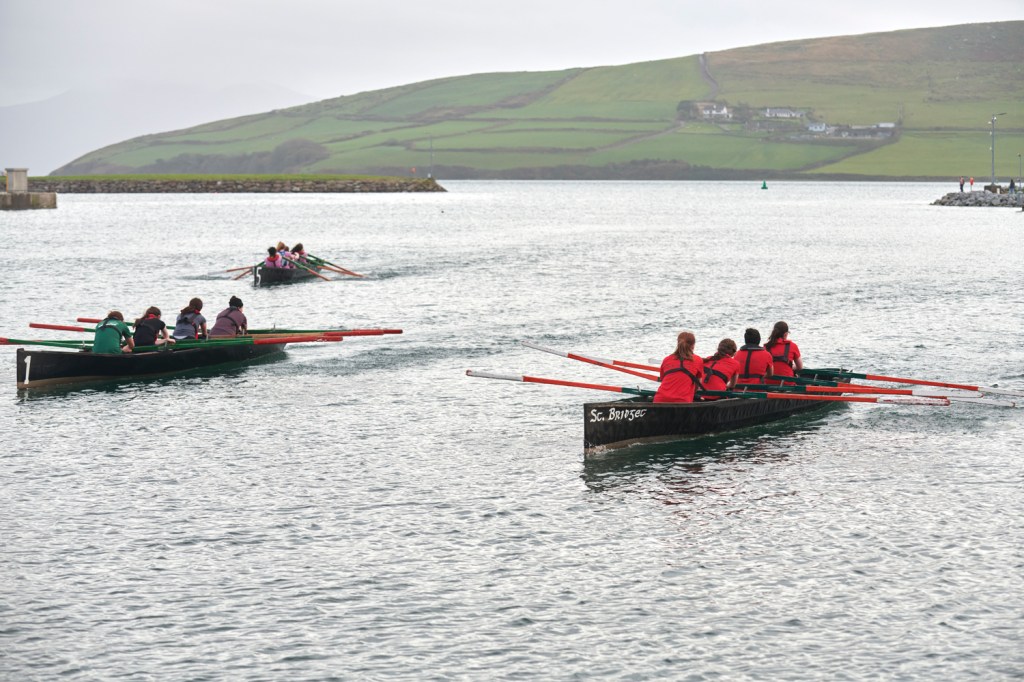
Tarrac (2022), directed by Declan Recks; screenplay by Eugene O’Brien. Stars Kelly Gough, Lorcan Cranitch, Kate Nic Chonaonaigh. Produced by Clíona Ní Bhuachalla, with Cinematography by Patrick Jordan.
In this work of director Declan Recks, career-woman Aoife (Kelly Gough), high up in the corporate world in Dublin, returns home to rural Kerry to care for her father after he has suffered a heart attack. Their relationship is fraught: her father, Bear, no doubt named for his grizzly temper and grand community stature, declares, ‘I almost have to die for you to come home.’
The film is set against the spectacular backdrop the Irish west coast, with most scenes taking place on the wind-licked ocean (and the lacquered-oak pub following a close second).
Aoife, we learn, was an expert rower in her youth, with Naomhóg racing embedded deep within her DNA. Almost incidentally, she is reunited with former crew on her first night back in Kerry after they have won heat that sees them qualify for the Munster semi-finals. It’s the first time a local crew has won that race since Aoife’s mother’s day, 22 years earlier.
After a fortuitous injury renders one of the lesser team members unable to race, the girls implore Aoife to compete with them in the semi-finals.

Naomhóg racing is a form of rowing featuring a traditional vessel unique to the west coast of Ireland. Both Aoife’s parents were esteemed racers before her mother’s untimely death when Aoife was sixteen. Neither she nor her father has appropriately mourned the loss of her death, with Bear living in a state ofundisturbed denial (her sewing room left entirely untouched in the decades following her death) and Aoife throwing herself into her demanding corporate career.
Aoife’s ruthless, cut-throat city mentality sees her quickly assume rank as captain of the crew, ridding the team of ‘dead wood’ and whipping the motley crew into shape.
The Baile na Trá crew has been on a losing streak for decades, and the team – an overworked mother, a failed actress and a troubled teenager – are dismissed from the outset as not having a chance of winning the Munster Cup. But what the girls do have over the other crews is an understanding of the tide.
Jude (Kate Nic Chonaonaigh) is the heart, where Aisling (Kate Finegan) has natural technique, Naomi (Rachel Feeney) the skill, and Aoife the drive. Under Aoife’s new management, we watch the team unlock their latent potential in a touching story of female solidarity and connection to place.
Tarrac is an Irish word meaning ‘pull’, which we can interpret to refer to the stroke on the boat, but also as Aoife’s umbilical drawback to her hometown. As the film opens with Aoife hitching up her tailored trousers to wet her feet in the rugged sea, we gather that despite her corporate success, her life in Dublin has left her spiritually undernourished at the expense of her sensual and cardinal self.
As for the Munster Cup, you’ll have to see for yourself if heart and determination are enough to bring the shabby underdog to victory for the first time in over two decades.
The relationship between the women is underdeveloped, and the festering family wounds between Aoife and Bear are a somewhat trite repetition of the stoic and emotionally distant father who could not be present for his sixteen-year-old daughter following her mother’s death.
The ocean as the site of their misplaced grief and as a metaphor for their capricious connections is somewhat ham-fisted. ‘On the day you were born,’ Bear explains after a feud with Aoife, ‘I nearly drowned in a storm.’ Reassuringly, however, their old wounds are not healed over a grandiose or excessively saccharine speech, but over a quiet wagon wheel on a boat.
Despite its predictability, Tarrac is a gentle story that is comfortingly familiar, aided by a strong performance by Gough with skillful cinematography that beautifully captures the Dingle Peninsula. The dialogue is affable and authentic, and the Irish language sounds earthy and alive on the girls’ tongues.
Isla Sutherland
Isla is a content and communications specialist for a global architecture and design firm. Her expertise includes writing for print and digital genres. She is a member of the Celtic Club’s (Melbourne) Cultural and Heritage Sub-Committee, passionate about preserving Celtic cultures and traditions.
It’s A Damned Fame: Dance First and Samuel Beckett
A Film Documentary Review by Steve Carey
Dance First (2023), directed by James Marsh, written by Neil Forsyth, with Gabriel Byrne as Samuel Beckett and Aiden Gillen as James Joyce
Presented as part of the Irish Film Festival Australia 2024, www.irishfilmfestival.com.au
This biographical film of the life of Samuel Beckett features a fine performance by Gabriel Byrne and looks beautiful throughout. Ultimately, however, it fails to cohere.
In James Joyce’s Ulysses (1922) George Russell (‘AE’) objects to ‘this prying into the family life of a great man’, dismissing Stephen Dedalus’s speculations on Shakespearean biography as mere tittle-tattle, unhelpful in illuminating the work.
We’ve had full-length biographies of Samuel Beckett, among others by the groundbreaking Deirdre Blair while Beckett was still with us, and then posthumously by Anthony Cronin and James Knowlson. And now we have a biopic (incidentally, surely BIO-pic rather than the appalling bi-OP-ic?), Dance First, part of the Irish International Film Festival (around Australia in October and November 2024). Written by first timer Neil Forsyth and directed by James Marsh (Man on Wire, The Theory of Everything), Dance First stars the excellent Gabriel Byrne both as Beckett and as Beckett’s subconscious or private or inner person… his alter ego, anyway. Byrne has the requisite angular aquiline handsome fizzog and big Irish conk, and what the TikTok generation used to call ‘rizz’ (charisma) until a Tinteán reviewer used it in this very sentence, instantly killing it.
Beckett, like his most important mentor James Joyce, wove his text from events in his own life, but unlike Joyce, Beckett was no self-promoter, or at least less overtly so. Though Joyce coined the term “biografiend” in Finnegans Wake, he conveniently forgets that he himself commissioned and minutely supervised a biography of himself by Herbert Gorman. Beckett’s approach was neither to approve nor to forbid, though he helped with many interviews and by not forbidding his friends from talking to them.
Joyce feels like someone we can know, though probably not like very much. By contrast, in this respect Sam Beckett is, like Bob Dylan, essentially unknowable: the more we know about him, the less we know him. This is some difficulty for a biopic.
Certainly we get oodles of Beckettian angst and misery, beginning with his muttered ‘Quelle catastrophe’ as a reaction to being awarded the 1969 Nobel Prize for Literature. (If he felt so strongly he could have refused it as Jean-Paul Sartre did a decade earlier, or Le Duc Tho in 1973.) Actually, he didn’t attend and it wasn’t him but his partner, later wife, Suzanne who called it une catastrophe. We are led away from expectations of a straightforward biopic when Beckett climbs a ladder from the stage to some other realm, there to agonise with his alter ego.
This catastrophe is what Forsyth has seized upon as the mainspring of the plot, with the famously frugal Beckett agonising over to whom he will give the prize money, which in the 1960s was US$26,000, equivalent to about US$250,000 now.
Though at its heart true, in that Beckett did accept the money and then gave it away, the agonising is an invention, except insofar as Beckett agonised over everything. While it is presented as a dramatic scaffold for the film, it is immediately jettisoned: long sections of the film are concerned with his long dead mother, the long dead James Joyce and his institutionalised daughter Lucia and with Beckett’s long dead friend Alfred Peron. In the end, apparently on a whim, Beckett donates the lot to his alma mater, Trinity College, Dublin. The film, like Beckett, fades away.
So what’s the point? Are we merely ‘prying into the family life of a great man,’ or does the film help us see Beckett’s work anew? Makers of a biopic must choose between going deep or wide: focusing in on a small section of their subject’s life, or attempting to cover it all. Dance First takes the latter option and delivers a film that, to change the metaphor, is a degustation.
There is enjoyment to be had in seeing Beckett sit at the feet of Joyce, wryly played by Aiden Gillen, in late 1920s Paris, in his playing a part in the French resistance during the Second World War, and in his eventual success as a playwright. The film is never less than beautifully shot, and Byrne is always magnetic. And the Beckett self-deprecatory self-talk nicely doubles as self-referential reflection on the very venture of making a film itself. Beckettians will enjoy the ride: others may wonder where it’s headed and whether the arriving was worth the driving.
Steve Carey
A Gentle Tribute to a Lost Dublin Institution
A Film Review by Steve Carey
Farewell to Hughes’s (2024), Directed by Ciaran O Maonaigh and featuring Brendan Gleeson.
Hughes’s in Chancery St was where the thirsty wholesale market workers came early in the morning after their night’s work, impatient to be let in at half seven. It was a convenient location to lubricate the lunchtime of the legal crowd from the Four Courts and the guards from the Bridewell, a place where gossip could be shared and deals cut. But who came of an evening? Martin Hughes, who bought the place in 1953, had the bright idea of inviting musicians for casual, laidback sessions… and the wisdom to just let them be, to grow by themselves. And they did, for decades: some nights there were two simultaneous sessions, one in the snug and one in the main bar. There was even a female session, with the women embracing the cheeky name of Fanny Power. They had to gently tell Martin to lay off the ham sandwiches: a moment on the lips, a lifetime on the hips.
The closure of the markets in 2019 was a heavy blow, and the intended refurbishment was halted, as were the sessions, by the pandemic. Hughes’s has not recovered, and the Irish Traditional Musical Archive asked Brendan Gleeson to help memorialise the place. His gentle, loving tribute, filmed over five days in January 2022, is a fond farewell, full of music and memories of the old days. A little like 2022’s North Circular, it’s a lament for Dublin in the rare old times. Gleeson is himself a musician of some renown, who played when he hosted Saturday Night Live and in The Banshees of Innisherin, and his genuine affection for the pub and the scene shines through. You’d love to be there now, with a glass of something, soaking in the atmosphere. Sadly, Hughes’s is no more.
Steve Carey
Steve is Treasurer of Bloomsday in Melbourne. His ply, Samuel Beckett and The Rainbow Girl, staged at St Martins, South Yarra, in June 2024, covers the time Beckett spent in Paris with James Joyce and his daughter Lucia.
That They May Face the Rising Sun
‘Isn’t That the Beauty of it….The Holy All of It’
A Film Review by Frances Devlin-Glass
That They May Face the Rising Sun (2024), directed by Pat Collins, based on the novel by John McGahern by scriptwriters Eamon Little and Pat Collins. Starring Barry Ward (as Joe), Anna Bederke (Kate), Sean McGinley (Johnny). Cinematography by Richard Kendrick.
McGahern’s last novel, That They May Face the Rising Sun (2002), is decidedly lower key and gentler than those which preceded it, and Pat Collins, the director, and the writers who adapted it for film have honoured that spirit to the letter. If you like your films fast and narrative-rich, this is perhaps not the one for you. It details (and detail is the key) a year in the life of a couple newly returned to work a farm in Leitrim (Galway in the film). It’s very slow-paced, meditative, mourning a way of life that had passed long before McGahern’s novel was published. So, dripping with nostalgia. Interiors are meticulously recreated, religious and ritual customs observed in time-honoured ways, and there is time to listen to one another.
The main character, Joe (played sympathetically by Barry Ward), one takes to be a version of McGahern novelist and he has much respect for documenting the passage of time, and there is mild tension with his artist wife (Anna Bederke) who is more ambivalent about the loss of her gallery in London, and taking longer to accommodate to customs that are alien to her. She’s not committed to motherhood, and finds the local expectation both intrusive and unnatural (‘…maybe there are enough children in the world…?’), but she is far from being an iconoclast and her manner is frank and unflinching. The film features many memorable cameos: mostly depicting broken men — a shattered emigré come home to die; an illegitimate old man, Bill, who substitutes the young farmer and family for what he never had, and sadly never quite learns self-respect; and there’s Patrick, the jester who is adept also at putting himself down. There is an excess of bachelors who need to talk, and one of them sadly comments that it’s ‘easier when there are two kippers in the box’. To add salt and pepper to this bucolic assemblage, there are several tense and unresolved relationships that are silently endured.
The scaffolding and the bedrock of this visually sumptuous film is what it does with landscapes and cloudscapes and the imposition of the human impress on them. At one point, Joe, the writer, looks through the unfinished roof of a greenhouse or studio, and notes that dividing the sky into squares of light makes the view more human. It becomes a motif of the film that sunlight is relished (faces being upturned often to the sun), that the bees are helped and their seasonal rhythms respected by the fearless farmer/novelist, Joe, and the whole community assembles to bale and house hay, and sheep regularly go off in small numbers to the town butcher, while their fleece is worked into warming yarn. Richard Kendrick’s camera works on the viewer to experience the everyday wonder and joy of agrarian life. And death also has its rituals which are lovingly enacted and observed.
This is a gentle meditative film that works its magic slowly and by accretion of detail, self-consciously bucking modern film-making practices.
Frances Devlin-Glass
Frances is a member of the Tinteán editorial collective.
Two Films about Death
Film Reviews by Dan Boyle
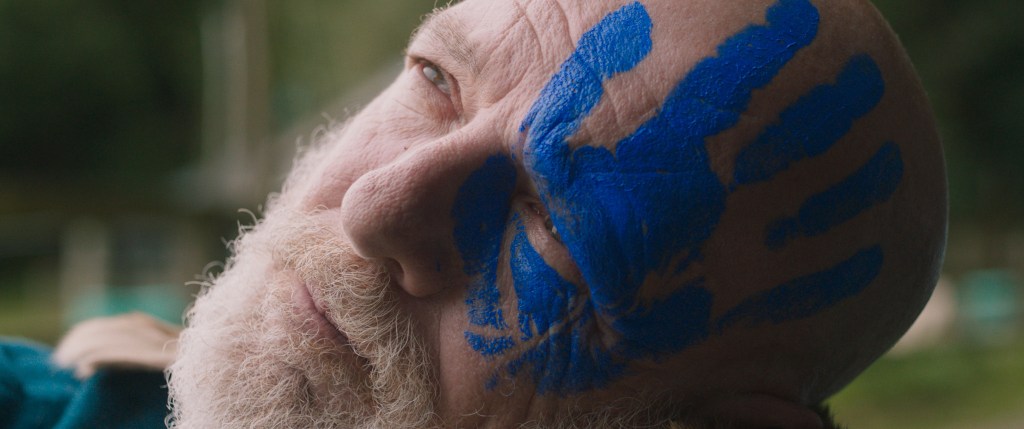
Sunlight (2022), Directed by Claire Dix and Written by Ailbhe Keogan, starring Barry Warm, Liam Carney and Maureen Beattie. Cinematographer: Narayan van Maele.
We will all die alone. At the beginning of Claire Dix’s excellent ‘Sunlight’ we meet reformed drug addict Leon who yearns for a grander life in popular music. Leon struggles to keep clean and has found a worthwhile purpose in caring for his terminally ill mentor/sponsor, Iver the Viking who helped him get straight. Iver ran a youth program offering a twelve-step recovery for addicts with Viking ideation rather than Christian ideation to inspire a cure. Sorry Jesus. The complication is that Iver wants to voluntarily end his life. Leon is shocked to discover Iver with a crude bag over his head in an illegal assisted suicide. Iver is being assisted by a euthanasia advocate Maria.
For the rest of the film Leon, (Barry Ward) and Maria, (Maureen Beattie) argue about the awful realities of assisted dying. Maria has personal experience of being unable to save her own child from a painful death. Leon decides that Iver, (Liam Carney) is just in a bad place and needs some cheering up or a the very least one last gadabout Dolphin’s Barn and environs.
In scriptwriter Ailbhe Keogan’s sure hands assisted dying has never been so life-affirming. Leon eventually comes to term with the inevitable. There is a twist to the dragon’s tail and Iver the Viking is allowed to enter Valhalla.
All You Need is Death (2024), Directed by Paul Duane , cinematography by Conor Rotherham, and featuring Simone Collins, Charlie Maher, Catherine Siggins and Olwen Fouéré
Who knew there was a black market in ancient Irish songs? In Director, Paul Duane’s thriller ‘All you need is death’ 2024, a shifty young couple, Dubliner, Anna, (Simone Collins) and sinister Russian, Aleks (Charlie Maher) are secretly engaged in surreptitiously recording old Irish songs in out-of-the-way pubs. Their mentor slash fence is a fallen academic Agnes (Catherine Siggins). They get wind of an old crone Rita Concarran (Olwen Fouéré) who has a trove of memorised old Irish songs.
Anna and Aleks inveigle their way into Rita Concarran’s home only to find Agnes has got there already. Rita is holding forth from inside her wardrobe. A harmless nutter? Aleks is sent on his way. The dirge Rita imparts is for female ears only. It’s a song of an ancient atrocity. ‘Love is a knife with a blade for a handle.’ Unbeknownst to these ethnographic thieves the song is accursed. The horror of the past reaches to claim the present. There is a mouldy chain of unspeakable consequences. Rita Concarran is horrifically murdered. Her son ‘Breezeblock?’ (Nigel O’Neill) vows revenge.
Director, Paul Duane tips his hat to his film genre masters, Davids, Lynch and Cronenberg: a droning soundtrack, body horror and a cameo by an odd American collector in a wheelchair. The soundtrack by Ian Lynch seems an extended preamble to a Celtic Death Metal recording.
All in all, a well-handled thriller/body horror flick worth seeing alone for Rita Concarran’s keening dirge.
Dan Boyle
Daniel Boyle is a Melbourne actor/performer/ director who has done everything from Shakespeare to the Broadway musical.

