Conviction Politics
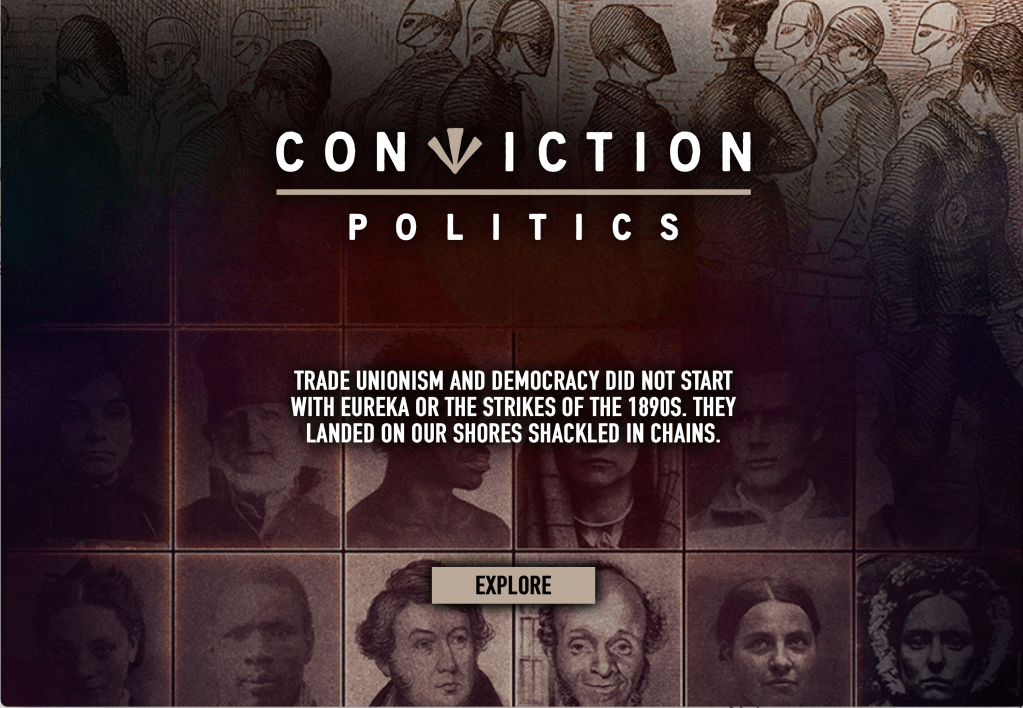
I unexpectedly attended a fascinating presentation at the Celtic Club this month on the massive international Conviction Politics project. Its aim is to use recently digitised records of Tasmanian convicts to reframe Australian democratic politics. It emphasises the scale of the convict system, and focusses on the ordinary working men and women. It gives them a voice and underscores their active resistance to the colonial imperial system. It argues further that such resistance led to what we think of the grand traditions of democracy: in particular trade unionism, the vote and general suffrage in Australia. The ARC-funded project (the project has many stake-holders both in Australia and overseas) deploys the skills of a former ABC documentary maker and now an academic at Monash, Professor Tony Moore, and a huge team of others, to develop smart short films, using animations, music, talking heads and more, to tell the stories of democratic reformers for a new generation. These are freely available on YouTube and very much pitched at younger people, but not talking down to them either, so the appeal should be very broad. A great introduction to the resources is to be found at the Hub Walkthrough
The project cleverly reverses the gaze from the punished convict to focus on the state, and makes very clear the ways in which unpaid convict labour made possible the stealing of a continent and enriching of a political system and a nation. It’s a radical project. The key themes of the project are unrest, dissent, punishment, activism, and the films we saw told individual stories in a variety of ways. They focussed on Irish convicts (some of whom were high-profile Young Ireland convicts of the 1848 protesting colonialism), and as well how allied classes of prisoners in England, notably the Tolpuddle Martyrs (transported for protesting wage cuts), and Chartists (for fighting for working-class rights and male suffrage), also contributed to reform movements by their resistance to a system that didn’t announce itself as slavery but effectively constituted just that.
These are imaginative and well-researched artefacts. I especially enjoyed We Are All Alike, the story of the women of the Cascades Female Factory who refused to identify the ringleaders of their subversion, and whose feisty song of resistance alternated images of real women’s faces with animations of nineteenth-century women rolling their eyes, laughing and scorning the police force mobilised to quell their singing and dancing. There are films about the Castle Hill Rebellion, William Smith O’Brien, Eureka and Catalpa. The films sometimes look at the afterlives of convicts: these stories are very heartening. It’s a fresh new take. Over 100 films in all their variety can be accessed from the site’s Resources page.
A highlight for the audience, followers of Weddings, Parties, Anything, the folk rock group, was a rendition of a song by the group’s frontman, Mick Thomas, about the Irish convict Alexander Pearce, the cannibal escapee, who in making his way from Macquarie Harbour to Hobart, consumed his entire party of convicts. The glee with which the audience counted down the each meal of the diminishing party of convicts and joined in the outrageous song’s chorus was infectious. It made a fine interactive climax for a very entertaining and intellectually stimulating smorgasbord of offerings. Look for ‘A Tale They Won’t Believe’ on Spotify.
Frances Devlin-Glass
Never Closer, at fortyfivedownstairs, 2-24 May 2026.
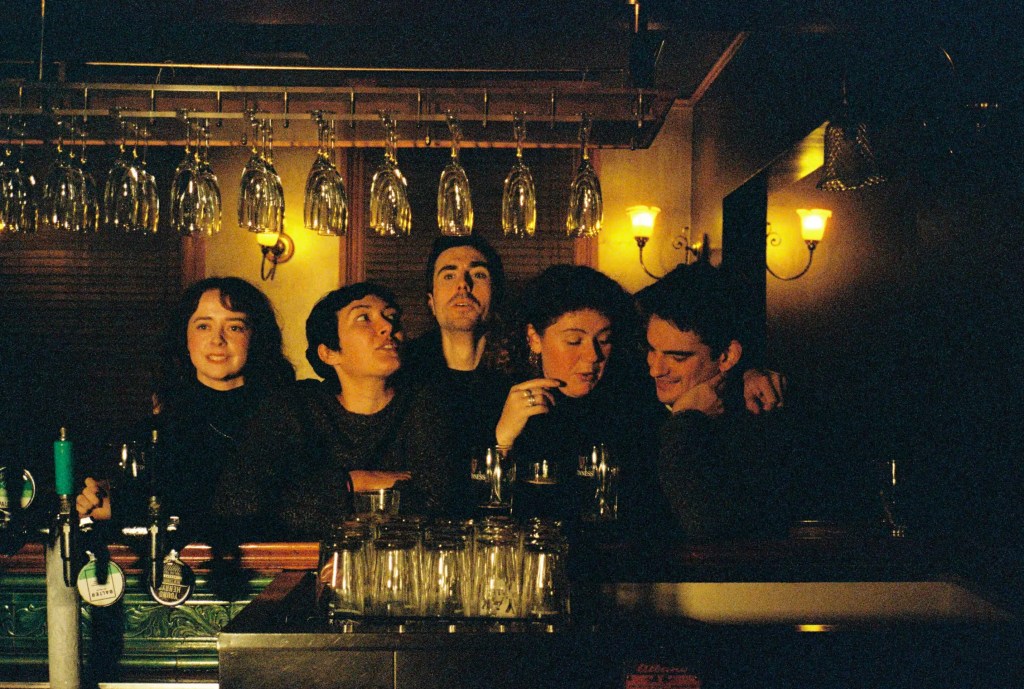
I caught the opening of a new Irish-Australian play Never Closer last night, set in Belfast in 1987 and beyond, written by Grace Chapple and directed by Marni Mount. It focusses on the agony of families deciding whether to stay or emigrate during the worst of the Troubles. Some are forced to emigrate; others don’t get the chance. Little is made of the return of the next generation, one branch from Australia, but the emigré generation carry the trauma and the need to understand the racial/sectarian divisions of their forebears and the legacies of warfare. But let me not suggest it’s a grim play: the craic is fast and furious, witty and funny, and very credibly of their generation.
The play is unusual : it is set in a box-like structure which recreated a Belfast living room of the ’80s, very beige and tan, and featuring lace curtains. The fourth wall was not eliminated (nor was the second or third), though the lace curtains were drawn back in the second act, creating intimacy when it was needed. The script and sound effects generate a lot of tension, and a sense of the menace beyond, which does at times invade the house. It tracks the lives of 5 lower-class school friends who are ‘Never Closer’ than in their adolescence, but not even that is simple. The terror and the grief with which they all live make commitment and even friendship uncertain and volatile. To what extent can human beings watch others play out ideological life-scripts which are inherently anti-social and damaging without themselves being profoundly damaged?
The title of the play comes from a poem by Seamus Heaney, but the sense of unease in this play is the opposite of what he generates in a superb lyric poem about the mother and son relationship while she prepares for Sunday dinner as the rest of the family is at church. No such idyll here. The earliest emigrée and the most successful of them, Niamh, returns for Christmas and to show off her barrister fiancé fresh from London, and a fuse is lit. It’s no-spoiler territory, and moving. I’m hoping there’s a sequel about the Australian emigrés, but maybe Grace Chapple has done the job she set out to do, which is to understand the imperative for some families to leave the North.
Frances Devlin-Glass

