We go behind the scenes with Steve Carey, playwright of Bloomsday in Melbourne’s June production, Between The Lines: The James Joyce/Groucho Marx Letters
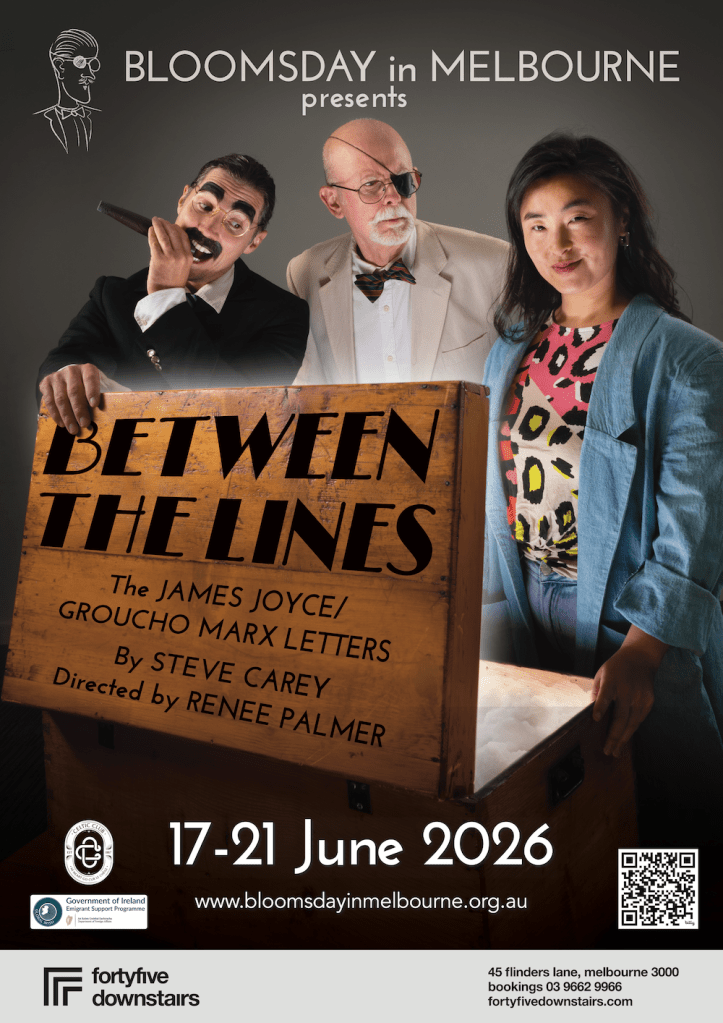
For more than a third of a century Bloomsday in Melbourne has made its mission to bring James Joyce to the theatre-going public. Joyce’s lyrical prose, humour and acute ear for Dublin talk, we long agon discovered, lends itself particularly well to the stage. Initially this took the form of street theatre, taking advantage of Melbourne’s many geographical and architectural similarities to Dublin, but eventually the attractions of warmth and comfort began to outweigh those of outdoor adventure in midwinter Melbourne, and now the group’s spiritual home is Fortyfivedownstairs, one of the city’s best-known independent theatres.
Last year at Fortyfivedownstairs we staged the wild ‘Circe’ episode, a drunken phantasmagoria set in 1904 Monto. For 2026, we’re back in the same theatre with a very different brew, a brand new piece, which takes as its premise the fictional existence of a cache of letters from 1937 between Joyce and Groucho Marx.
It’s not quite as unlikely as it might sound, since Marx kept up a lengthy correspondence of mutual admiration with T. S. Eliot as well as numerous other American cultural figures. Their distinctively different working practices certainly make a pleasingly contrasting pair: Joyce the novelist with no editor, creating a world entirely between his own ears, whereas Marx and his siblings take their scripts to the stage for raucous public road testing. Imagining them curious about the other’s methods enables us to eavesdrop on the artist’s workshop. Joyce was eloquent about his intentions, leaving many cues and clues in letters, conversations and even schemas as to what he was building – occasionally so much so that later he expressed regret that he’d been so explicit. (It’s one of the things that can make Joyce’s work initially off-putting: the critics and the commentators know the backstory, while the novice reader does not. Every episode of Ulysses, for example, has an Homeric title – Telemachus, Eumaeus, Penelope – that is nowhere to be seen in the text, leaving the newcomer wondering where on earth all this information comes from. Once you know he gave a nod and a wink, you realise that it’s not you after all!
Onstage a letter becomes a soliloquy, and then eventually one side of an unlikely friendship, the two men sharing melancholy news about their personal and financial woes. In the late 1930s Joyce’s reputation as one of the world’s great modernist writers, built entirely upon Ulysses (1922), was being gradually eroded by the puzzled and dismayed reception that greeted Work in Progress, the work that eventually becomes Finnegans Wake (1939) that makes Ulysses look like a walk in the park. Meanwhile his daughter Lucia was falling more and more prey to the terrible mental illness that distressed her father so much. Throw in Joyce’s legendary ability to fling money around and his perennial eye troubles (he underwent about a dozen agonising surgical procedures, wryly describing himself as an ‘international eyesore’) and the poor man’s distress is evident.
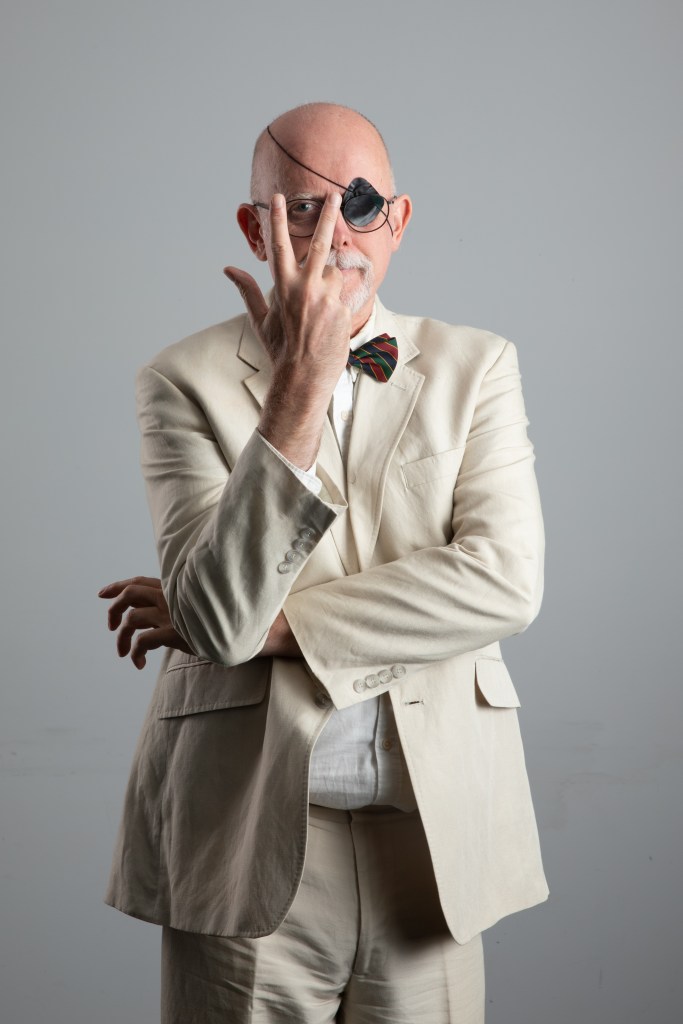
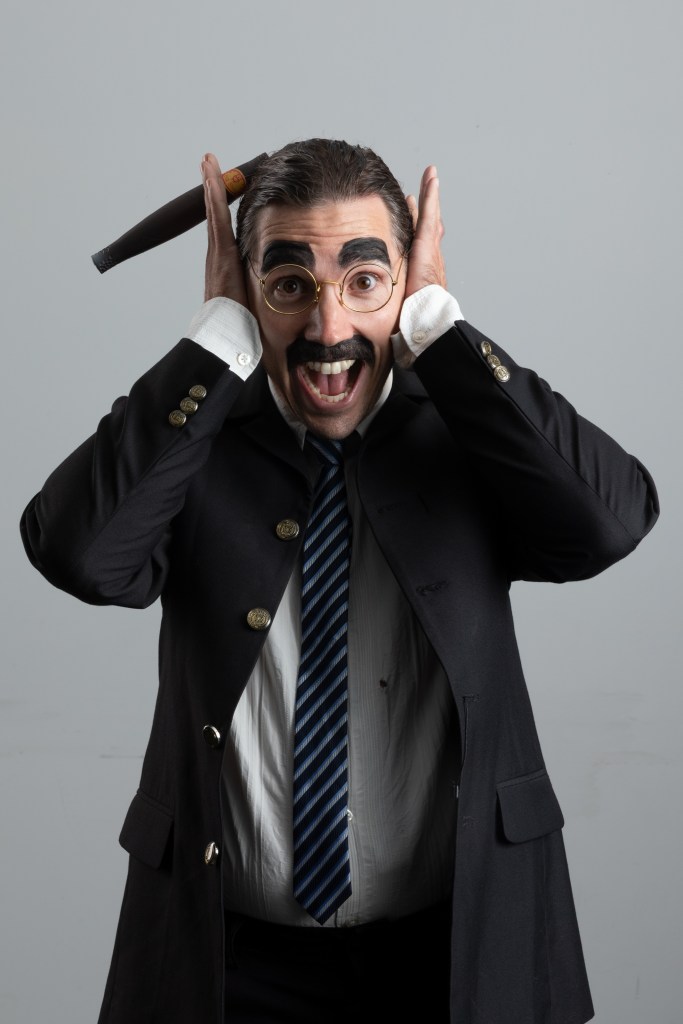
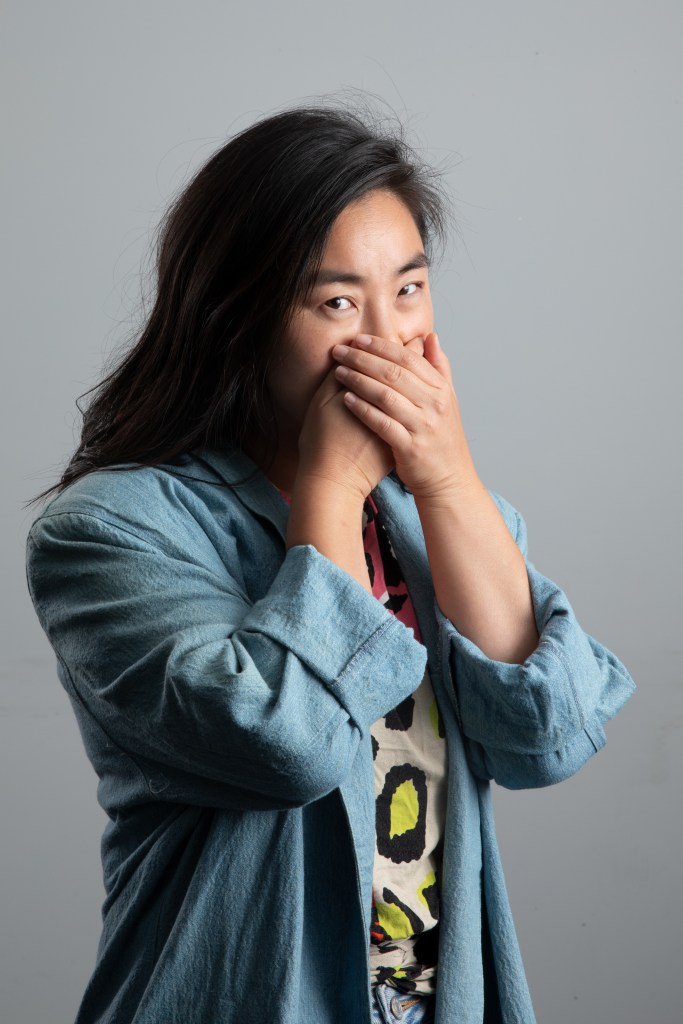
| James Joyce (Bloomsday veteran, Tref Gare), sees no evil… | While Groucho Marx, played by Scott Middleton, hears no evil… | and the finder of the Joyce/Marx letters, Pandora Friedan (Seon Williams), speaks no evil. |
Marx’s situation was superficially better, at least financially, though he was increasingly disenchanted with the grind of movie set and stage, and was more than halfway through an unhappy first marriage that was to end in bitter divorce just a few years later in 1942. The invented letters of 1937 predate Marx’s later renaissance as a radio and TV host, so we’re left with a middle-aged man tired and bored of fame and the lengthy hours it took to sustain it and keep the money rolling in. He’s tired, and the constant wisecracks – ta da! – a veneer barely concealing despair: be careful what you wish for.
So far so good, and Bloomsday gets a tick for delivering on one half of its remit: to shed light on Joyce and his work, the better to lure the innocent into a closer engagement. But a series of letters isn’t a play, and the other half of Bloomsday’s remit is, we fervently hope, to give the theatregoer a good evening out. Dialogue isn’t drama: conflict is drama.
The discovery of these letters, however, does open up dramatic possibilities. Who finds them? Well, they are found, after Marx’s death, in his rotting house by Pandora Friedan, a young, female academic in 1980s Britain, which then of course begs further questions: what happens next? What goes wrong? (It’s a play: you know something will go wrong. Them’s the rules.) Pitch her down the rabbit hole into the patriarchal world of academe and in particular the Joyce industry and now we have action and plot: a struggle between youth and age; female and male; ambition and power. Guess who wins? Guess again…
This, incidentally, also goes some way towards addressing a perennial issue for Bloomsday, the paucity of good female roles in Joyce. Molly aside, there are precious few complex, believable female characters in Ulysses – one could argue that’s part of its point, or one could argue that it’s a Joyce blind spot. One could argue either way, but the fact remains we struggle to offer female actors juicy roles. Between The Lines has six parts, three of them women.
So now we have our dramatic engine, where can it take us? Between The Lines is set in the 1980s, a world halfway between the finding of the letters in the 1930s and today, long before our contemporary obsession with identity politics, ‘Me Too’ and all. That’s not to say those things don’t matter, only that perhaps one way to see them more clearly is to look back on a world that didn’t have them and to cast a cold eye on the attitudes that prevailed, invisibly, then. In the decade when the letters are (supposedly) written, Groucho was still playing the part of a comically unlikely but constantly horny Lothario, cigar and eyebrows wiggling suggestively – but came from a reality where male power, that of the producer and of the director, was absolute and where the casting couch was an everyday hazard, but also a means of career progression for aspiring young actresses. Harvey Weinstein is but the latest in a long line of sleazy, disgusting douchebags exploiting the extreme vulnerability of desirable young women in a hyper-competitive world where the men hold all the aces, facilitated by yes men and yes women whose livelihoods depend upon their wilful blindness.
The decade in which the letters are supposedly found, the 1980s, is a world many of us remember but which is alien in so many unrecoverable ways: padded shoulders and jacket sleeves rolled up, music videos, distressed double denim, cigarette smoke everywhere, no computer smaller than a heavy suitcase, no internet, no mobile phone, the CD and the Sony Walkman the hottest of hot technologies, not even 24 hour television (at least not in the UK or Australia). ‘Computers,’ one character wonders: ‘will they even last?’
And where might one find a detailed examination of such a world? With just a little stretch, the 1987 today of Between The Lines is also the world of Helen Garner’s The First Stone (1995), that extraordinary and extraordinarily divisive account of sexual harassment in the workplace at Melbourne University in 1991. For just about as long as Bloomsday has been around that book has elicited visceral reactions, particularly among women who recall reading it when it first appeared, and I’ve met many who will never forgive Garner for what they see as a betrayal of her sex. In brief, they say, she takes the view that women have always faced sexual advances – and by implication always will – and advocates that most of the time the best approach is to take it in one’s stride and accept that men have their silly sexual drives, their pathetic infatuations and blundering misreadings of social cues. Just get on with it, she says, and if that doesn’t work, knee him in the balls and get on with your day.
That is not the response of the three young women at the centre of the story, subjected to groping by a senior Professor and confronted by their institution’s refusal to take their complaints seriously. Instead, they shouted, long and loudly enough to eventually have him sacked, an outcome that Garner sees as wildly disproportionate to the offence.
While the events of Garner’s book were undoubtedly traumatic for many, they are a gift for a dramatist, who is in the blessed position of being able to exploit the grey areas of complexity to pose the question the book asks: given that all sides agree that such things happen, what is to be done when they do?
Given these threads, then, it is not surprising that we have found a female director, Renee Palmer, to take charge of the production. Together with our two lead female actors, Christina Costigan – known to Bloomsday regulars as a female incarnation of the hellfire priest in Portrait of the Artist (2016) and a hoop-bound Molly in 2017’s Getting Up Joyce’s Nose – and Bloomsday newcomer Seon Williams, Renee spent many an hour developing the more, ah, delicate parts of the original script into something they could truly feel, while your correspondent, the playwright, scribbled furiously trying to capture their emotion and thoughts.
So, what do you do when your PhD supervisor makes a clumsy move on you after a drunken night out? If you complain – and we’re talking about the 1980s, though sadly it can still be true today – you risk being labelled a difficult woman, someone who’s ‘high maintenance,’ and an invisible black mark against your career; alternatively, if your complaint is upheld, you lose your supervisor and potentially your one slim chance at academic success. But then again, if you shrug off something that every woman will recognise, are you abrogating your responsibility to make sure it doesn’t happen to other women less well placed to deal with the situation than yourself? Isn’t that just privilege in (in)action?
Meanwhile, as the women to whom this happens struggle with their consciences and try to decide what’s best to do, the perpetrators press blithely on, in many cases unaware of the damage done.
Between The Lines: The James Joyce/Groucho Marx Letters spans three eras: the 1930s, when the letters are written; the 1980s, when they’re found; and today, when we look back. You can expect to hear Joyce’s remarkable insights into his own work. You can expect to hear that trademark Marx wit. And you can revisit a time when so many of our contemporary concerns had not yet bubbled to the surface. It takes a big team, not just of director and actors, to bring this world to life, but a costumier (the remarkable Zach Dixon, who fitted out Circe’s Carnival of Vice last year), a set designer, lighting and sound directors and more. We very much hope to see you in June, and hope that you go home not only just a little wiser about Joyce, but thinking about the 1980s, whether you were there or not!
Between The Lines: The James Joyce/Grouch Marx Letters plays at Fortyfivedownstairs from Wednesday 17th to Sunday 21st June 2026. On Sunday 21st you can join Bloomsday in Melbourne’s Founder and Artistic Director Frances Devlin-Glass and the play’s writer Steve Carey, as well as Professor Ronan McDonald, for our annual Bloomsday Seminar and Lunch at The Wild Geese in Brunswick. More information about the play and tickets here; and more about the Bloomsday Seminar and Lunch here.
This production is supported by the Emigrant Support Scheme of the Government of Ireland and the Celtic Club Melbourne.
Steve Carey is Treasurer of Bloomsday in Melbourne and President of Kingston Writers Centre.

