A Feature by Elizabeth Malcolm
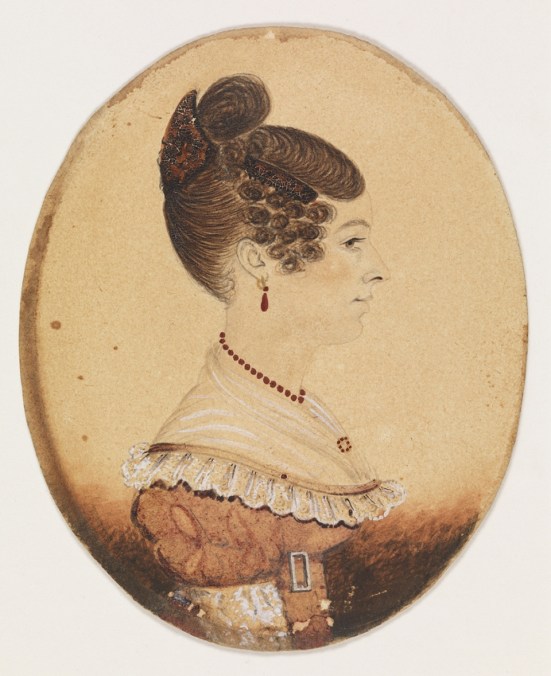
Anna Maria Bunn (dictionaryofsydney,org)
Introduction
The first novel published in Australia was written by an English convict, Henry Savery (1791–1842), and it was initially serialised in a Hobart newspaper in 1830–31. Seven years later, in 1838, the first novel written by a woman appeared in Sydney. Entitled The Guardian, the book was privately printed, with few copies produced. The author’s name was not included on the title page and, instead, the book was said to have been written by ‘An Australian’. Not surprisingly perhaps, the work was quickly forgotten. It was not until the 1960s, that the author was identified as a young Irish widow named Anna Maria Bunn (1808–89), and in 1991 the novel was reprinted with an introduction by the Australian literary scholar, Elizabeth Webby.
Webby and other Australian critics have in the main been intrigued, but not overly impressed, by The Guardian, yet the book and its author’s life throw interesting light on the experience of Irish Catholics in Australia, in particular Catholics from middle-class backgrounds.
Life
Bunn was born Anna Maria Murray in 1808 into a family of strong farmers near the town of Shanagolden in north-west Limerick. Her father, Terence, served as a paymaster in the British army during the Peninsular War in Spain and Portugal (1808–14). Indeed, three of Terence’s brothers also joined the army, while others worked as farmers, graziers and merchants. Anna Maria’s mother died when she was very young and she and her two brothers, James and Terence Aubrey, were brought up by relatives while their father was absent abroad. All received good educations, with Anna Maria attending the Ursuline Convent in Cork, today one of Ireland’s oldest girls’ schools.
County Limerick was an impoverished, unsettled and violent place during the first decades of the nineteenth century. Whiteboy movements fought to lower rents, abolish tithes and prevent evictions, attacking not only Protestant landlords and their agents, but Catholic graziers like the Murray family. Faction fights were common in the Shanagolden area, as were abductions of farmers’ daughters by poor labourers and forced marriages. The county was placed under martial law several times and, under the 1822–4 Insurrection Act, more convicts were transported from Limerick to the Australian penal colonies than from any other proclaimed Irish county. In considering the lurid gothic features of Bunn’s novel, it is important to keep in mind the violent society in which she grew up.
After the end of the Napoleonic Wars in 1815, Bunn’s father opted to remain in the British army and was transferred to NSW, where he served in Sydney during 1817–24. Sent next to India, Terence decided to resign from the army and return to NSW with his children in hopes of acquiring a large government land grant and establishing himself and his sons as wealthy pastoralists. Peninsular War veterans were influential in NSW and, when the Murrays arrived in 1827, the governor, General Ralph Darling, was a veteran of the war. In 1829 Terence and his youngest son, Terence Aubrey, were awarded about 1,600 hectares in south-east NSW by Darling. Terence died in 1835, but Terence Aubrey continued adding to the family lands until he controlled a pastoral estate extending from modern-day Canberra south to the Murray River. Of course, all these lands had been initially confiscated, often violently, by the British crown and white settlers from their Indigenous inhabitants. Terence Aubrey, who based himself at a homestead called ‘Yarralumla’, now the site of a Canberra suburb, went on to pursue a prominent political career as a minister in NSW governments, being knighted by the crown in 1869. He married twice: first in a Protestant church and second in both a Protestant and a Catholic church, but he was buried a Protestant in 1873.
In Sydney in 1828, Anna Maria married an English Protestant sea captain and merchant named George Bunn, who was about 18 years her senior. Bunn had led the rough life of a sailor trading between ports in India and China, before later captaining convict transports to the Australian colonies. Despite being brought up and educated a Catholic, Anna Maria married Bunn in a Sydney Protestant church. It is hard to see what the two had in common, but Anna Maria’s father appears to have paid Bunn a substantial dowry. The couple had two sons in quick succession and settled in a house they built overlooking Darling Harbour named ‘Newstead’. The name was doubtless a gesture by Anna Maria to her favourite poet, Lord Byron, whose English ancestral home was called ‘Newstead Abbey’.
Life at ‘Newstead’ was not to prove happy, however. In 1834, George Bunn died unexpectedly, leaving Anna Maria in debt. Shortly afterwards, her uncle and guardian, Richard Murray, arrived from Cork, having been bankrupted. And in 1835 her father, Terence, also died. It was in the wake of these deaths and financial difficulties that Anna Maria wrote her only novel. In 1840, she left ‘Newstead’ and took her two sons to live with her older brother, James, at a pastoral property named ‘Woden’, which he had recently bought and which is now the site of a Canberra suburb. She stayed there until 1851, when she moved to another property named ‘St Omer’, near Braidwood, which had belonged to her husband, George Bunn. There Anna Maria lived out the rest of her life, helping to run the station with her eldest son, William, developing a renowned garden and painting and drawing the local flora and fauna. Despite her Protestant marriage, she was buried in the Catholic section of Braidwood cemetery.
Work
The Guardian has two main protagonists: teenage girls who had become friends while at school in London and later regularly correspond with each other. By early 1826, one, Jessie Errol, an orphan, is living in County Limerick near Shanagolden with the Irish O’Brien sisters. The two sisters are relatives of Jessie’s guardian, Sir Charles Vereker, a hero of the Napoleonic Wars. Sir Charles grew up in England with Jessie’s mother and had planned to marry her, but she was raped by another man and died soon after Jessie’s birth. Sir Charles thereupon adopted Jessie, joined the army and took her on campaign with him as far as Greece and also to Waterloo. Obviously, Sir Charles is a very different character from Bunn’s soldier father, Terence Murray. As a teenager, Jessie fell in love with Sir Charles and, as the book opens, she is determined to marry him.
The other teenage girl is Clara Dean, a rich English heiress, who is living with her mother and friends at Clifton, a resort near Bristol in the west of England. Clara is witty, selfish, opinionated and loves gossip; and, despite her wealth, she is determined to marry for money.
Clara meets Sir Charles in Clifton and becomes convinced that he is about to marry, and she passes on this gossip to Jessie in one of her letters. But it is not true, as Sir Charles considers himself already wedded for life to Jessie’s dead mother. Jessie is devastated and, on the rebound, she accepts the proposal of Francis Gambier, a young landlord from County Clare, who is in love with her. The couple marry in a Protestant church, but Sir Charles and one of the O’Brien sisters, who is a staunch Catholic, do not attend. Bunn does not explain this non-attendance. However, readers at the time would presumably have understood that Catholics were not supposed to attend Protestant church services.
Towards the end of the novel, in late 1827, when Jessie discovers that Sir Charles has no intention of marrying, a gothic tragedy ensues. It emerges that Francis Gambier’s father was the man who raped Jessie’s mother. Having just given birth to a son, Jessie realises that her husband, whom she does not love, is her half-brother, and she throws herself and her baby off the sea cliffs of County Clare. Distraught, Francis wanders to Greece where it appears that he too commits suicide.
The novel is melodramatic in its tropes of obsessive love, rape, incest and suicide. But, as Australian critics recognised, Clara Dean’s letters are humorous and contain much social satire. Thus The Guardian is a rather odd mixture of a gothic tragedy and a comedy of manners––Mary Shelley meets Jane Austen one might perhaps suggest!
But, knowing Bunn’s Irish family background, it is possible to analyse some of the peculiarities of the novel. Marriage, religion and identity are important themes. Influenced by the romantic poets, Bunn champions marriage for love. While Sir Charles loved Jessie’s mother, Jessie’s own marriage to Francis in a Protestant church is not a love match and ends in disaster. Some of Clara’s friends also have unhappy courtships or marriages when love is not involved, while Clara herself marries for status and wealth. She at first rejects Alphonso Bacre’s proposal because he has no money and is a foreigner from an obscure family living in Vienna. But, when he unexpectedly inherits an English title and estate, she accepts him. The treatment of marriage in the book suggests that Anna Maria’s own marriage, arranged between her father and George Bunn, may not have been a happy one.
As her Murray father and brothers were Irish Catholics enjoying the benefits of British colonial service, Bunn’s treatment of religion and identity is also interesting. She obscures the religious affiliations of a number of her characters. It is not even clear whether some of them are English or Irish. Bunn seems to be trying to create a society where religious and ethnic loyalties do not matter very much. Presumably this was a society in which the Murrays, although Irish Catholics, could live and work alongside and on equal terms with English Protestants. And yet the central gothic disaster of the novel is caused by a wealthy, feckless English woman. It is Clara Dean’s inaccurate gossip about Sir Charles Vereker that produces an incestuous marriage and leads directly to the deaths of Jessie Errol, her husband and son. Perhaps, ultimately, Bunn did see England as the source of Ireland’s problems.
Further Reading
Anna Maria Bunn (‘An Australian’), The Guardian: A Tale, 1838, ed. Elizabeth Webby, Canberra: Mulini Press, 1994.
Gwendoline Wilson, Murray of Yarralumla, 1968, 2nd ed., Canberra: Tabletop Press, 2001.
Elizabeth Malcolm is an honorary professorial fellow at the University of Melbourne.

