A Book Review by Frances Devlin-Glass
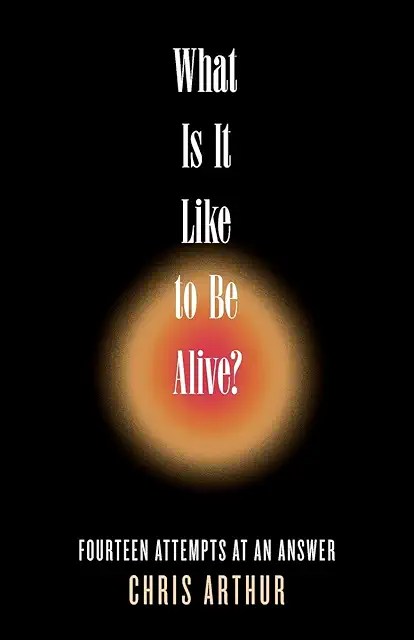
Chris Arthur, What Is It Like to Be Alive? Fourteen Attempts at an Answer,
Eastover, Eastover Press, Rochester (Mass), 2024
RRP: AU$43.72
ISBN: 9781958094518
Having read and reviewed multiple collections of essays by Northern-Irish-born essayist, Chris Arthur, I definitely qualify as a fan. I cherish these essays for their literariness and groundedness: they are an invitation to get off the spinning earth and take a long, slow look at life. His subjects are quotidian, but his meditating on them makes them expressive of different intensities of the sense of living through the senses, with the pleasurable engagement of the brain.
The subjects can shift from a purely aesthetic first looks and move into disturbing territory, as does his first story about a decorative, elegant Japanese woodblock print, Asakusa Ricefields, by the master of his craft, Hiroshige (made in the Edo period, in the seventeenth century). You may know it: It depicts a fat white cat looking out on a rural scene at Mt Fuji. What is hidden in plain sight is the story of an indentured geisha Arthur names Tama after a famous haiku-maker who yearns for her freedom. The signs of her trade cannot be unseen once noticed, and the jarring collision between the soothing Japanese aesthetic and the economically enforced realities of the performance of the ‘honorable act’, the servitude of the courtesan’s life, make for a sobering conjunction with decorative print.
Often the essays are organised to enhance the different tonalities of each by juxtaposing unlikely subjects. The essay that abuts ‘A Lament for Tama’ is just such an oddity, taking the form of a study of an excentric neighbour who keeps ferrets in a small Welsh town. There’s something faintly repellent to me (I’m rodent-phobic) about a creature that could be introduced to a house through the mail slot. For Chris Arthur, though, it is a ‘combustible’ moment, and it is the proliferation of such moments in ordinary urban houses along a nondescript street, which, added together, create ‘a massive pointillism of completeness’. The task he’s given himself is ‘splitting the atom of the humdrum’ to observe the shocking radiance that he can release.
Sometimes in an essay he focuses on events that are overcharged morally and emotionally, like the Story of Elizabeth in ‘Splinter’, a graduate student committed, probably unwisely to unpacking a Holocaust narrative for a Ph.D. dissertation. Experienced supervisors know that topics usually arrive pre-charged by the prior experience of the candidate, but Arthur raises the question of whether or not, if the study causes irremediable grief, it is time to abandon it. I’d have found that decision very difficult indeed, and probably not taken his path of recommending avoidance as a way of evading survivor guilt. What is wise? I’m unsure and don’t know all the particularities of this charged incident.
Another intriguing essay tells the story behind an imperial statue in Lisburn (Northern Ireland). It is of a soldier, John Nicholson, who ‘made good’ in India. It was lauded on erection as a ‘sacred’ monument extolling courage and loyalty to King and country. For others, including Chris Arthur, Nicholson is a grim and dark cult hero. He was, despite his barbarism, regarded as something approaching a demigod by his Hindu, Sikh and Muslim followers, the ‘saviour of Delhi’. The refrain of this essay, oft-repeated, is ‘There are many ways of seeing the same thing’. Arthur continually shifts from one perspective to another. Still, it’s hard to disagree that the dramatic raised sword and pointing gun of the statue was in 1922 an appropriate ‘battle standard’ for Lisburn, or even that it epitomised ‘Britishness’. It has to have been an entirely old-fashioned statue in 1922, long after the Great War, harking back to hand-to-hand warfare. He recommends more worthy local contenders, like Frank Pantridge (inventor of the mobile defibrillator).
The transience of human life is something that Arthur returns to throughout this collection, whether it be his meditation on the shards left by the Pictish population buried in a Hallowhill near St Andrews, Scotland, or the garden bench plaques in his local Botanical Gardens. He loves to play with long and short perspectives of time and space to activate his ‘compound eye’, and his sense of ‘absent presence’.
Best of all, the essays enact an intelligent interrogation of certainties and an invigorating sense that uncertainties are what we live with habitually, and that this may be a way of being more alive than otherwise. The subtitle, after all, reminds us that his 14 essays are ‘attempts at an answer’.
Frances Devlin-Glass
Frances is a member of the Tinteán editorial collective, and her interest in the Essay as a form has been reinvigorated in recent years, mainly by encounters with Northern Irish-born writers.

