by Dymphna Lonergan
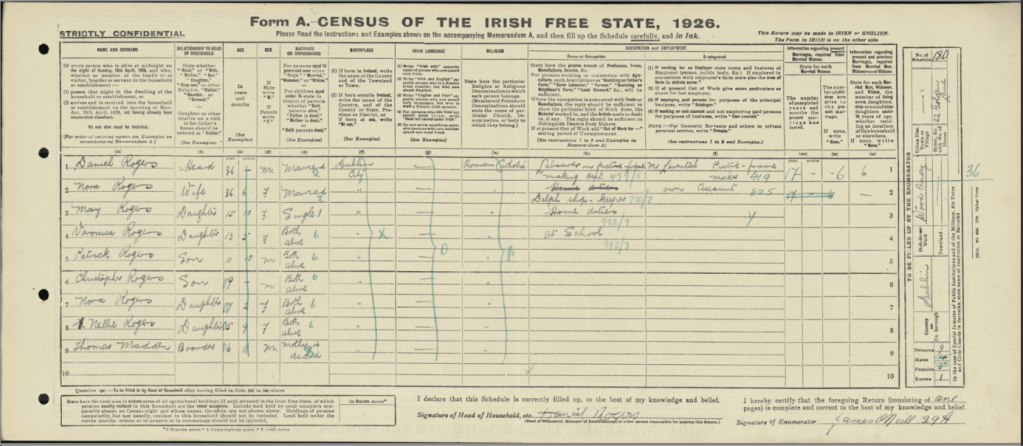
Golden%20Lane_3076_0003_0087_0_00173
Reproduced by kind permission of the Director of the National Archives.
It’s difficult to explain why my eyes suddenly filled with tears on viewing the 1926 Census form for the first time, before I even began to search for my ancestors. That title, The Irish Free State, seems triumphant, declarative. It was not a term I heard growing up in Dublin. Ireland was called ‘Ireland.’ Many years later here in Australia, I became friends with a woman from Portadown, and in discussing our respective Irish backgrounds she used the term ‘The Free State’ as if it was an ordinary term. I explained to my friend that I grew up knowing the country as ‘Ireland.’ So, to see ‘The Irish Free State’ at the top of the 1926 census form made me emotional thinking of the long, hard, fight to be able to use it. It reminded me too of my cousin who fought with De Valera in Boland’s Mill in 1916, but also of another who is buried in a military grave in Belgium having joined up to fight in World War 1 and being shot by a sniper in 1914. Such is Ireland’s complicated history.
In the online Australian edition of The Conversation (April 17, 2026), Ciara Breathnach, Professor of Gender History, University College Cork, reminds us that the 1926 census ‘…holds several keys to unravelling Ireland’s complicated past.’ It helps to bridge the gap caused by the destruction of documents during the civil war; we can deduce the effects of the first world war and the influenza pandemic on population and movement. The 1926 shows a ‘decrease in the Protestant population from the 1911 census.’ Above all, as with any census, the 1926 Census is important for how it records ‘ordinary lives.’
Form changes
Marriage details
Apart from the change in title from Census of Ireland, 1911 to Census Of The Irish Free State, 1926 (Mór-Áireamh Shaorstáit Éireann, 1926 on the reverse side as an option to use the Irish language), there are some interesting changes in categories. In 1911, the ‘Particulars as to Marriage’ category asked whether ‘Whether married, widower, widow, single.’ The 1926 form’s category is ‘Marriage or Orphanhood’ and asks for details for children under 15 in respect of parents, whether both parents are alive or ‘father is dead’ or ‘mother is dead.’
Employment
In 1911 the Census asked about ‘Rank, Profession, or Occupation.’ In 1926 we have two sections: Personal Occupation and Employment
Personal Occupation
State here the precise branch of Profession, Trade Manufacture, Service, &c.
For persons working in connection with Agriculture, such descriptions as Assisting on Father’s Farm, ‘ Farm Labourer,’ ‘Farmer,’ ‘Assisting on Neighbour’s Farm,’ ‘Land Steward,’ &c., will be sufficient. Where the occupation is connected with Trade or Manufacture, the reply should be sufficient to show the particular kind of Work done, the Material worked in, and the Article made or dealt in, if any. The reply should be sufficient to distinguish Dealers from Makers.
Employment
If working for an Employer state name and business of Employer (person, public body, &c,) If employed in connection with employer’s farm state also the area of farm in statute acres.
If at present Out of Work give same particulars as above for last employer.
If employing paid persons for purposes of the principal business, write ‘Employer.’
If working on own account and not employing paid persons for purposes of business, write ‘Own account’.
For Domestic Servants and others in private personal service, write ‘Private’.
Religious Profession (1911)
Members of Protestant Denominations requested not to describe themselves by the vague term ‘’Protestant,’’ but to enter the name of the Particular Church, Denomination, or Body to which they belong.
Religion (1926)
Members of Protestant Denominations should state the name of particular Church, Denomination, or body to which they belong.
I am struck by the change in tone here.
These differences in tone ande informaton sought would make for an interesting study. The enlarged employment detail sought also provides useful terminology for family history researchers: self-employed is ‘own account’. The purpose is to clearly distinguish between ‘dealers’ and ‘makers.’ My understanding of the term ‘dealer’ growing up came from the sellers of fruit and vegetables in Moore Street, Dublin.
From my grandfather’s 1926 entry, I found that at that time he was a ‘labourer’ for a picture-framer who is named on the document. The family lore was that my grandfather had a picture-framing business. His wife is reported in 1926 as being a ‘Delph shop-keeper’ on her ‘own account.’ This matches my mother’s story of the family having a shop. I never knew what they sold, but my mother’s tales of their premises being raided by soldiers who poked through the hay at the back of the shop looking for guns and of my nine-year-old mother delivering guns as ‘laundry’ have a larger context for me now. Of course, I can’t help romanticising about the word ‘delph’, a word we don’t hear much anymore, but I remember it being commomplace when I lived in Dublin. The Oxford English Dictionary says that it is ‘chiefly Irish English,’ a word for, ‘Plates, dishes, etc., made of earthenware or china; crockery.’ The OED provides a 2013 reference that shows the word alive and well in Wexford.
A huge thank you to..those who provided raffle and door prizes, Hotel Curracloe for providing extra seating and delph.
Wexford (Ireland) People (Nexis) 1 January (Features section) 64
Tips for your census research
‘Manage expectations’, we are advised’ in The Conversation article. I can personally attest to this when having found one set of grandparents I moved on to the next, only to be disappointed at not finding them. I need to slow down and re-check my input. Slowing down will also reduce those episodes of scurrying down rabbit holes in desperation, or just out of curiosity and meeting confirmation bias. At one point I was merrily researching what seemed to be an interesting place name of origin for my grandchildren’s great grandfather on their father’s side, when on looking again at the 1926 record, I saw names of male and female siblings that were never mentioned by ‘Jack’. Indeed, we have a letter sent by Jack to my daughter when she was five that mentioned only two sisters.
Another tip is to research one side of the family at a time and to put those documents away before moving on to another family. With my table covered in ancestral documents, I have found myself researching the wrong surname because my main focus was on the first name.
We also need to lower expectations. I was hoping to see my father’s name for the first time in a Census, but a search returned as blank. He was born in 1912. I looked for his name in the 1926 Census as a teenager with a mother named ‘Dora’, but it returned a blank. I also searched every Dora who matched her age, with no luck. I suspect that the family simply did not take part in this Census, for whatever reason. However, I can see my father’s grandparents’ record in the 1926 Census and it shows a busy and industrious group. His 71-year-grandfather is ‘unemployed’ for three years, previously a ‘porter’ for the Munster & Leinster bank. Three daughters worked as tailoresses in Pims, Georges Street and ‘Siely’ Grafton Street and one daughter was a ‘factory hand’ in ‘WD & HO Wills Tobacco Factory’ in Marrowbone Lane. These daughters are aged from 35 down to 24. There is a ‘grandson’ aged 8 on the record with a surname that matches a lodger staying with the family in 1911!
Searching on the 1926 Irish Census is not as easy as it is on the 1901/1911 Censuses, but I am sure it is a work in progress and will improve over time. Overall, though, I am proud to hail from a country that has so generously made the 1901, 1911, and now the 1926 Censuses freely available for the ’80 million people globally’ who claim Irish ancestry, It is indeed ‘momentous.’


I hope you have included a DNA test in your search.