Remembering Ned Kelly
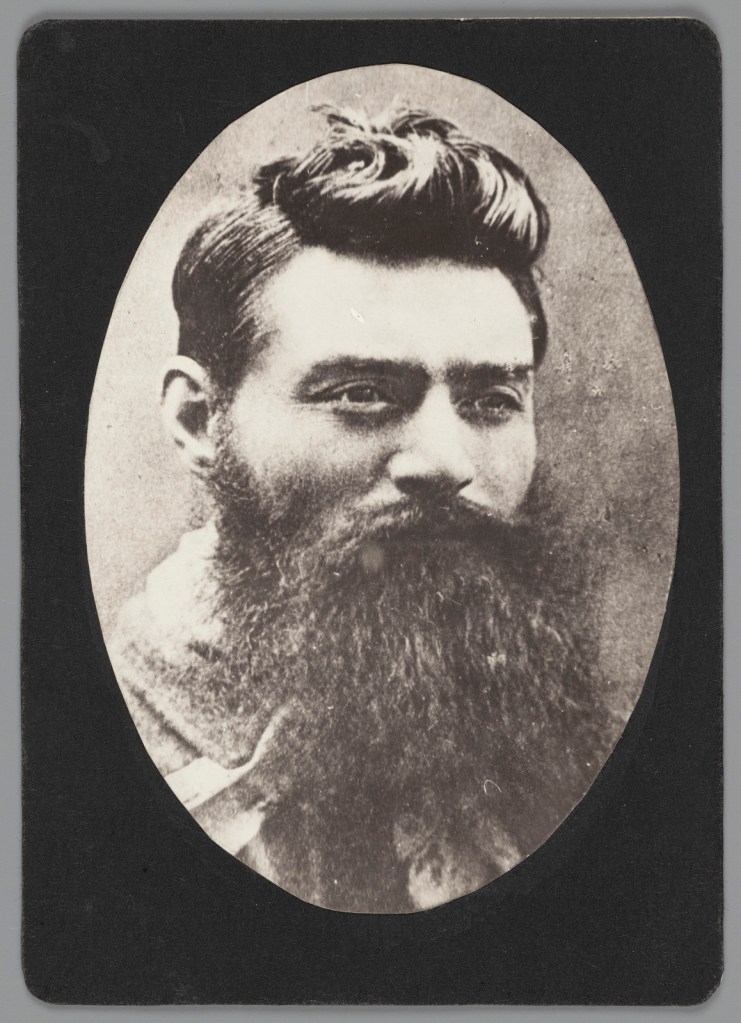
Photographed by Charles Nettleton the day before Ned Kelly’s execution.
(Credit: State Library of Victoria, H18202)
A Feature by Siobhan O’Neill.
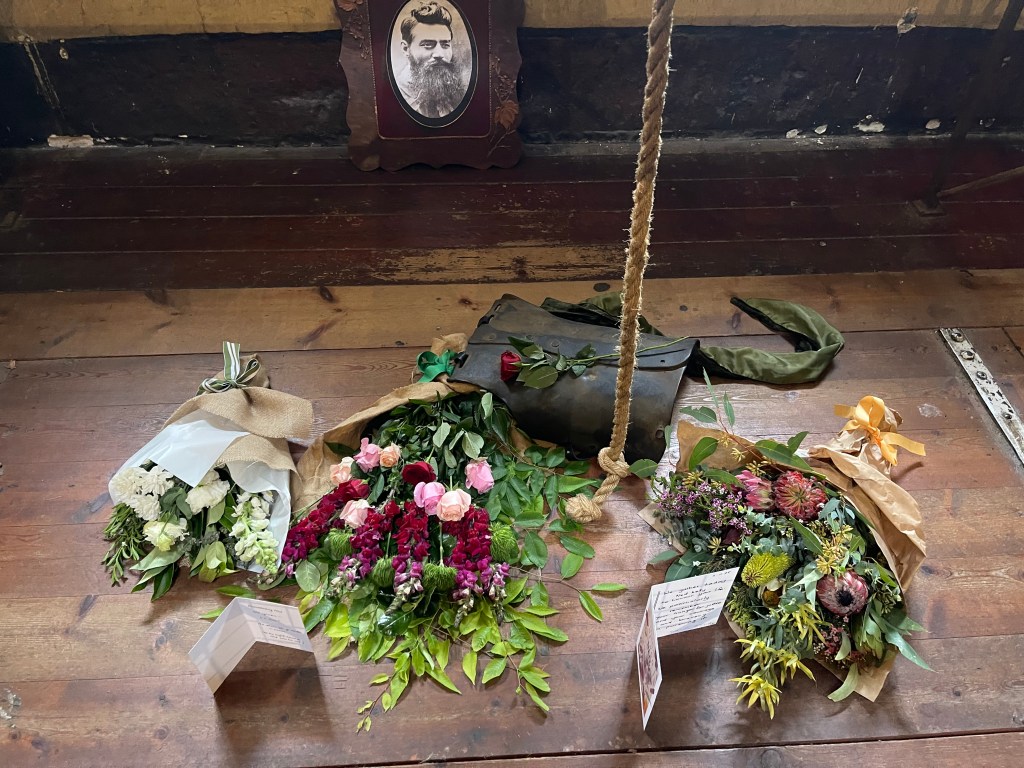
On 11 November 1880, a young man stepped calmly onto the gallows in Melbourne. Ned Kelly was 25 years old and already internationally known within his own lifetime for a bushranging career that lasted just 18 months. And today he will again be remembered by a gathering at the gallows, an annual tradition that draws family members, Kelly story enthusiasts, and the curious to the Old Melbourne Gaol.
Some 133 prisoners were executed on this spot during the jail’s long history. But the young outlaw’s death is by far the most remembered, attracting many visitors to the awarded prison-museum.
Ned Kelly’s story is of course important to the Old Melbourne Gaol, not only is it a poignant part of Melbourne/Victoria’s history, but his story essentially ended at the Old Melbourne Gaol. The legend of his story of course continues today.
Kathleen Toohey, Major Attractions Manager, Old Melbourne Gaol.
Of course, many would ask why – or even how – Ned Kelly elicits such interest, some 146 years after his death; this son of convict John Kelly from County Tipperary and Bounty Migrant Ellen Quinn of County Antrim?
Ned Kelly was a bushranger and self-admitted horse thief, whose gang robbed two banks, and engaged in a siege with police, where all members of the gang but Ned Kelly died. In the Melbourne Supreme Court, he was tried and sentenced for the death of one of three policemen killed in a tragic shootout at Stringybark Creek in 1878.
The police party had been searching for the Kelly Gang – then 23 year old Ned Kelly, his 17 year old brother Dan, and two friends 21 year old Joe Byrne and 20 year old Steve Hart. The Kelly brothers were in hiding, accused of shooting a trooper in an altercation at their home. It was a crime they denied, but one which undoubtedly caused the so-called Kelly Outbreak when it resulted in the arrest and three-year incarceration of their mother, Ellen. She was still serving that sentence in the women’s wing of the jail, when her eldest son was executed in the neighbouring block. It was reported that, although allowed to remain in her cell that day, she chose instead to work in the prison laundry; the closest point to the gallows.
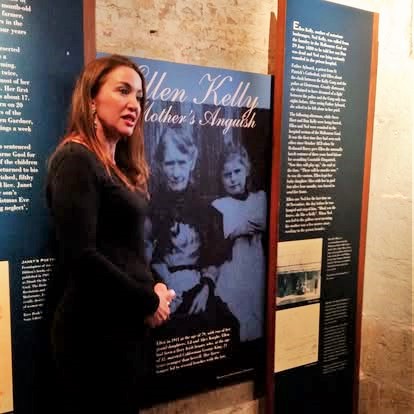
(Photo: Siobhan O’Neill, 2015)
Much has been added to the Kelly mystique over time: no shots fired in either bank robbery; the gang credited for sharing bank spoils with the poor of the region; and their gallantry towards women. Not to mention an audacious series of letters released by Ned Kelly during his outlawry, detailing their side of the story. Add personal charisma, and a Last Stand in iconic armour at Glenrowan, and it is easy to see why the story has endured. Notwithstanding, there are of course many Kelly detractors. In his own time and now, Ned Kelly was and is a polarising figure; murdering thief to his critics, downtrodden hero to his sympathisers.
It all presents the staff of the Old Melbourne Gaol with a unique and complicated legacy. Kathleen Toohey comments:
It’s certainly an interesting and in truth an unusual practice to witness. As most memorials or services like this would occur at the person’s place of burial. However it’s more interesting than anything else. Seeing how connected people are to the story and to Ned as well, even after all this time. It also creates some great conversations on the day. It can be challenging to manage our usual operations around it, but we make it work each time. Being a private, not-for-profit organisation, we do need to continue about our day as usual, so rely on mutual respect to get it done.
In full disclosure, the writer is one of the self-proclaimed ‘flower people’ who visit Old Melbourne Gaol on this day. My lifelong interest was driven by family holidays in the Kelly Country (North East Victoria), an enduring love of history and, from Irish immigrant parents, a passion for the Irish-Australian story.
Indeed, people from many walks of life and a wide range of age groups meet on the gallows. People like Judy Macleod of Melbourne. She has been fascinated by the Kelly story for over 50 years, ever since seeing the 1970 Ned Kelly movie as a teenager:
Reading about the story, I was struck by his youth, strength and bravery.
It captured her imagination, as did the idea for the armour and the potential for a Republic of North East Victoria, as unlikely as that might have been. But, despite the heady heritage of the story, at its core, it is the personal aspect that ultimately resonates most with her:
Being at Old Melbourne Gaol to remember Ned on the anniversary, and seeing others there doing the same, is both touching and satisfying.
Michaela McCarthy of Melbourne has a similar view; her interest first fuelled in childhood, as her grandfather read her stories of the Kelly Gang’s exploits. She explains:
My ancestors come from Ireland, as his did. Both families were farming poor country in roughly the same area of Victoria. He was born here. He felt as free as any other and, when he discovered injustices, he took a stand. There were good laws and bad laws, and the bad laws needed to change. He helped that to happen. The Irish understand why – this is a true Irish-Australian story.
For Kerry Kuchel, from the Grampians in Victoria’s far west, standing at the gallows on the anniversary started as a happy coincidence. Her daughter’s 10th birthday wish was to visit Melbourne and the family found themselves at the Old Melbourne Gaol on 11 November. She delighted in being able to speak with others gathered there:
I didn’t realise there would be flowers and I was fascinated and touched by the tributes. I didn’t realise how many people like us were interested in his story. But now, from afar, I always remember Ned and his family on the day.
And, again, the personal aspects of the story proved the most profound. As a mother, Kerry found herself deeply touched by the life story of another mother.
Sitting in the cell, eyes closed, imagining … I think Ellen would be wowed to see this remembrance and interest.
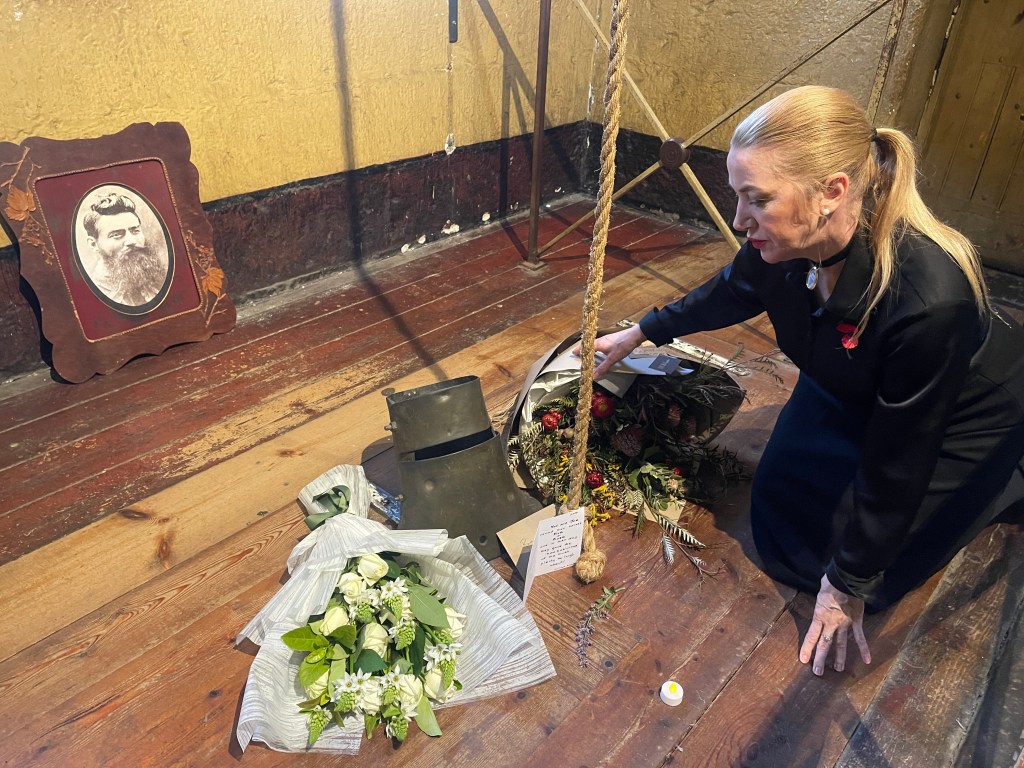
(Photo: Siobhan O’Neill, 2015)
But, of course, the personal level is the only way that Kelly family members can ever view the story. And they, like others, also now gather at the gallows to mark the anniversary:
I always found it too painful to enter the Gaol, but after we were forced into the public arena when Ned’s remains were discovered, I decided to do so (Joanne Griffiths).
Her great-grandmother was Grace Kelly, Ned’s youngest sister. It was Joanne who was entrusted by her family to help organise burial of Ned’s remains in 2013, ultimately fulfilling his last wish. And she now has the duty of formal rights as Senior Next of Kin for Edward Kelly.
On the anniversary, family members and others gather at 10am, the time of Ned Kelly’s execution. The numbers are not big but, over time, it has seamlessly folded into a solemn, unofficial gathering.
It is important for us to be able to mark this occasion, to show our respect to the man that had such an incredible impact on our lives, and the psyche of Australians. What is very touching is all the people we have met each year. It is lovely to share the experience with others who come to show their respects, some with flowers to lay them on the gallows, and always in such a loving and personal way. It makes me feel very proud, when I look at all the flowers that people have brought.
Joanne Griffiths
Encountering members of the Kelly family at the gallows and on the anniversary always prompts surprise, but visitors embrace the chance to ask questions and talk about Ned.
One young man, part of a senior boys’ school group, approached us asking lots of questions. I was so impressed with his and the whole group’s keen interest in history, and desire to learn more. It gave me hope that there are young people out there who wish to learn about our history. On another occasion, I met a young family who said they moved to Australia to escape religious persecution, and expressed a need to visit on the anniversary and pay their respects.
Joanne Griffiths
Of course the Kelly saga is a very public one, but also a private family story, and sometimes the two collide. This means having to share with the world a relative, who also happens to be one of Australia’s best known historical figures. To accept criticism from some, or be forced to defend family with others. But, ultimately, Ned’s relatives see the positives of being able to share their family story with people of all viewpoints:
I am humbly reminded that Ned not only holds an important place in our family, but in our country’s history (Joanne Griffiths).
The National Trust also acknowledges the importance of the story in Australian history. According to Kathleen Toohey:
Being such a polarising figure, the Ned Kelly story of course is an appealing one and does bring a lot of people to the Old Melbourne Gaol to find out more about the figure they have heard of or seen. The National Trust endeavours to tell the Ned Kelly story as we know it through fact, not opinion, and encourages people to make up their own mind on it.
And what might Ned Kelly make of it all? We may have an insight, from one of his last prison letters:
I do not pretend that I have lived a blameless life, or that one fault justifies another. But the public, judging a case like mine, should remember that even the darkest life may have a bright side.
After the worst has been said against a man he may, if he’s heard, tell a story in his own rough way that will lead them to soften their harshest thoughts against him and find as many excuses for him as he would plead for himself.
Let the hand of the law strike me down if it will, but I ask that my story may be heard and considered …
If my lips teach the public that men are made mad by bad treatment, and if the police are taught that they may exasperate to madness, men they persecute and ill-treat, my life will not be entirely thrown away …
Edward Kelly, 1880.
A young man of poor means who championed change for what he saw as police persecution of his class in rural areas. And, although he didn’t live to see it, four months after his death a Royal Commission was held into police conduct during the Kelly Outbreak. As a result, some 250 police – from the rank of Commissioner down – were demoted, dismissed or pensioned-off. That was almost one-quarter of the force, then numbering circa 1100. What emerged was the genesis of the now over 21,000-strong Victoria Police Force that works to protect and serve us today.
Ultimately, whatever one may think of Ned Kelly, it is clear that he carved a unique place in our own Australian story; a social statement of his time, Australia’s colonial past, and the early days of Victorian statehood. So perhaps it is little wonder that we still say ‘as game as Ned Kelly’. And, on this anniversary, some gather at the gallows.
Siobhan O’Neill
Siobhan O’Neill is a contributor to Tinteán. A writer and producer, she is on the broadcast team of the Irish Radio Program, Glór na nGael – Voice of the Irish, on 3ZZZ 92.3FM, and a long-time member of the Irish Famine Orphan Girls Commemoration Committee Melbourne.

