by Damian John Gleeson
In the half century culminating in the ill-fated 1798 Irish Rebellion, well organised secret societies that opposed the Penal Laws and the harsh treatment of Catholics and Dissenters (Presbyterians), threatened law and order, landlords, and the Catholic Church. The expedient response by the Catholic hierarchy and most clergy, who held little status in Ireland at that time, was ardent loyalty to England and condemnation of groups such as the Levellers/Whiteboys, Rightboys, Defenders, and United Irishmen. Often adopting Masonic-style terminology and tactics, including secret oaths, these societies attracted strong support from the majority Catholic population, who lived in poverty, paid tithes to the Established Church and high rents to unscrupulous landlords.
Levellers and Whiteboys
The first co-ordinated society, formed in south Tipperary in 1761, were the Levellers, so named because they levelled the ditches that landlords had erected around common land, which had previously been used as free grazing. This group, which also objected to cottiers and small farmers paying a disproportionate number of tithes, became known as Whiteboys, because they wore a white shirt over their clothes to identify one another at night. The Whiteboys — differed from earlier agrarian groups due to the importance they placed on an oath of secrecy — and had a mythical leader named Queen Sieve Oultagh. The movement quickly spread to Limerick, Waterford, Cork (‘The Cork Boys’), Kilkenny, and north Tipperary strongholds of Nenagh and Borrisoleigh.
In March 1762 Bishop John O’Brien of Clyone instructed his priests to excommunicate Whiteboys or anyone involved in illegal activities. One priest who sided with his congregation was Nicholas Sheehy, parish priest of Clogheen, County Tipperary. Sheehy opposed tithes and Catholic couples paying a marriage fee to the Church of Ireland. His actions attracted Protestant ire and he was repeatedly indicted for alleged rebellious behaviour. After being found innocent on several occasions, he was indicted on a trumped up murder charge of an informer. A solid alibi and clear evidence of witnesses being dubious, did not deter Sheehy’s fate and he was executed at Clonmel in 1766.
Despite the minority Protestant community in southern Ireland claiming a ‘popish plot’, the Whiteboys had no qualms in also attacking large Catholic landlords, such as the brother of James Butler, the Archbishop of Cashel, in 1775. The bishop’s response in organising loyal Catholics to repel the Whiteboys only served to intensify feelings of anti-clericalism. The Catholic hierarchy, ever anxious to project itself to Dublin Castle as conservative, issued many pastoral letters condemning secret societies. Apart from anti-social behaviour, the bishops were chiefly concerned by the secret oath. In October 1779, Bishop John Troy of Ossory (Kilkenny) urged clergy to read the following message of excommunication to parishioners:
The underwritten statement of excommunication is to be published with the usual ceremonies of Bell, Book and Candle at each of your respective Masses on Sunday next, the 17th instant, and you are to read it in Irish, where the ignorance of the English language amongst the generality of your parishioners may render it necessary. You are likewise to explain the nature and dreadful consequences of an Excommunication, and by every possible method endeavour to prevent your people from being exposed to so great an evil.
Such declarations, however, had little impact in discouraging membership.
Rightboys and Defenders
The Rightboys, taking their name from an imaginary Captain Right, formed in County Kerry in 1785 and successfully recruited across Catholic parishes in Munster. As part of growing anti-clericalism, their grievances included payment of high sacramental fees (baptisms, marriages) to priests. While the hierarchy promised investigation of clergy acting improperly, its primary response was to maintain control and to be seen as loyal to the British government. Bishop James Caufield of Ferns (covering most of County Wexford and Wicklow) miffed that ‘an infernal spirit of democracy prevails … the people scoff, sneer and laugh in their sleeve at the few who venture to control them’. To prevent the Rightboys continuing to meet to administer their ‘wicked oaths’, Troy closed chapels for a month in 1786 and refused them communion. Wives of Rightboys were denied the ‘churching’ ritual after giving birth.
In Ulster, where religious persecution was rife, Catholics mobilised in 1775, under the banner of Defenders, a name first used to support clergy during the 1640s disturbances. The new Defenders sought to protect families from attacks by Peep o’ Day vigilantes, a sectarian movement. By 1785 the northern counties were in major disturbance. The Defenders spread from Armagh into neighbouring Down, Monaghan, Cavan, Meath, and Louth. While membership was exclusively Catholic at first, some local variations occurred, though the oath of secrecy was consistent. The youthful Richard O’Reilly, archbishop of Armagh (later primate of Ireland), denounced Catholics who joined the Defenders and excommunicated them.
By 1790, all of Ireland was in a state of perpetual unrest. In describing Defenders as a ‘deluded Catholics’, Bishop Patrick Plunkett of Meath in 1793, said:
The means to which you have resorted for a redress of grievances, are in direct Violation of law, or peace, and of Good Order, and must of course be opposed by the entire power of the State, and by the great body of the people of every description.
Sectarian violence in Armagh and other northern counties caused the forced exodus of 7,000 Catholics to Cavan and Leitrim. After the Peep-o-Days, with English military support, defeated the Defenders, at the 1795 Battle of Diamond, they formed the Orange Order, attracting middle and upper class Protestant support.
Earlier, in 1791, Samuel Neilsen, a Belfast merchant, had started the Society of United Irishmen, a debating club seeking to bring about political reform, especially for Dissenters. Soon after a Dublin branch was formed under Wolfe Tone’s inspiration. Concerned that United Irishmen might forge links with rebellious leaders in France, the English outlawed public debate in 1793, which led the Society to become more secretive and militant.
To support its objective of a United Ireland, embracing Catholic and Presbyterian equality, the Society made a major shift and encouraged Defenders to join them. This 1795 alliance brought together two quite different philosophies: the pressing rural needs of Catholics and the loftier aspirations by Presbterians and well educated people for political change.
Australian Catholic literature has often portrayed the rebellion as confined to Wexford in 1798, but it was a nationwide rebellion that continued throughout the 1790s. Many battles occurred across Ireland, and in places like Leitrim, the rebels ‘went early’ in 1795 and were soundly defeated. In Tipperary, former Whiteboys, turned United Irishmen, did not always embrace a ‘United’ spirit when they attacked Protestant churches. Such outrages mobilised Protestant anger, increased splits within the United Irishmen, and informers, including an occasional Catholic priest, damaged the United cause.
By 1796 and 1797, the English had captured numerous affiliates of the planned rebellion, including many of the men who would later be transported to New South Wales. As the rebellion proceeded in 1798, it had clearly shifted along clear sectarian lines, especially in Wexford and Wicklow. Outrages occurred on both sides, but the milita, Orangemen, and red coats, were especially brutal in their reprisals against individuals and families unconnected to the rebellion.
In a strongly worded pastoral address in 1798, Troy, now as the Archbishop of Dublin, ‘bitterly lamented the fatal consequences of this anti-Christian conspiracy. Submission to established authority and obedience to the Law, are among the duties prescribed by Religion.’ He urged United Irishmen to ‘immediately surrender and express loyalty to the State or face the consequence as enemies of the State to a sudden death under the operation of Martial law’.
Further major battles occurred in Carlow, Kildare, Wexford and Wicklow, where despite some initial successes, the United Irishmen were routed. The scale of atrocity committed by militia and English troops, included the last major battle in September 1798 at Ballinamuck, County Longford. After the combined French and United Irishmen had surrendered, the French were allowed to withdraw, but the English slaughtered 500 unarmed United Irishmen.
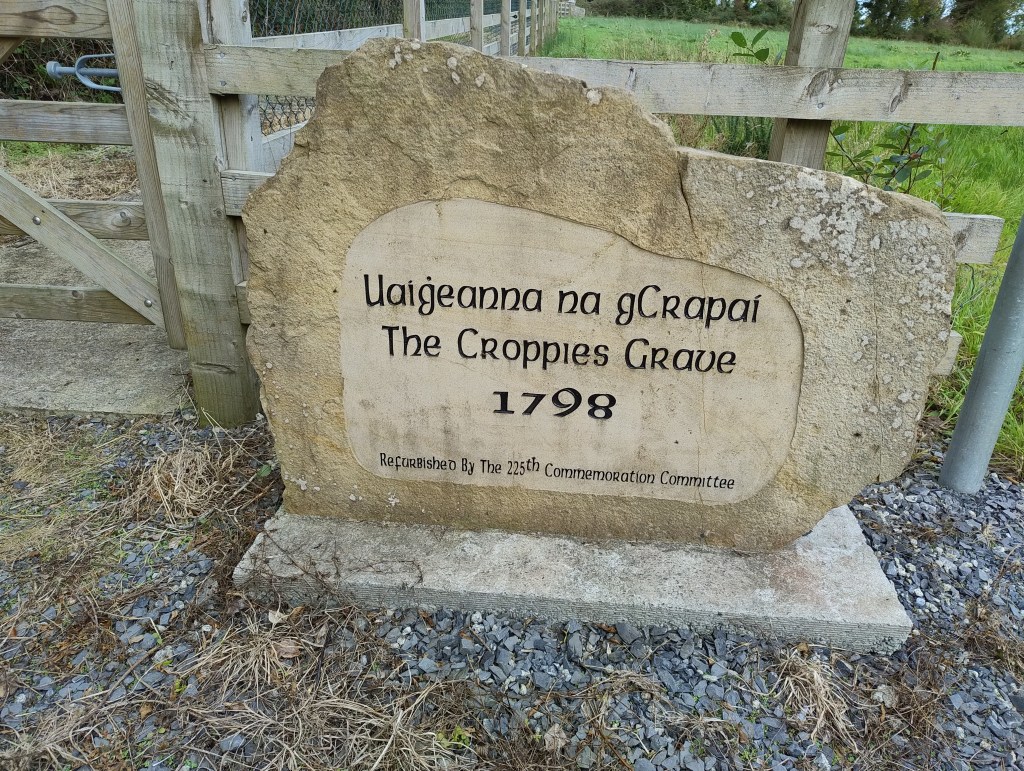
A total of 20,000 and possibly up to 30,000 people, predominantly Catholics, died during the rebellious 1790s, including a number of priests and Presbyterian clergy who had joined the rebels.
For the Irish bishops, loyalty to England had likely saved their lives, given a strong anti-clerical atmosphere. In return, the Catholic bishops had helped quell the community, which benefited Dublin Castle. Perhaps the bishops had few other options? Troy, in 1799, acquiesced to England having a veto over the appointment of Roman Catholic bishops. Men such as Butler, Caulfield and Troy came from Anglo-Norman heritage, and O’Reilly, from a wealthy family, also had a vested financial interest in the status quo being preserved. The bishops quickly learnt, however, that loyalty was not always a two way street. After the rebellion was put down, Caulfield, who had protected and shielded many Protestants in Wexford, was angered when the same people turned against him and accused the Catholic Church of inspiring the rebellion. Troy, aware that Dublin Castle was opening his mail from the Vatican, was disheartened that his attempts to secure government employment for a nephew amounted to nil.
Quickly, in literature, the events of ’98 fell along religious lines, and the leaders who inspired the rebellion – the northern Presbyterians – faded in memory. Atoned in English literature, Presbyterian rebels, especially those with business or family connections, were offered the choice of joining the army or going to the United States. Not so for those United Irishmen imprisoned for minor involvement or on the basis of spurious informers. Numerous men died in disease-ridden gaols, in the hulks in Cork or on transports to Botany Bay, including Fr William O’Meara, who had been a key United Irishmen leader in north Tipperary.
More than 500 Defenders and/or United Irishmen, often without trial, were banished to New South Wales between 1800 and 1806. Many did well in business and farming in the colony, and very few returned to Ireland, even if the opportunity arose. William Davis, James Dempsey, Michael Dwyer, Michael Hayes, and Edmond McRedmond, have been exalted in Australian Catholic literature, despite earlier condemnation by the Irish Catholic Church. This contrast in memory between Australia and Ireland has received little coverage in the literature and may be addressed in a future article.
Damien John Gleeson is an Australian Religious History Fellow at the State Library of New South Wales
Primary sources
Dublin Diocesan Archives: Archbishop John Troy Collection.
National Archives of Ireland: State Prisoners Petitions and Cases; Rebellion Papers.
Select published works
Thomas Barlett, Ireland: A History, Cambridge, 2010.
Liam Cox, ‘Westmeath in the 1798 period’, Irish Sword, Vol. IX, 1969.
James S. Donnelly Jr. ‘The Whiteboy Movement 1761-5’, Irish Historical Studies Vol. XX1, No 81. March 1978.
Damian John Gleeson, ‘Wealth without Happiness: William Davis and Catherine Miles’, Australasian Catholic Record, Vol. 99, No, 1 January 2022, Vol. 99, No. 2, April 2022.
Liam Kelly, ‘Convicts from Leitrim and Cavan transported to Botany Bay: 1791–1800, Breifne, Vol.
IX, No. 37, 2001.
Ruan O’Donnell, ‘Desperate and diabolical’, Defenders and United Irishmen in early N.S.W’, Irish- Australian Studies, 1996.
Trevor Parkhill, ‘The Wild Geese of 1798: the Emigrees of the Rebellion’, Journal of the Armagh Diocesan Historical Society, Vol. 19, No 2, 2003.
Captain H.B. C. Pollard, The Secret Societies of Ireland, London, 1922.
Maureen Wall, ‘The Whiteboys’ in T. Desmond Williams (ed) Secret Societies in Ireland,Dublin, 1973.
H.B. F. Wheeler and A.M. Broadley, The War in Wexford, London, 1910.
Kevin Whelan, The Tree of Liberty: Radicalism, Catholicism and the Construction of Irish Identity, Cork, 1996.
Anne Maree Whittaker, ‘Swords to Ploughshares? The 1798 Irish Rebels in New South Wales’, Labour History, Vol. 75, 1998.

