A report on the Democracy Awards Dinner 2026 at Batman’s Hill on Collins by Frances Devlin-Glass.
The Eureka Democracy Award Dinner at Batman’s Hill on Collins on 24 October featured a relaxed, expansive and recently (semi) retired Antony Green, arguably Australia’s most loved and respected senior psephologist. He himself admitted that he got the job at the ABC because of his programming ability, a skill not shared by most journalists. He was the recipient of the annual Eureka Democracy Award in 2026.
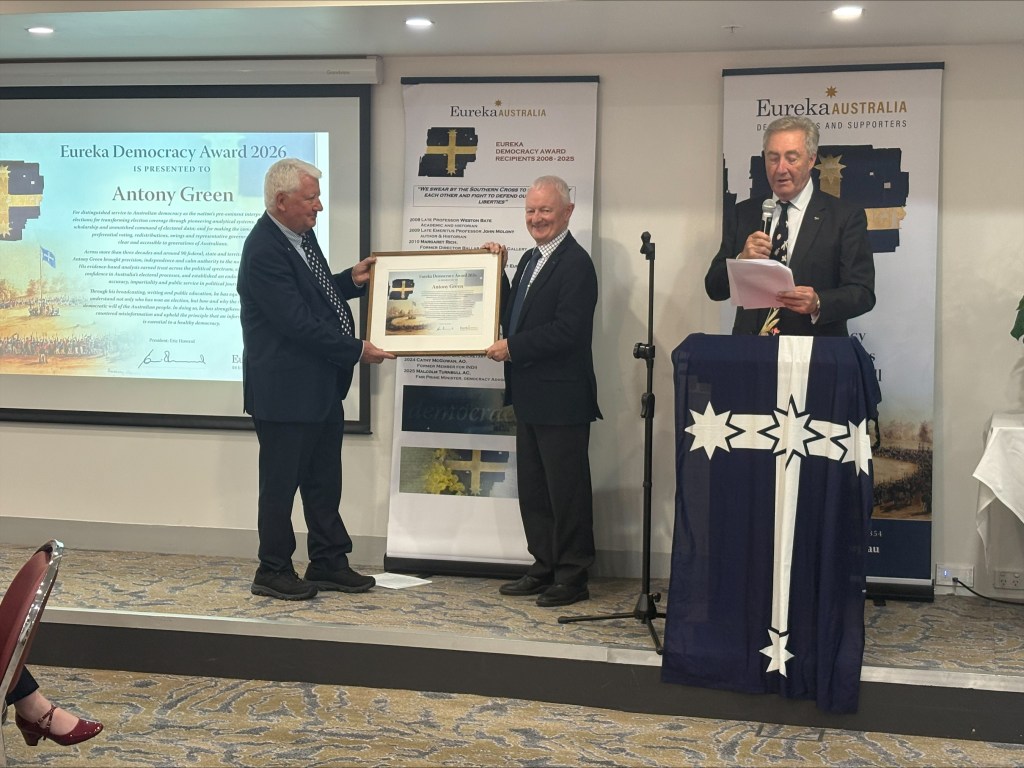
He started in jocular vein by asserting that as a New South Wales schoolboy, he’d missed out on the story of Eureka. However, he made a strong case for its significance in building one of the oldest and most stable democracies in the world. He saw the collapse of the Chartist movement in the UK as an enormous fillip for Australia, as the transported felons and their demands for the suffrage were strongly represented, alongside the Irish, at Eureka. The colonies were less restrictive in allowing people to vote than expected. The miners’ grievances on the Ballarat gold fields resulted in the right to vote, and suffrage without requiring a property qualification was permitted in Australia to all male British subjects between 1856 and the end of the nineteenth century in many states (cf 1920 in the UK). Secret ballot occurred in the 1850s, compared with 1870s in the UK; and the young men of the volunteer army had the right to vote. Female suffrage was gradual from 1894, and achieved state by state, but secured much earlier in Australia and creating pressure worldwide. Women in Australia were voting in long before their counterparts in the UK, and much earlier than the UK’s ‘Flapper’ election of 1929.
Post-Federation, in 1924, it became compulsory to vote in Australia, and this privilege was enforced with fines (the amount often exaggerated in people’s minds). Voters, however preferred to go to the ballot box rather than pay a fine. Between 1859 and 1880, three gold-field electorates were created, requiring only a gold licence to vote in those electorates. Electoral protocols were not published and this led to Hustings entertainments, sometimes featuring inebriates.
Antony Green spoke glowingly of the quality of the data produced by the Australian Electoral Commission (AEC), and suggested that it was gold-standard in the global context because of its strict donation laws; its refusal of using Government funds for party purposes; its checks and balances against gerrymandering; and its fine record in not losing voting papers. When, in the last election, 26 votes went missing from the Bradfield electorate, there was no doubt about the vote, and full video evidence meant that the matter did not need to end up in court (it had been selectively edited by complainants). Green believed there was no loss of confidence in the broader system. The system in Australia requires proof and evidence, rather than what happens in the US when officials must prove a negative.
He noted that the task was incrementally more difficult for the AEC because an increasing population makes it almost impossible to print the required number of ballot papers in the three-week window of opportunity after the announcement of a general election; it is also increasingly hard to staff (in some countries, it is treated like jury-duty and citizens routinely get involved on a volunteer basis). He also expressed concern that the counting of pre-poll votes takes longer and longer, with staff foregoing breaks and food to meet the demands. Furthermore, pre-polling takes candidates into polling places rather than engaging in more pressing electoral matters.
His comments on the Australian system of preferential voting were challenging: he believed it had been introduced for partisan rather than principled reasons and to bolster the two-party system.
Green’s address was lively, full of matter and encouraging statements about the state of Australian democracy. However, he noted, as many contemporary commentators do, that he was concerned by the coarsening of political debate, and the indulgence in vitriol, since the Gillard era, sometimes conducted under the false colours of free speech. He cited John Stuart Mill’s injunction that one has free speech provided it doesn’t impinge on others’ rights.
As well as the Irish Embassy’s new Consul-General for Melbourne, Marie-Claire Hughes, another guest of the organisers was the Italian Ambassador, His Excellency Sr Nicola Lener, who reported on the finding of an Eureka rebel’s grave in Rome: four Eureka rebels died overseas. Attempts continue to locate the resting places of the other three.

