by Trevor Prasad
The Odyssey emblazoned across the imposing IMAX cinema in Darling Harbour, Sydney. Time did not permit savouring Christopher Nolan’s modern interpretation of Homer’s 2,700-year-old-poem. Nonetheless, it appears I was about to be captivated by Greek mythology.
By chance, on my return flight to Melbourne, I struck up a conversation with the founder of Bloomsday in Melbourne. I soon was reminded of the significance of a single-day in Dublin, 16 June 1904 and the literary brilliance of James Joyce’s Ulysses. Unfortunately, a Gorgonzola sandwich to be washed down with a Burgundy was not to hand on our flight; however, I have now been delightfully drawn into Joyce’s 1922 Ulysses. Joyce’s novel was a masterful twist on Homer’s writings and is noted as being one of the most important literary pieces of the 20th Century.
<>
As our plane prepared for landing, our conversation continued. With references to the Celtic Club (Melbourne) we quickly joined the dots on Irish/Australian history and the recent naming of the Alice Anderson room at the premises of the Celtic Club at The Wild Geese hotel in Brunswick, Melbourne.
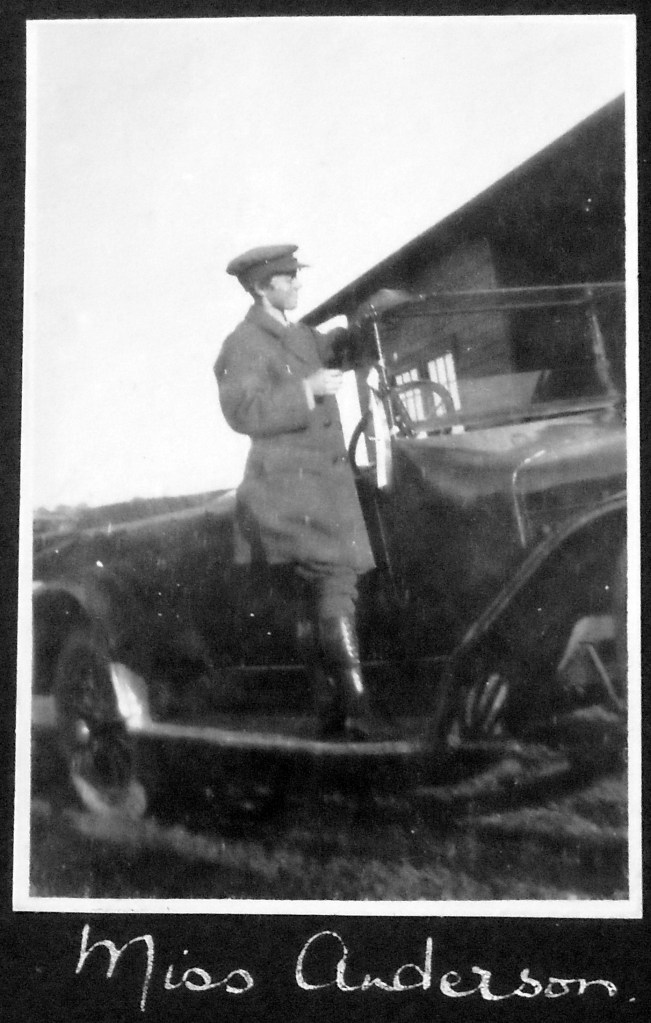
Alice Anderson was born on 8 June 1897 of Irish Protestant parents Joshua Thomas Noble Anderson (JT) and Ellen Mary Anderson (née White-Spunner). I’d like to share with you the significance of this Irish descendent and hence the naming of the room at the Celtic Club Melbourne (in her honour) and how I personally got to know about this extraordinary woman.
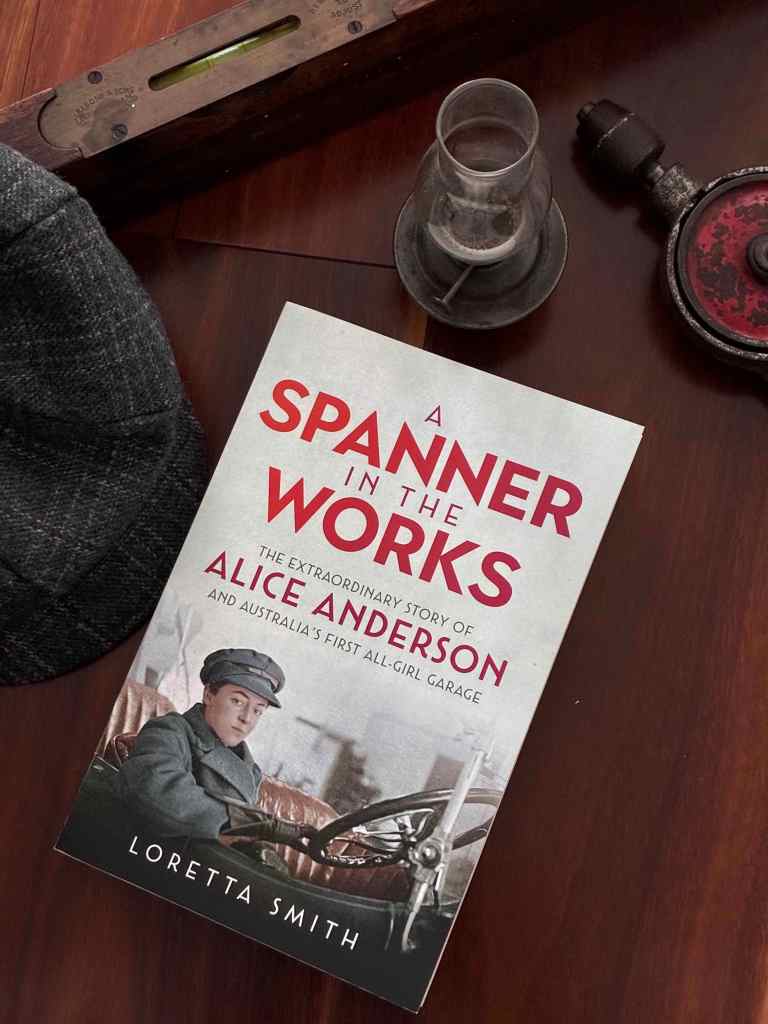
As a car club member in my home state of Victoria, in a conversation with club members on 100-years-of-motoring, references were made to some early Australian automotive pioneers. One such pioneer was the extraordinary Alice Anderson and her establishment of Australia’s first all-girl garage (in Cotham Road Kew, Melbourne), as told by Australian historian Loretta Smith in her book titled A Spanner in the Works (Hachette Australia, 2019).

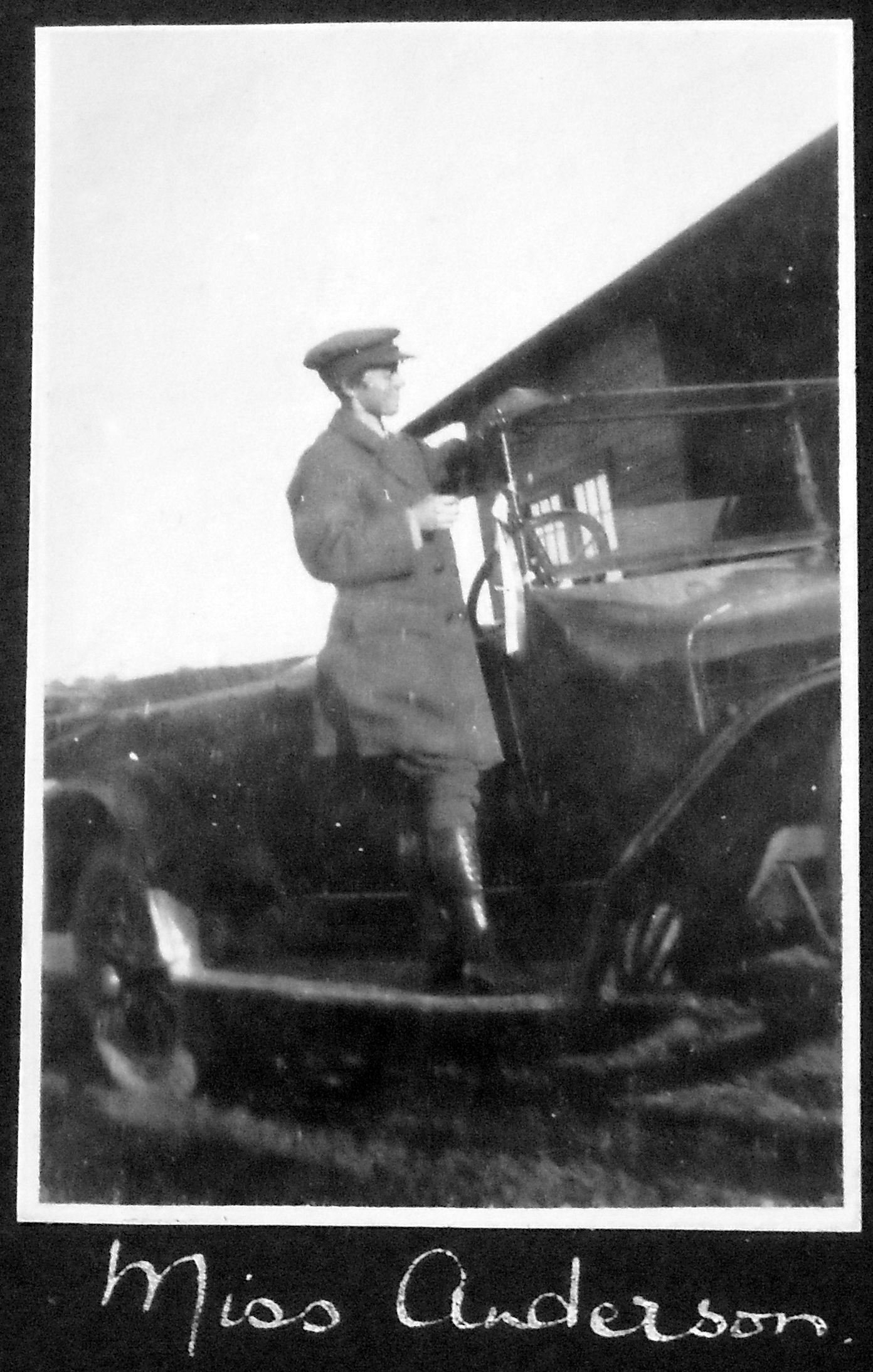
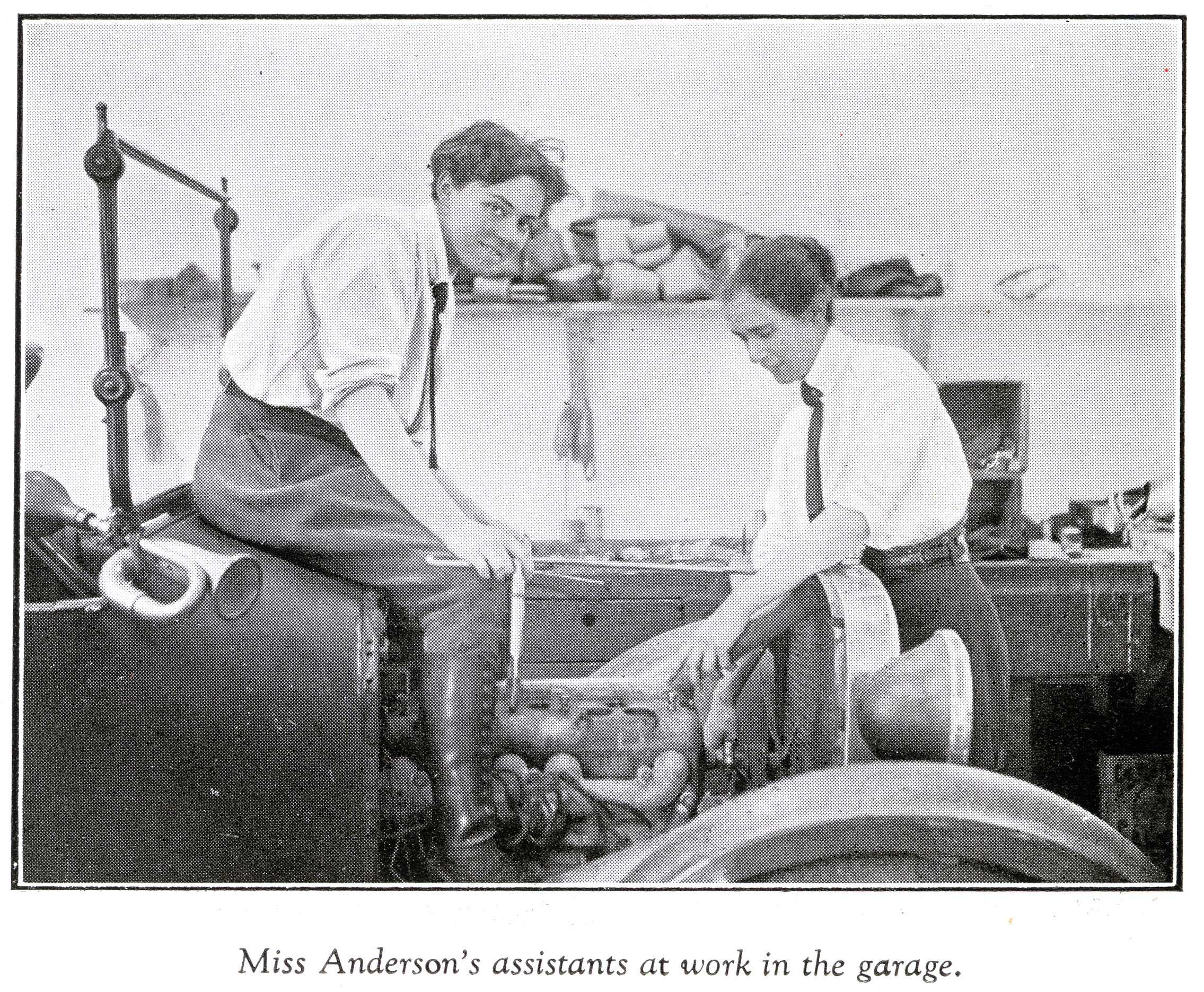
Beyond public archives, Smith was able to track down relatives of some of the garage girls and relatives of Alice. The result is an extensively researched book that provides an index and appendices including interviews with relatives, personal letters, and Smith has been very careful to present facts rather than indulge in personal interpretations.
What I enjoyed most about Smith’s writing is the manner in which she weaves in the historical context and provides insight into societal attitudes of the day, conservative Melbourne, middle-class Melbourne and its customs, world events, and the relentless struggles of a woman being seen by men as a ‘…woman muscling in on a profession they saw as their own’ (p. 136). This contrasts with British women on the frontline in WWI who were lauded for their contributions, driving motorcars, buses, ambulances and munitions trucks. Alice on the other hand and her contemporaries in Australia had to deal with the ever-present innuendo, scandals and prejudice, as woman drivers and mechanics. The women of the Red Cross Volunteer Motor Corps were at the same time lining up at Princess Pier in Melbourne to transport the returning wounded serviceman.
There are also wonderful tales of Alice’s upbringing in the remote farming town of Narbethong, and the physical isolation and hardship. Alice in 1916, became the first woman driver to traverse the treacherous Black Spur to provide the mail service between Healesville and Marysville. At 19 years of age, Alice had learnt to be totally self-reliant in the event of mechanical breakdown. On one occasion, Alice had to drive one-handed, the other holding a torch when the car lights failed.
A Centenary
Loretta Smith’s book cover proclaims:
‘Alice was also an adventurer, and her most famous road trip saw her make the 1500-mile-plus journey from Melbourne to Alice Springs in a Baby Austin – but then her inspirational life was violently cut short, leaving only mystery and memories behind’.
September 17 this year marks the 100th anniversary of the tragic loss of Alice Anderson at just 29 years of age. She had accomplished so much as a true pioneer in our Australian motoring history.
The 1920s was also an exciting period for aviation. By chance, Alice on her return trip from Alice Springs got to meet the British aviator pioneer Alan Cobham who touched down for refuelling at Oodnadatta, on 31 August 1926, in his de Havilland DH50 seaplane. Smith notes that ‘WW1 had given aviation technology the impetus required to develop effective fighter planes and now the race was on to conquer the challenge of distance’ (pp. 271-275). Cobham was attempting a world record for the longest flight, London to Melbourne and return.
Her Irish Ancestry
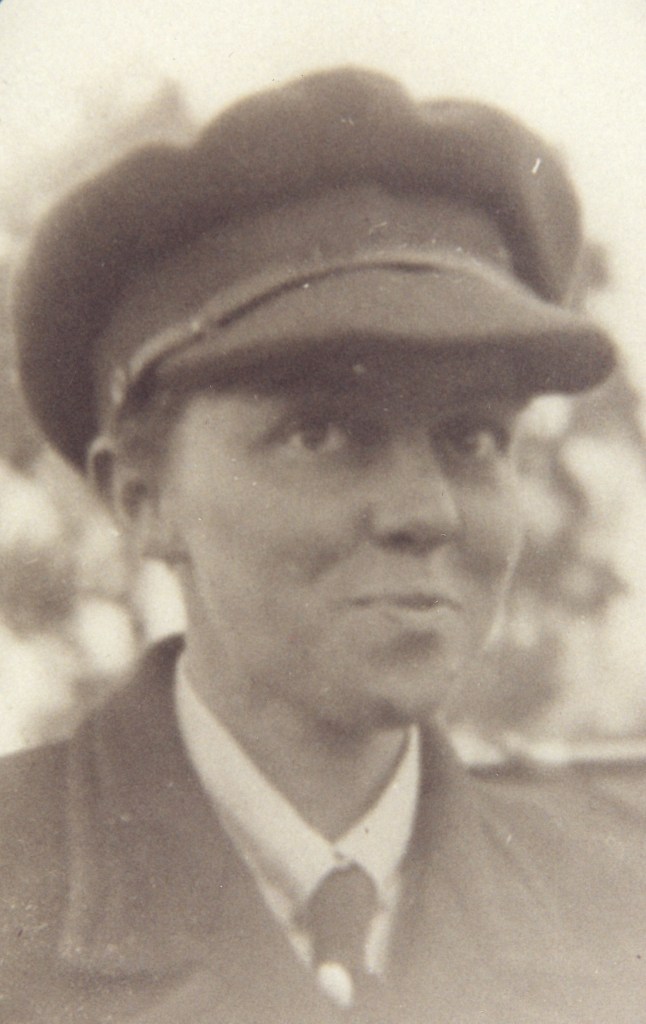
To truly understand Alice, the influences that informed the aspiring entrepreneur, inventor, adventurer and pioneer, is to learn more of her Irish parentage and ancestry. The close bond she had with her father JT, throughout her childhood and adolescence.
JT and Ellen Mary were born to Protestant families in Ireland where upper-middle-class values rubbed shoulders with financial uncertainty. Born in 1865 and 1864 respectively, both had strict clergyman fathers. JT’s father, Reverend Samuel Anderson, Vicar of Upper Fals, refused to accept the disestablishment of the Church of England in Ireland in 1869 and as a result continued working in his parish on the small stipend of a curate. Nevertheless, Reverend Anderson ensured all seven children, boys and girls, received a good academic education (p. 7).
‘Blessed with a fierce intellect and a questioning mind’, Joshua (JT) was educated at the Royal Belfast Academical Institution and Queen’s College Belfast, finally graduating at the Royal University of Dublin. ‘JT’s eldest sister (after whom he named his own daughter), was equally intelligent, if not more so. She was the first woman to study and graduate from Belfast University’ (p. 8).
JT, inspired by his brother Jack, emigrated to Australia in 1883 and was ‘struck by its natural beauty and economic prospects’, particularly for a newly qualified engineer. Having established a private engineering practice in Melbourne (1889), he also secured a part-time position as a lecturer in mechanical engineering at the University of Melbourne. It was at this university that he met John Monash. Many a Melburnian will know of Sir John Monash (1865-1931) as a renowned Australian civil engineer, a military commander, and public administrator.
In 1894, JT & Monash established the firm Monash & Anderson with an office at 49 Elizabeth Street, Melbourne. Providing consulting and engineering services to the state of Victoria. Anderson was an ideas man, the enthusiastic one who charmed people into signing on the dotted line, while Monash held everything together – especially once it dawned on him that Anderson had no head for business. Of note, JT gambled on the idea that reinforced concrete would transform construction methods. In 1899, the Anderson Street Bridge (now known as Morel Bridge), which crossed the Yarra adjacent to the Royal Botanic Gardens: the first reinforced concrete bridge in Victoria and the largest attempted in Australia. It caused quite a stir within the engineering profession as others questioned whether three slender arches spanning ninety-five feet would bear the weight (p.11).
The firm Monash & Anderson was short-lived through a set of unfortunate circumstances.
JT in April 1902 was appointed engineer in chief to the drainage board in Dunedin, New Zealand. In accepting the position. JT had agreed to the mammoth task of designing and developing Dunedin’s sewerage system.
The Anderson family settled in their new home, ‘The Mont’ in St Clair, ‘little Alice floating, as all the family did, on JT’s unwavering optimism and supreme self-confidence’ (p.15). For Alice and her siblings, it was a ‘fairytale place’, complete with swimming pool.
A tragedy in April 1906 at the Dunedin Sewerage works (close to completion) prompted JT to resign from the Drainage Board, proclaiming ‘the colonies were no place to bring up children’ and made plans to return to Ireland. ‘On 5 July 1906, under the cloak of grief nine-year-old Alice and her family departed Lyttleton’ for her parents home country of Ireland.
Upon arrival, JT’s old firm had invited him to return to Belfast, but on doing so he fought with them, immediately ending his re-employment prospects. ‘JT had assumed steady work would eventually come his way, that he was at an employment advantage, having literally paved the way for colonial progress in bridges and sewerage’, but nothing could have been further from the truth. JT’s contracts had dried up and he was no longer in favour for prominent engineering positions’ (pp.39-40).
To what extent scepticism played a role in JT’s inability to re-assimilate is unclear, however his bullish personality and unswerving opinion most-likely compounded matters.
By September 1907, (a little over 12 months), JT conceded that his plans to stay in Ireland and create a new life for his family was futile: ‘We are going back to Australia.‘
Going Back to Australia
You will recall my earlier reference to Narbethong (north of Healesville in Victoria). With no-longer the financial means to return to their former middle-class existence in Malvern, the family had to make do with settling into their very basic slab-hut summer cottage in Narbethong, a remote rural community that comprised just a stable, a pub and the post office. This is where life for Alice in particular becomes a journey of survival, resilience, and resourcefulness. With her father away most of the time in efforts to secure an adequate income, Alice’s brother now in England, and her mother virtually an invalid unable to walk short distances, Alice thrived in taking care of the family: chopping wood, repairing fences and all manner of things, including home-schooling her younger siblings.
As you get the opportunity to read A Spanner in the Works, I’ll leave you to discover the detail and sequence of events that led Alice to become a pioneer in establishing Australia’s first all-girl garage. But I will share this interesting aspect in relation to feminism and in the context of the times she lived by replaying the words of the author, Loretta Smith:
‘Alice did not speak of her business as a feminist enterprise. It would be easy to conclude that she saw herself as a feminist championing women’s rights but what did this actually mean in 1918 and the years immediately following the war?’
The war saw active feminists rallying against conscription, opposing capitalism and generally pushing for better conditions and protection for women and children in the form of a maternalist national state. Given Alice’s strong patriotic stance and her attempt to create a successful enterprise, she might not have identified with this particular brand of feminism. However, Alice did fit into a public feminist ideal prevalent at the time that came from women who ‘were concerned with individual achievement in areas not traditionally female.
Claire (Alice’s sister) insisted Alice ‘wasn’t part of a movement or anything else, she just got on with the job and showed her capacity by doing it’.
Feminist motoring historian, Georgine Clarsen, has written that Alice was part of a generation of ‘radical individualism’ whereby one’s individual accomplishments were emphasised over the idea of gender differences.
Clarsen sees any idea of the garage being a feminist enterprise as ‘an implied, non-collective kind of feminism that did not seek claim to that name’ (pp.144-5).
Is it serendipity as I complete this article and arrange a meeting at the Celtic Club that I notice the significance of the date. As I glance at my calendar entry of 6 August 2026, it occurs to me that this was in fact the day 100-years-ago that Alice set forth on her most adventurous and courageous tour ‘to the never-never’ – Melbourne to Alice Springs in a tiny, heavily laden Austin 7.
It is worth noting that Alice chose to depart Melbourne in the front of the Lyceum Club on the corner of Queen and Collins Street. Modelled after the first Lyceum Club in London, 1904, the club in Melbourne had been established in 1912. The purpose was to give professional and university-educated women a forum in which to network. Alice had been given a ‘2B’ membership, denoting women without academic qualifications ‘who have otherwise rendered distinguished public service’ (p. xi). It was recorded that someone had asked Alice for her qualifications and she responded, ‘Oh I got through as the pioneer of women in the motoring industry’ (p. x).
Alice posthumously, continues to be a trailblazer with the successful fundraising campaign (supported by council) to have her image rendered in a bronze statue in Boroondara Shire Council. The exact location has not quite been confirmed, but be rest assured, in Cotham Road, Kew very soon, you will not only discover her statue, but quite remarkably, the original Art Deco garage designed and built by Alice Anderson in 1919, once thought to have been demolished, has been recently located, hiding in plain sight.
Creative writing has become a passion for Trevor in retirement, and he is the author of Balance in Motion: Living in Natural Harmony with Parkinson’s. For Trevor Prasad, the subliminal effects of growing up in a medical family didn’t quite prepare him for the diagnosis he received in 2018. With sheer determination, Trevor continues to lead an adventurous life and follow his passions. He can often be seen at Melbourne jazz clubs. He plays pickle ball twice a week, and is an active member of an Italian car club.

