A Feature/Review by Steve Carey
Steve Carey considers Christopher Nolan’s new film version of Homer’s epic, and wonders about the fool’s errand that is the search for authenticity.
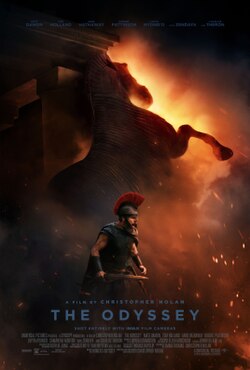
Christopher Nolan’s new film adaptation of The Odyssey cost US$250m to make, lasts nearly three hours and was shot entirely in IMAX, a format that can only be experienced fully on fewer than 2,000 screens worldwide. It made its money back on the first weekend and has opened the strongest of any of his films, even before it hit the vast Chinese market, where 800 of those IMAX screens are located. Homer’s classic is certainly having a moment, which comes as a delicious riposte to all the keyboard warriors, led by Elon Musk, who predicted a dismal flop – ‘Go woke, go broke!’ they bleated. Some woke, some broke.
Their complaint, insofar as it was coherent at all, seemed to be against casting a black actress, Lupita Nyong’o, as Helen of Troy and a transgender actor, Elliot Page, in the role of Sinon, who isn’t in The Odyssey. People who ten minutes ago couldn’t have told you anything about The Odyssey were very protective all of a sudden of its supposed “authenticity,” such complaints revealing a profound ignorance of the poem itself, as well as its rough appropriations over the centuries by all kinds of translators and interpreters: Irish classicist WB Stanford’s The Ulysses Theme reveals just how the shifty Odysseus has shifted over three millennia.
Which Odyssey? Chapman’s seventeenth century translation, that so astonished Keats? Samuel Butler’s, who imagined that the poem was the work of a woman (for no man would ever get so much wrong, he argued)? EV Rieu’s multimillion prosaic prose retelling? Lattimore’s or Mendelsohn’s precise echoing? Fagles’ free verse or Emily Wilson’s iambic pentameter? Traduire, c’est trahir – or, rather, let us not pretend that any translation can be transparent or without values. Musk is promising us an ‘historically accurate’ movie adaptation before the year is out: breathholding not advised.
The poem itself toys with the shallow concept of authenticity, with Odysseus’s adventures largely told in flashback by a self-serving man who couldn’t lie straight in bed. Even when he meets his decrepit, senile father he invents another new set of autobiographical porkies, as if he’s addicted to it. You can tell he’s lying, because his lips are moving. This is a story about storytelling, about the impossibility of sticking a pin in the facts as if somehow they could be teased apart from the story itself.
James Joyce was first attracted to the poem as a boy by Charles Lamb’s Romantic morality tale version. As an adult he found Odysseus to be not so much polytropos (a twisty turny man) as the “most complete all-round character in all of literature.” He told his friend Frank Budgen (whose book James Joyce and the Making of Ulysses remains as good an introduction to the novel as any) that Odysseus surpassed Faust or Jesus, both of whom lacked a domestic or sexual identity, whereas Homer’s hero was son, father, husband, friend.
This allroundedness was just what Joyce needed for the protagonist of his epic of a day in Dublin in 1904. Stephen Dedalus, his protagonist from Portrait of the Artist As A Young Man, wouldn’t do: he had a shape, said Joyce, that couldn’t be changed. Instead he needed Leopold Bloom, who notices things most of us don’t: do fish get seasick, he wonders. (Turns out they do.) Why do priests use Latin? ‘Murmuring all the time. Latin. Good idea the Latin. Stupefies them first.’ Perhaps Musk has been soaking up the Latin: that would explain the stupefaction.
Odysseus is an outsider, the last hero from Troy to make it home, and all alone – to lose one companion may be regarded as a misfortune; to lose six hundred looks like carelessness – arriving at a place where the suitors have taken over and his son doesn’t know his own father. Bloom’s corollary is his Jewishness, but like Odysseus’s identity no simple matter: he’s not circumcised, has been baptised twice as a Catholic and once as a protestant and lacks the requisite Jewish mother. Bloom, as Jonathan Miller put it about himself, is not a Jew, but he’s Jew… ish. Like Proteus, Odysseus and Bloom prove elusive and hard to pin down. For Joyce that means he has a reliably unreliable point of view, someone who can see things but not take them for granted.
Odysseus is striving to get home, starving and crying along the way: he may be the most corporeal hero in classical literature. An eating poem, Henry Fielding called it. But he’s also wily, too: the Trojan horse is his idea – beware of gifts bearing Greeks.
Nolan’s film cuts corners and finds in Odysseus a victim of Post Traumatic Stress Disorder. Is this ‘authentic’? The question is ridiculous. The poem itself is a mish-mash of styles and vocabulary, the result of perhaps four centuries of existence as an oral artifact, told and retold thousands of times as a greatest hits package for entertainment-hungry audiences by bards literally singing for their supper. Lose the audience and you don’t eat – it’s every bit as authentic as Hollywood itself, which is to say not at all and none the worse for it.
Joyce invites us to reflect on what he’s doing: you don’t call a book Ulysses unless you’re making a point. And it’s the Latinised version, note, not just the Greek: Joyce’s story is reflected through a Latin kaleidoscope. Early readers assumed Joyce’s point was a “How are the mighty fallen” motif – once we had gods and heroes, now we have an insignificant middle-class nobody. But that’s to overlook what Joyce’s biographer Richard Ellmann calls “the heroic in the everyday, the everyday in the heroic.” Odysseus too was himself a ‘Nobody,’ as in his trick on the Cyclops: ‘Nobody hurt me!’ the wounded shepherd howls, and his fellow monocular monstrosities shrug and go back to bed. Bloom gets into trouble with The Citizen, a terrifying Irish nationalist who sees what he wants to see, a Jew (he’s not) who wins big on the horses (he didn’t) and refuses to spend his winnings (there were none) on getting his round (Bloom doesn’t join in and doesn’t take anyone else’s hospitality). In other words, Bloom is what others perceive him to be – as Jean Paul Sartre argues in Réflexions sur la question juive (1946), the Jew is defined by what the anti-Semite sees. So too Odysseus, whom the suitors see as a dirty beggar because that’s what they expect to see. And so too The Odyssey, which continues to fascinate us as it did Joyce, because its multi-faceted layers reflect us back to ourselves. Odysseus, c’est moi. Leopold Bloom, c’est moi.
As The Big Lebowski, another great film about identity and tricksiness, puts it: ‘the dude abides’. The dude Odysseus abides; The Odyssey itself abides. No epic poems were harmed in the making of Nolan’s movie, and if it’s not to your taste you can always go back to whichever translation you imagine is most ‘authentic.’
Steve Carey is Treasurer of Bloomsday in Melbourne and President of Kingston Writers Centre
 Tinteán