A Book Review by Seamus Bradley
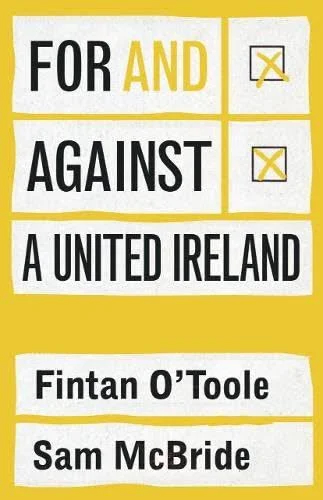
Fintan O’Toole and Sam McBride: For and Against a United Ireland, Royal Irish Academy, 2026
RRP: $A71.99 (from Readings online); paperback, A$ 55.65 and eBook $30 (Booktopia).
ISBN: 978-1802050356
In the pre-Brexit years Ireland seemed to be drifting towards a sort of soft unity within the European Union. The border was invisible, the guns had fallen silent, the sectarian murders had mostly stopped and the majority of British soldiers had returned home.
Cross-border co-operation made many lives easier: a patient in Letterkenny (in the Republic) could be treated in nearby Derry (in the UK) and vice versa, Tourism Ireland marketed the whole island to the world.
Communities that had been cut in two by partition from 1921 were gradually knitting back together. The border roadblocks disappeared, old roads and disused bridges were repaired and reopened. It no longer took a 10-kilometre drive and a harrowing border-post ordeal to visit a neighbour who lived just hundreds of metres away.
Supermarkets replaced watch towers. Watchfulness receded but had yet to disappear. The wound is instant, healing is slow. But the international border had become as permeable for a person as it was for a fox or a crow.
Then, in 2016, came the shock of Brexit. England and Wales voted to leave the European Union and ripped Scotland and Northern Ireland out of the EU against their will.
Overnight the Irish unity debate was revived. As positions quickly hardened, there were fears of a return to violence and rumblings of a border poll, where the constitutional future of the island could be decided (like Brexit) by the slimmest of slim and ill-informed margins.
Brexit threatened much of the increasingly comfortable intra-Ireland relationship. A return of the hard land border between the EU and the UK threatened again to rip apart communities, damage lucrative North-South trade, and harm the still somewhat fragile peace process.
Enter O’Toole and McBride’s book project. For and Against a United Ireland was commissioned by the non-partisan ARINS (Analysing and Researching Ireland, North and South), which was established in 2020. It is a partnership between the Dublin-based Royal Irish Academy and the Indiana-based University of Notre Dame.
The result is a volume that argues against itself.
Both authors – respected, well-known and award-winning journalists and columnists – argue the case for a united Ireland, and also against it.
The idea was not to pit one journalist against another, that would be too easy and too clichéd. Instead, Dublin’s O’Toole (from a southern nationalist tradition) and Belfast’s McBride (from a northern unionist tradition) get to argue convincingly with themselves.
First, O’Toole argues against unity, an odd position for someone born in a Republic where a night out can end with catchy old ballads about freedom and the evils of colonial oppression.
‘There is nothing natural about nations’, is O’Toole’s opening. Plenty of islands contain more than one national jurisdiction. Polls show that southerners aren’t prepared to pay a single extra euro in taxation for unity. Southerners are also unwilling to change the anthem or any of the national symbols, no matter how tacky or tasteless. Then there is everything that is different or incompatible between the two jurisdictions: the currencies, policing, education, health, social welfare, taxation, kilometres v miles and so on.
Next McBride, likewise challenged to argue against his cultural background, makes the case for unity. ‘Some of those once violently hostile to Irish unity are now returning to their ancestral understanding of the island’s essential unity’, he writes. McBride reaches back across centuries to the Protestant United Irishmen, calling on a turbulent past to paint a picture of hope for the future, where no tradition has supremacy over another.
Then it is O’Toole’s turn to argue against himself, finding meaning where others might find bafflement.
One of the many ironies of Brexit is that it led to a rapid increase in the willingness of people in the North to hold Irish passports. Much of the increase can be understood as a pragmatic response to Brexit – it is more convenient for travellers to the continent to hold EU passports. But pragmatism is itself highly meaningful. It points to an underlying flexibility about national affiliation. People make choices about identity based on history and culture – but also on the real circumstances of their lives.
But what about all those cross-border incompatibilities? Take policing. It is impossible to envisage a lumbering country cop from the west of Ireland successfully quelling a riot in the mean streets of Belfast with an easy going ‘ah now lads’. The southern force is unarmed so must be disarming; in the north the police are well-armed, well armoured and occasionally under siege.
The education systems are incompatible, certainly. But it turns out that both jurisdictions don’t have a single system. In the Republic, the Catholic education system is incompatible with the state system which is incompatible with the private system. Health is similar but with greater disparity: in the South there is a mix of private and public care similar to Australia’s hybrid system, though northerners would find it hard to give up access to the universal healthcare provided by the UK’s NHS, even though the NHS appears to be falling apart.
At the height of the Troubles, singer-songwriter Paul Brady released The Island, a ballad in which he cautioned against ‘trying to reach the future through the past … trying to carve tomorrow from a tombstone’.
To encourage a future of peace and prosperity for all of Ireland, O’Toole and McBride carve their way through vast swathes of the past, providing historical context and logical, fact-based arguments. They work through almost every issue imaginable: culture, broadcasting, politics and possible models for unity including integration, federation, or some new constitutional entity.
Meanwhile, the greatest argument against unity might not be logical at all. Emotion might end up playing a key role, with the over-riding emotion touched on by McBride in his final chapter: ‘Fear’, specifically, the fear that disaffected hotheads could restart the war. It is a concern with a solid foundation. Sectarian gangs remain active. The Republican New IRA, which aims to unite Ireland using violence, has been blamed by police for a number of recent attempted bomb attacks. On the Loyalist side, the Ulster Volunteer Force (UVF), Red Hand Commando and Ulster Defence Association (UDA) were involved in riots and threats related to post-Brexit trade agreements. Republican and Loyalist gangs are involved in extortion, protection rackets, drugs and other criminal activities, according to reports from BBC News Northern Ireland.
In the end, though, it will all come down to one person to decide when the question of a united Ireland is put to the people.
The UK’s Secretary of State for Northern Ireland can call a border poll if s/he forms the opinion that a majority of voters in the North want to join a united Ireland. It is widely held that, an ill-informed or rushed poll could have catastrophic consequences both sides of the border, but particularly in the North. The UK hasn’t always chosen well-informed, considerate or stable individuals for the Secretary of State role, so a border poll could be called at any time, even out of sheer frustration.
While the future is coming, unity is no certainty. O’Toole and McBride are helping the people of Ireland, north and south, to think and prepare for whatever future eventuates. Both are so convincing well-researched and engaging that reading their work is like enjoying a doubles final at Wimbledon – where Roger Federer and Rafael Nadal go up against, well, Roger Federer and Rafael Nadal. Every serve, backhand and groundstroke is anticipated and countered.
It turns out that the winner is for you to decide. You, dear reader, have the privilege of being the umpire.
Séamus Bradley
Séamus Bradley is an Irish-born award-winning journalist and crisis communications professional based in Melbourne, Australia. He is a former news editor at The Age and associate editor at the The Sunday Age. He serves on the Board of Management of the Celtic Club.
 Tinteán