A Book Review by Frances Devlin-Glass
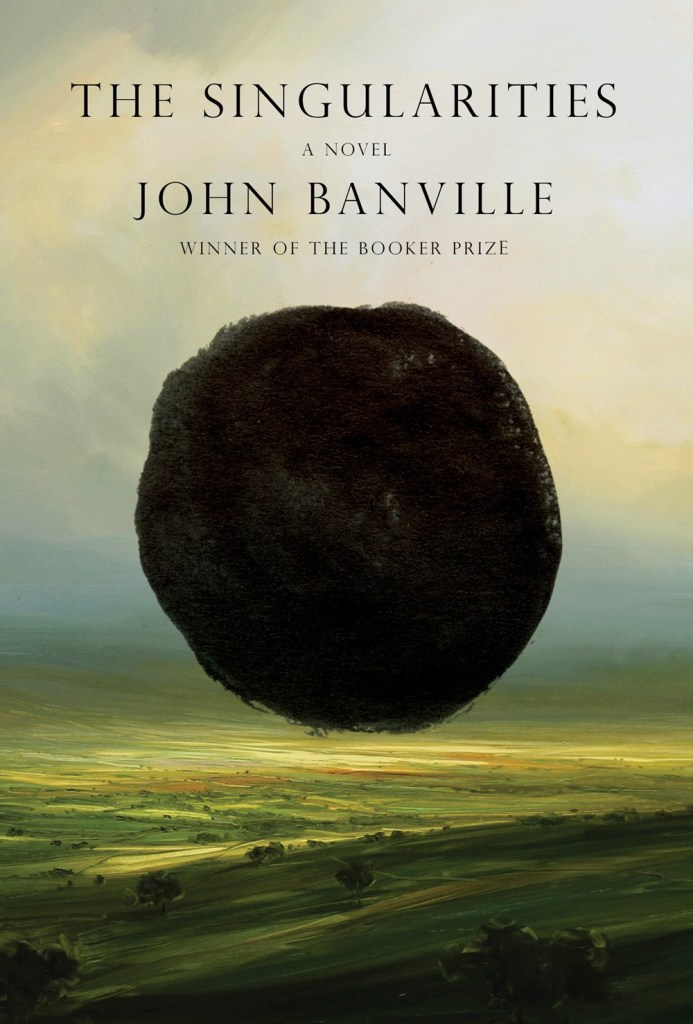
John Banville, The Singularities, Swift Press, 2023 [2022], n.p.UK
eISBN: 9781800753372
RRP: A$ 25.72; $10 Kindle.
I’m undoubtedly not the ideal reader for John Banville’s The Singularities, but it does offer much to fascinate a literary reader, even one who is not turned on by his obsession with scientific subjects. When the hero (?), Felix Mordaunt (aka Freddie Montgomery, his prison nickname – or name in the nick – Banville relishes the wordplay), makes his way out of jail after 25 years of incarceration for murder, the prose sparkles. He has all the appurtenances of a Squireen, but the narrator, a minor mischievous godlet (Hermes, the trickster, the god for travellers), is deflating, if not downright hostile and uses a metaphor that punctures the illusion:
The poor ape has been released into the wild, and still the awful clang of the cage door shutting behind him is, in his ear, the sound of the sanctuary gates slamming to. No, bro going back. See him lope away, his knuckles grazing the ground, gibbering, red-arsed and alone, into the frightening thickets of the world (p.10).
The ‘homing urge’ takes the ex-convict to a former residence, which like Freddie has undergone a name-change, though it’s less of a makeover in terms of how it is togged out. Although it reads like a (shabby, decaying) Big House in the post Anglo-Irish era, Freddie increasingly acts the confident squireen, a new form of himself’, making up for financial deficits with chutzpah and style, and some light-fingered thievery. It is to create an alternative version of himself.
The novel, via the Freddie sequences, promises something akin to a crime fiction, but continually frustrates that expectation of plot. Banville introduces a second very different kind of plot in which an academic, Professor Jeybey (a disgrace to his profession), some time in the future (after USA has been newly conquered by the Netherlands and New York has become New Amsterdam), is taking up residence in the former house of Freddie. Jeybey’s commission is to write a biography of a much-lauded mathematician, Adam Godley senior, inventor of the Brahma theory or, more properly, theorem. The biographer’s credentials are dodgy, to say the least, and his footnotes tell a story of ambivalence about his subject, and attest to the hubris of both the subject and the biographer. Godley is engaged (probably) in plagiarising his subordinate, Gabriel Swan’s theory, claiming it as exclusively his own. His testimony relies on a manuscript which (magically?) wrote itself while he was out taking walks. Banville may be seduced by science, but he is no fan of academia, or academics, and he adduces a list of similar highjackings of scientific insights (Kepler, Kopernikus, Einstein and others). Godley exploits the psychological instability of his subaltern Swan while at the same time, and deviously, acknowledging him ‘as possessing a mind almost as subtle and inventive as his own’ (p,175):
After the Brahma theory was published and had achieved universal acceptance, Godley dropped all mention of Swan and the contribution he may or may not have made to the project. Swan’s champions see this was evidence that he did make a contribution, that it was significant, and that Godley, his fame and fortune secured, was anxious to claim the masterwork as exclusively his own. (p.179)
Swan meets a suspicious and puzzlingly premature end:
[Godley] had a place for each of his captives, a fixed orbit around the blazing star that was himself. Appointed planetary transits only were permitted, and none must seek to eclipse the light of another. And there he ruled, at the centre of his little cosmos, le Roi Soleil supposedly malgre lui. Surely we must agree, whatever our reservations, that there is something impressive, even admirable, in the romance of so violent an extreme of wilfulness, self-regard, and unremitting resolve.
The novel ends unexpectedly with ‘a genteel bacchanal’ (p.281) which brings together the entire suite of characters from the novel, and as well some fantastical locals, ‘a troupe of raucous maidens and larky youths’ ruled over by a lesbian Penthesilea (p.283), whom we have not previously met. Even a Gabriel Swan lookalike turns up, a figure from a future world (that of New Amsterdam). It is a factitious ending, and one that unmasks the villain (Freddie aka Felix).
The capricious metafictive antics of this novel I was not entirely convinced by, but I did enjoy its ‘spot the allusion’ games: Godot, G M Hopkins, Shakespeare, Chekov, Huckleberry Finn, Faust, Scott’s Marmion, Flaubert, Lolita, Lewis Carroll, Gilbert and Sullivan, Death in Venice, were only some of what were on offer in this promiscuous smorgasbord, and they seductively stroke one’s literary sense of self. Equally pleasurable is Banville’s self-indulgent wallow in language itself, sometimes quotidian and graphic, as here:
[Felix Mordaunt] goes around by the side of the house, with guarded tread, for Ivy’s chickens leave their droppings everywhere, zinc-white, emerald, olive-drab, he has often stepped in the stuff. And indeed, here is one of those baroquely comical creatures, scratchingin the gravel with a beady mien; it takes fright at his approach – he has been known to aim a kick – and rushes off with a stiff-legged, rolling gait its petticoats flying. He lets himself in at the back door, which is always left on the latch, for Ivy is a ridiculously trusting soul, like everyone else at Arden, as it seems. Stepping over the threshold always marks, for him, a series of tiny but significant transitions: outdoors to indoors, light to shade, that-he to this-he. Nothing like the slammer to intensify the self’s awareness of its self, inexistent or otherwise. (p.111)
What’s not to enjoy in the sensuous account of chicken droppings? Or the little hen’s feathery petticoats? The final phrase of the quotation functions as a reminder of the tricksy wiles of the self-conscious author, and it draws attention to Felix’s multifarious Wildean performances of himself. And perhaps the moment of discombobulation he recalls on his first day of his 25-year sentence when he crossed another and different threshold, ‘the non-where of death’ when everything had been nothing, everything including himself. Nothing.’ (p.240). It’s hard not to think of the novel as that of an old writer saying farewell to fiction, as ‘mark[ing] a full, an infinitely full, stop.’ These are the final words of the novel, and they point to, as in Finnegans Wake, a return to the beginning when the deliciously wicked Felix, or is it his ‘godlet ‘narrator, comments:
Yes, he has come to the end of his sentence, but does that mean he has nothing more to say? No, indeed, not by a long stretch.
Is the final proposition the one we should take seriously or the opening one? Beware, writer addicted to ambivalence and trickery, and Felix has been offered on a plate (by the putative victim) another murder to commit.
Frances Devlin-Glass
Frances is a member of the Tinteán editorial collective.
 Tinteán