It is inevitable that a centenary of a significant event will unearth stories about people and events captured in a moment of time and passed down through history unexamined. The latter is the purview of the historian. The historian is not disturbed or disappointed when new facts are uncovered, but for others, new information might not be welcome.
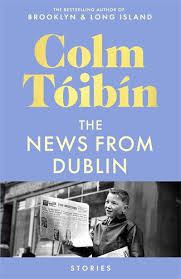
‘The Journey to Galway’ is the first story in Colm Tóibín’s The News from Dublin. I was just a short read into the story when I detected the subject matter. The words’ Galway’ and ‘Robert,’ ‘airman’ and ‘Coole’ evoked a favourite Irish poem. Tóibín’s tale is of the unnamed Lady Gregory travelling to Galway to report Robert’s death to his wife Margaret. That poem, ‘An Irish Airman Foresees His Death’ is forever changed for me with this new information about Robert Gregory, information that has been around since 2018, seemingly, ninety years after his death. While I had difficulties with a short story based on a famous poem, ‘The Journey to Galway’ is a suitable beginning for a collection of stories about betrayal, deception, disappointment, and secrets. Many of these secrets are made possible because of distance.
The collection’s title is Tóibín’s second short story. Perhaps because Ireland’s capital is situated on the east coast, the words ‘The news from Dublin’ suggest great anticipation and the delayed and sometimes protracted method of communication for the rest of the country. This story, however, covers a power disparity of another order: Maurice, an Enniscorthy teacher needs to convince the Dublin politicians to help his younger brother who is sick with TB and would benefit from a new drug that is currently not available to him. In this Dublin world of politics, it is who you know and who knows you that holds the power. In the first instance, Maurice has to go through Sean Flood to get to the relevant minister. He will need to establish his social credentials with the minister before the topic of the new drug is raised: ‘…who he was and who his father was…’ He has already considered bringing up ‘Frongach’ where his father was incarcerated after the Rising, but has also decided to avoid ‘The Civil War’ topic. Back in Enniscorthy his brothers and the rest of the family will be waiting on the news from Dublin when, in effect, ‘he has nothing to tell them.’
While some of the stories in The News from Dublin are set in the twentieth century, ‘Five Bridges’ is very much current: an Irishman living illegally in the US for thirty years attempts to develop a relationship with his now teenage child from an estranged relationship before flying to Dublin in the face of inevitable deportation. Because he is undocumented, he has avoided detection by secreting his money in socks at the back of a drawer. He is an unqualified plumber who relies on word-of-mouth for his work. Before he leaves the US, he must reveal his biggest secret, his child, to his family in Dublin.
Also set in the US is ‘Sleep’, a gay relationship that suffers because of a secret that is so buried it only reveals itself in nightmares. The older and troubled partner is Irish and the younger American. The grief and guilt following a brother’s death can only be resolved by returning to Ireland: ‘There is always that sense of being released when the plane takes off from JFK for Dublin. Every Irish person who gets on that plane knows the feeling; some, like me, also know that it does not last for long.’
The stories in the second half of The News from Dublin are longer, allowing for greater character development as secrets weigh heavier: a schoolboy is an inveterate liar and thief in ‘A Sum of Money’; a convicted Irish pedophile needs to avoid Irish tourists when he is living in Barcelona on his release as ‘A Free Man.’ It is a difficult subject for the reader, but Tóibín presents the story in his usual quiet and non-judgmental way. The almost novella-length ‘The Catalan Girls’ is replete with deception and secrets, sibling rivalry and the struggle to fit in, including the necessary suppression of the girls’ Catalan dialects. They adapt to life in Argentina through pretense: claiming to be older or more experienced or of a higher class. The mistress of subterfuge is the eldest sister Nüria who ‘is what she says she is’ and who has ‘learned to behave as if she were a member.’
Tóibín’s array of characters in The News from Dublin bear out the maxim that ‘Life is difficult for everyone.’
…………………………………………………………………………………………………………………………………………………………………………………………
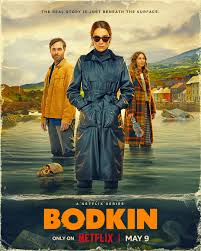
Image https://www.rottentomatoes.com/tv/bodkin
Studying English for me in school in Ireland involved learning poetry and great speeches off by heart. I can still recite ‘Robert Emmet’s Speech from the Dock’ that we learned in primary school along with ‘The Ballad of Athlone.’ In secondary school it was weekly recitation of speeches from As You Like It and Hamlet.
When I was told about an Irish tv series now available on Netflix called Bodkin, my mind immediately went to Hamlet’s ‘To be or not to be’ speech where a ‘bare bodkin,’ an unsheathed dagger, was one of his options. The title Bodkin may have been explained during the nine-part Irish tv series, but, if so, I missed it. Instead, at the end, I did a Google search of the word and was surprised to find that Bodkin is the name of a Galway tribe. According to MacLysaght’s The Surnames of Ireland, Bodkin comes from Irish Boidicin, originally Bowdekyn, a diminutive Baldwin. And the Irish placenames website logainm.ie provides Timpeallán na mBoidicíneach/Bodkin Roundabout named by the Galway County Council.
While I do not have the patience for audio true crime podcasts, and often have a cringe response to Irish comedy that is ‘Oirish,’ Bodkin offers more: a spoof on the true crime podcast genre; excellent acting (award-winning Siobhán Cullen especially); more than a cúpla focal to represent the Irish language in today’s Ireland; and a soundtrack that covers country, Irish, and rock. See https://screenrant.com/bodkin-soundtrack-songs-guide/ However, the official soundtrack does not include Ger Kelly’s striking a cappella rendition of ‘A Stór Mo Chroí’ we hear near the end of episode one.
Oh, and while I did not have the patience to work out the mystery at the heart of Bodkin, I found out from watching that the Irish invented the place Purgatory. I spent many an hour on a Good Friday in Dublin as a child saying three Our Fathers, Hail Marys, and Glory Bees to release possible relatives from that place. I’ll never get that time back.
Dymphna Lonergan
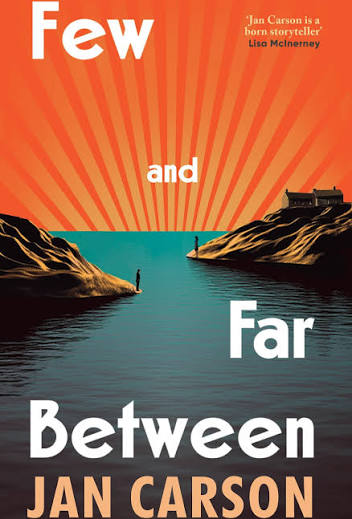
Few and Far Between (a title I’m yet to fathom) by Jan Carson is a novel set in a heavily fictionalised Lough Neagh, and on an archipelago, The Ark, populated by refugees from the Northern Irish Troubles. It treads an uneasy, and very familiar, path between a Utopia which gives comfort to those who don’t fit into the rigidities of NI life and culture, like those from mixed marriages and there is one suffering Transgender person, and the transformation of that condition into a Dystopia. There are also those who seek death by suicide, and those traumatised by their experiences on ‘The Mainland’ who are comatose, but able to be resuscitated when the ‘Peace’ arrives on Good Friday 1998.
These categories of refugees are disquieting, but more so are those who return to the islands as participant observers and anthropologists, especially the esteemed elder of his academic tribe, RJ, at the end of his career and with untrammelled authority in his field who exploits his position, and a younger breed of Anthropologist, Alex, who is untenured and desperate for a major publication, and prepared to do what it takes with people she had lived among as a child. The archipelago has its secrets which are strenuously guarded, not only by the children of RJ who cannot tolerate his exposure as a womaniser and potentially a paedophile, but also by the strange phenomenon of a sinkhole which regurgitates unpredictably what it formerly buried.
Many threads are entwined, including a climate change scenario whereby the Lough has become poisoned by its inhabitants, and needs to be flushed out in ways that signal the end of The Ark. The novel works its way to hard closures, and in the process many characters are changed utterly. These metamorphoses do not necessarily satisfy as they are so clearly means to arrive at an ending which is not always prepared for.
Nonetheless, the novel is immensely readable because of the quirky characters and because of its oblique ways of dealing with the Troubles nearby. We’re spared the usual tropes of civil war, and instead focus on the slower less dramatic forms of damage sustained by those caught up in the horrors of civil war.
Frances Devlin-Glass

