by Jules McCue
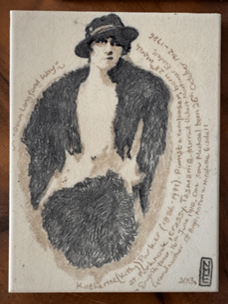
A ceramic tile 2013, created by Nicolette Eisdell, the granddaughter of Kitty Parker. Courtesy of the artist.
In this essay, I have reinstated Kitty within the context of traditional Irish music and history; a reconnection for those who have been dislocated from their ancestral culture – perhaps restoring her into an extensive genetic, musical inheritance. Though descending from some of the most revered Irish/Australian rebels, Kitty did not embrace an ‘Australianness’ or an ‘Irishness’ in her creativity and work. In his 1910 book on ancient Irish music, P. W. Joyce, Irish historian, writer, and music collector, speaks of music and Ireland: From the remote times the Irish took great pleasure in music: and they studied and cultivated it so successfully that they became celebrated everywhere for their musical skill . . . musicians are spoken of with respect and admiration.
.
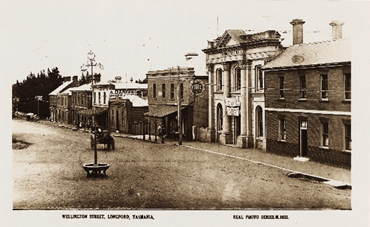
Postcard Wellington Street, Longford, Tasmania. (Valentine Real Photo Series M1033). Item No. LPIC 147/4/265. Start date 01 Jan 1905. End date 31 Dec 1910. Local Launceston.
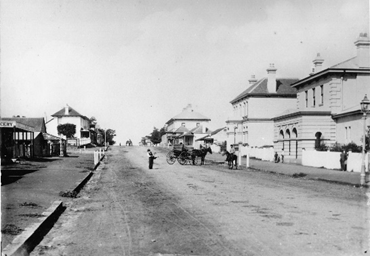
Postcard Queen Street Campbelltown, NSW. Courtesy of the Campbelltown and Airds Historical Society.
Kitty’s mother Florence’s ancestors are listed in the (NSW) Campbelltown Pioneer Register (1800 – 1900). Florence’s parents were Joseph Leary, b. 1831 Campbelltown, NSW and Catherine Keighran, b. 1832, whose parents were John Keighran and Catherine Byrne, daughter of Hugh Vesty Byrne (Michael Dwyer’s Lieutenant) and Sarah Dwyer, the sister of Michael Dwyer known as the last Wicklow Chief. All exiles and United Irishmen, they were transported on the ship Tellicherry to the NSW Penal Colony in 1806. Joseph Leary, Kitty’s grandfather, in his lifetime was highly esteemed and considered progressive regarding social and cultural amelioration. He was elected Member for Narellan in the (New South Wales) Legislative Assembly during the years 1859-1880.
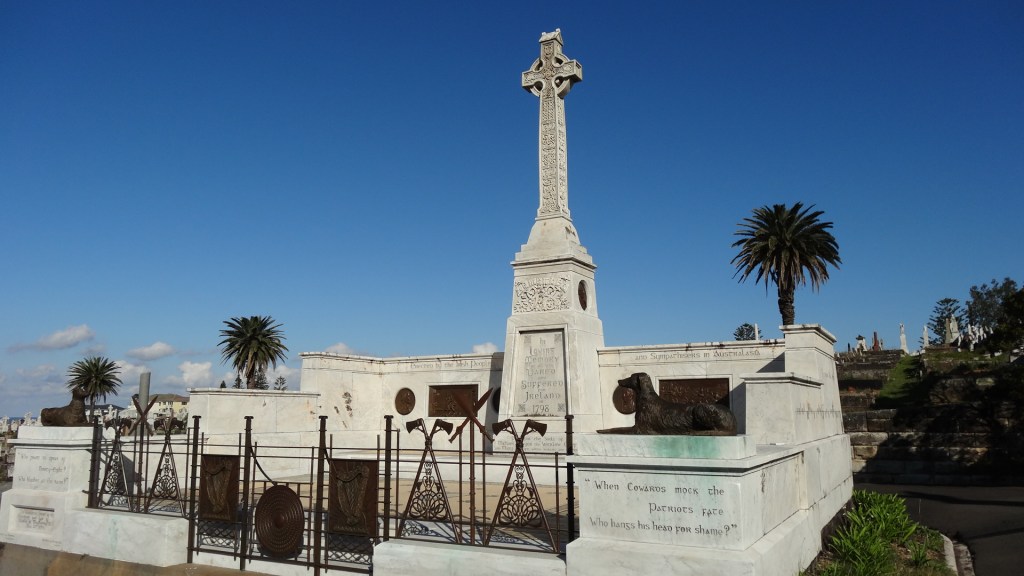
Kitty’s ancestors mentioned above, Michael Dwyer the ‘Last Wicklow Chief’ and his wife Mary Doyle, are buried at Waverley Cemetery, Sydney. Dwyer, his officers and supporters held out in the Wicklow forests and mountains for several years after the United Irishmen’s defeat at the Battle of Vinegar Hill, Wexford, against the well-armed English forces, until he and his supporters surrendered, resulting in their transportation to NSW. Their Sydney tomb is an extended architectural memorial to all Irish heroes, their stories and epitaphs told in the various inscriptions, engravings and low-relief sculptures on this site. The magnificent edifice sits under a very large and beautifully designed Celtic High Cross. One could say that O’Dwyer’s life and fight for Irish freedom has placed him as a ‘symbolic chief’ of Australian/Irish rebel heroes. A mass celebrating all those who sacrificed their lives for Irish freedom is held there every Easter Sunday.
Kitty’s forbearers emerged from exiled rebel ancestry into positions of privilege and land ownership in Australia. According to Kitty’s paternal grandfather, Charles Allen Parker’s obituary, he assisted John Mitchel, the ‘Irish Exile’ and ‘Young Irelander’ with a horse in Mitchel’s attempted escape from Van Diemen’s Land [Tasmania]. In his 1854 Jail Journal, Mitchell explained:
We intended to make first for the house of Mr Grover* [Grover is not the real man’s name] whose son, a well-affected Tasmanian native, was known already to aid me in any such affair. . . . (John Mitchell: p. 315)
Charles Parker was born in Tasmania in 1828. His father, a magistrate, and a Mr Roderick O’Connor his superior in Tasmania, arrived on the Ardent, May 7, 1825 (Trove, Hobart Town Gazette and Van Dieman’s Advertiser, p. 2, May 7, 1824). O’Connor either commissioned or bought the ship departing Dublin in 1824 and sailed to Tasmania. The O’Connors were wealthy Cork and Meath people and were nationalists and Protestants with links to the United Irishmen.
Kitty’s rebel ancestors in Australia
Here is a brief snapshot of Kitty Parker’s rebel ancestry: Michael Dwyer’s sister Sarah married Hugh Vesty Byrne, Dwyer’s Lieutenant. They had fourteen children. In 1825 a daughter Catherine Byrne married John Keirghan also a currency lad, or child of the convict Patrick Keirghan transported on the Marquis Cornwallis, 1796, who married convict Catherine Kitts in Sydney. John Leary, a convict on the Prince Regent 1824, married convict Catherine Jones in Sydney 1825. Their son Joseph Leary born 1831, married Catherine Keirghan, daughter of John Keirghan and Catherine Byrne. One of their daughters Florence Leary married Erskine Parker of Longford northern Tasmania, in 1880 and had a son and six daughters, one of whom is Catherine [Kitty] Parker, born in 1886. Kitty is related to both Dwyer and Byrne, the latter (c. 1762-1842) from the townland Kerikee, Co. Wicklow. Florence Leary attended St John’s and St Patrick’s catholic schools in Campbelltown where she and Erskine Parker were married at St John the Evangelist Church.
Kitty and her music
Kitty’s mother Florence Parker (née Leary) played the organ in the Launceston Catholic cathedral. Her grandfather Jo Leary believed that ‘education, music and recreation would affect the reform of the drunkard and not taking the pledge.’(The Australian, p. 15, 1896)
In 1904, Kitty accepted a scholarship to attend Melbourne University Conservatorium, graduating in 1906 with Honours, winning silver and gold medals. In a 1907 review of her recital in Launceston’s Daily Telegraph, technical skill is emphasised. Importantly this remark points to her exceptional creative gifts: ‘… while permeating the whole of her work is an intensity of feeling and sympathy which distinguishes the true artist from the mere mechanical student.’
Early in 1909, her passion and talent took Kitty to London hoping to study with Percy Grainger, the celebrated Australian composer. Grainger described Kitty as his most gifted piano student ever: ‘She did everything by nature and I felt a fool trying to teach her.’
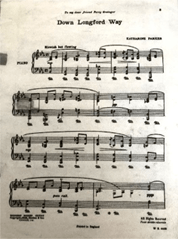
Left: The sheet music for ‘Down Longford Way’ composed by Kitty Parker. Originally arranged by Percy Grainger.
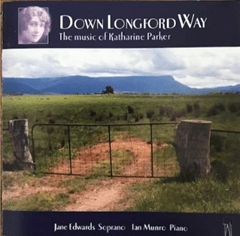
Right: The jacket cover for the Compact Disc Down Longford Way, The Music of Katherine Parker. Tall Poppies label, TP 174, 2005. [Photos supplied by Nicolette Eisdell]
Grainger introduced Kitty to contemporary classical forms, such as the composers Debussy and Ravel. Her piano music could be considered as impressionistic colour poems, profane in content, though some of her songs verge on the sacred in their dramatic intensity. Jeanelle Carrigan discusses Kitty’s compact collection in her 2017 book about Australian women composers for piano, Composing Against the Tide. (Carrigan: pp. 67-73) She asserts that:
… Even though her piano music is really exquisite and beautifully written for the instrument, it has not ensured her longevity as a composer, though to a certain extent she has received something of a recent revival. (Carrigan: p. 199)
In Grainger’s London ‘salon’, Kitty was exposed to celebrated musicians and composers including her future husband Hubert Eisdell – an English tenor whom she married in 1912. Kitty’s first composition was published in 1913. She continued to compose as well as being Hubert’s accompanist; a co-operative role played by many women on the performance platform. Kitty eventually separated from Hubert around the time a son Michael was born. Little is recorded about child-rearing or domestic duties. Nonetheless, Grainger always encouraged Kitty:
I have never found anyone in a million places who plays with the charm, empathy, skill and sweet feeling that you always had in your superb playing. (Carrigan: 2017)
Is musical erudition an ethnic, Irish characteristic? Irish music is certainly highly celebrated and sought after across the world in present times. Discussing the musical career of singer Cecilia Curtain of Daniel Mannix’s Melbourne era, Aileen Dillane ponders on how the function and culture surrounding the performance of Irish national songs is perceived as the ‘inherent musicality of the Irish’. In discussing the sentimental heroic in Thomas Moore’s lyrics such as ‘The Minstrel Boy’, historian Parick O’Farrell emphasises Moore’s music as an acceptable celebration of Irish heritage:
Moore’s sweet distant echoes of a highly romanticised Ireland was all the ‘Irish’ music that they cared to hear: the beat of colonial busyness and success were much more their tune. … ritualised homesickness … Victorian emotions … respectability …'(O’Farrell: p. 193)
Thomas Moore elucidates his own role in the process, a sentiment that well pertains to early Australia:
It may be in the recollection of most of my hearers, that, in one of the earliest of those songs, I myself foresaw and foretold the sort of echo they would awaken in other lands: (Ronan Kelly: p. 534)
Renowned Australian pianist Ian Munro and soprano Jane Edwards recorded Kitty’s entire oeuvre on one Compact Disc, titled Down Longford Way (Tall Poppies 174, 2005, Sydney). In the early twentieth century, away from colonial Australia and the Irish diaspora, Kitty is immersed in modernist European music. Her ‘Arc-en-Ciel’, similar to French composer Eric Satie’s ‘Je te Veux’, a cheerful waltz, is her only ‘mirth- music’ besides her Scott Joplin-style rag, ‘Brushing up the leaves’; similar in title-form to those in the huge Irish cache, wherein appellation is essential for distinction, such as ‘Tripping up the Stairs’ and ‘Scatter the Mud’. Most of Kitty’s compositions are ‘sorrow-music’ [lament] or ‘sleep-music’ [lullaby]. These descriptive phrases are in the Irish tradition of naming pieces and classifying musical genres.
In 1935, at her behest, Grainger orchestrated her signature piece, ‘Down Longford Way’ written in 1928. It is hardly representative of her work, but you can find many versions on YouTube music. What would P. W. Joyce have thought of Kitty’s sweet air? Regarding Irish ‘airs’, Joyce extrapolates: ‘ . . . compared with musical pieces composed in our time, are generally short and simple, they are constructed with such skill, that in regard to most of them it may be truly said that no composer of the present day can produce airs of a similar kind to equal them.
After separating from Hubert, Kitty’s production diminished. ‘Down Longford Way’ is Kitty’s only composition that resembles Irish traditional musical style. The Czech composer Janacek (1854-1928) believed that ‘[e]ach folksong contains an entire man: his body, his soul, his surroundings, everything. He who grows up among folk songs grows up into a complete man’. (Farrington: p. 19).
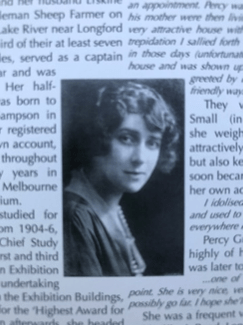
photo of Kitty Parker. Courtesy of Nicolette Eisdell.
The Irish mind and cultural Identity
Kitty faced the usual challenges in pursuing a creative career and succeeded, for a time. Kitty’s collection is evidence of a sincere and diligent creative practice. She mastered Modernist musical composition, and a unique and lovely Irish-style ‘air’ was often included in piano recitals. Though not prolific nor highly publicised during her musical life, for a time she lived as an example of a professional female musician – teaching, concert tours, composing, publishing and recording at a time of motherhood and being a supportive partner, musically and domestically. Though impossible to ascertain, she must have inspired others to take the leap in the ‘Spirit of Freedom’.
Archaeological and literary evidence tell us that Ireland was a land of saints and scholars, artists and poets. The artistic mind was based on a love and knowledge of nature; this strict and inspired observance of their surroundings produced an originality and elegance. Seán O’Faoláin, cultural commentator and historian, emphasises these Irish, creative characteristics, also intrinsic to Kitty’s diligence and talent, upon which were marked by:
. . . W. P. Kerr on the old Celtic mind and its literature to intimate that its struggle was towards intellectual and imaginative freedom. (Ó’Faoláin: p. 91)
Kitty certainly took the leap into modernist music and lived thousands of miles from home as an adventurous expatriate, wherein, her diligence and giftedness produced an elegant and expressive body of music.
Her legacy
Ian Munro’s compact disc of Kitty’s published works is an excellent example of ‘quality’ being preferable to ‘quantity’ (Janelle Carrigan). The collection emphasises Grainger’s advice to Kitty stressing that her work is:
. . . full of sheer genius – especially that genius I feel counts most: a sense of largeness in form and the ability to unfold naturally. . . . How I wish you could settle down to a life of composing great works to the glory of our darling country. (Ian Munro: 1997, annotations on CD cover of Down Longford Way, 2005)
Kitty doesn’t seem to have visited Ireland while in London and was more fully immersed in international Modernism rather than an Irish – Australian cultural community. She looked to oriental and other poetry for inspiration.
No art is pure, original or insular, even that of the little island on the edge of Europe, though the nature of an Irish cultural identity, especially in music, has undeniable local features. Kitty and many Australian artists were expatriates for some of the time. Writer Seán Ó’Faoláin elucidates upon the value new locations have in inspiring creative practice and awareness of one’s explicit culture and homeland:
It is how all history happens. Take expatriation, or emigration. We would not be able to claim Jonathan [sic] Swift as in any sense an Irish writer if he had not at first had to leave Dublin for London and then, at the height of his powers, been shanghaied back from London to Dublin. … . As our prime expatriate Joyce drily put it, the shortest way to Tara is via the mail boat to Holy head (Ó’Faoláin: p. 132)
Additionally, the enrichment of relocation is: ‘What James Joyce called ”the shock of new material” that invigorates the work.’ (Ó’Faoláin: p. 133). Time away stimulates imagination and possibilities. Wanderlust frees the intellect and creative spirit. Kitty produced her most poignant vital work overseas.
During World War 1, in which she lost relatives, Kitty jettisoned her musical career, driving an ambulance. In 1947, illness took her to Sydney. Moving from state to state she worked in teaching and radio. The vicissitudes of Kitty’s life and work reveal an emotionally vulnerable soul expressed through music, the most sentient of the Arts.
Kitty Parker retired around 1960 in Sydney. She died in 1971 at the Sacred Heart Hospice, Darlinghurst, making 85 years. She was interred with full Catholic burial rites. She left some memoirs in a collection of letters and other documents held at the Percy Grainger Museum in Melbourne. (K.S. Inglis: Dictionary of Biography online, 2005) The very sensitive Kitty named a song ‘I Don’t Care’, (CD, Down Longford Way, Tall Poppies) but no doubt she did. Even with privilege, it was not easy for artists in ‘tall poppy’ Australia, but more especially for women and those who didn’t live and work on the East Coast.
Kitty’s creative life is just one example of the many musically gifted (no doubt an inherited trait from Irish culture), who were brought into the second nation of Australia, through a diaspora of rebels and famine refugees.
BIBLIOGRAPHY AND REFERENCES
Australian Dictionary of Biography. Online – Supplementary Volume, [MUP], 2005.
Bayley, William. A., History of Campbelltown, NSS, Campbelltown City Council, 1974.
Campbelltown Pioneer Register 1800 – 1900, Campbelltown District Family History Society, compiled by Esma Hannah, Ist Edition, 2000.
Carrigan, Jeanelle, Composing Against the Tide: Early Twentieth Century Australian Women Composers and their Piano Music, Wirrapang, Wollongong, 2017.
Corkery, Daniel, The Fortunes of the Irish Language, The Mercier Press, Cork, 1968.
Danaher, Kevin, In Ireland Long Ago, Ist Pub. 1962. The Mercier Press, Dublin and Cork, 1978.
Dillane, Aileen, ‘The Sacred and Profane: Songs of Cecilia Curtain in Mannix’s Melbourne, 1909 -36’ in The Australasian Journal of Irish Studies, vol. 17., 2017, published annually by the Irish Studies Association of Australia and New Zealand [ISAANZ]. This publication is supported by College of Arts and Education, Victoria University, Melbourne and The Gerry Higgins Chair of Irish Studies, The University of Melbourne.
Farrington, Karen, The Music, Songs an Instruments of Ireland, PRC Publishing, Ltd, London, 1998.
Inglis, K. S., ‘The is the ABC’ (Sydney, 1983), – E. Dorum, ‘Percy Grainger’ (Melb, 1986), Australian Dictionary of Biography. Online – Supplementary Volume, (MUP), (2005).
Joyce, Patrick Weston, Chapter XLIX, Ancient Irish Music, A Reading book in Irish, Project Guttenberg. Org. (E Book #33439, release date: August 25, 2010). Pub., 1900, M. H. Gill & Stone, Ltd. Dublin.
Kelly, Ronan, Bard of Erin: The Life of Thomas Moore, Penguin, Ireland, 2008.
Malcom, Elizabeth, and Hall, Dianne, The New History of the Irish in Australia, New South Publishing, University of NSW Press Ltd, 2018.
Mitchell, John, [Prisoner in the hands of the English] Jail Journal, [a reproduction] Original Edition, M. H. Gill and Son, Ltd, Dublin, 1854.
Moore, Tony, Death or Liberty: Rebels and radicals transported to Australia 1788 – 1868, Pier 9, Sydney, 2010. (also see reference to: R. Ward, ‘The Australian Legend Revisited’, Historical Studies, vol. 18, no. 17, Oct. 1978: V. Palmer, The Legend of the Nineties, Melbourne University Press, Carlton South, 1967.)
Morton, H. V., In Search of Ireland, Methuen & Co. Ltd., London, 1930.
Munro, Ian, annotations (1997), Down Longford Way, The Music of Katherine Parker, CD: Tall Poppies 174, Sydney, 2005.
Ó’Faoláin, Seán, The Irish, Pelican, Great Britain, 1969.
O’Farrell, Patrick, The Irish in Australia, New South Wales University Press, 1986.
Trove Online : National Library of Australia
Jules McCue is a Wollongong based artist, musician, writer, teacher, and independent researcher. She has written many essays about artists and their work, for example: Extraordinary Exhibition: Holy Threads: Savanhdary Vongpoothorn, (1998); Black Man in a Whiteman’s World: Indigenous Art in NSW Jails (1998) ; Allan Mansell: The Creation of Visual Stories from an Original Tasmanian (2012). Her Master’s Dissertation: Wildflowers and White Porcelain and Circles and Seeds: a study of the History of Women Artists through Still Life Painting (1994), University of Wollongong. Conference Papers include Not Surrealism, Magical Realism (1995), University of Wollongong, Katheen and Kitty: Two Women; a painter and a composer/pianist, both of Irish heritage, Flinders University (2019), and Historical Ireland: control and cadastrophe through stories of circumjacent mythology, weird and wonderful, ambiguous shapings of the vigorous mind, Auckland University (2021). Dissident Donegal: they keep leaving, Australian Catholic University Melbourne, (2023), Another CaDastrophe: Charles and Kate O’Connor and The Vulnerability of Cultural Isolation, (2025), Otago University. (also see essays in Tinteán) – Email: julesmacarts@gmail.com
Website: julesmccue.com

