by Dr Damian John Gleeson
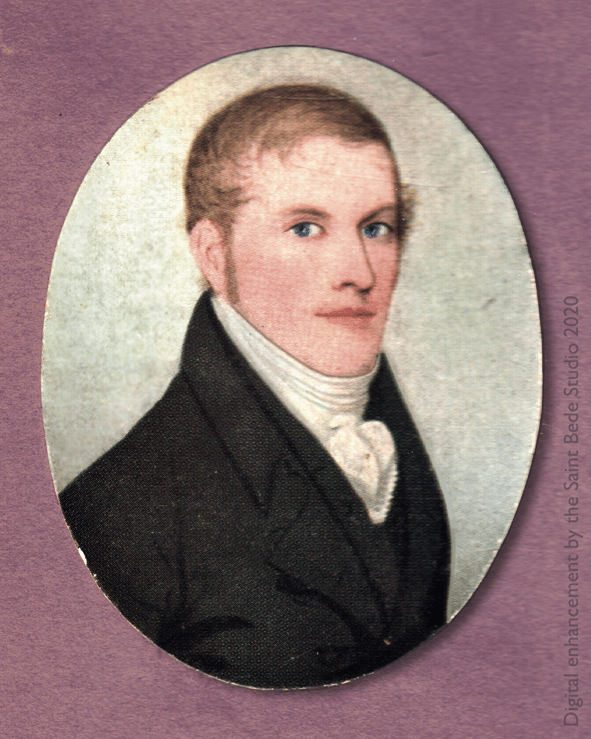
John Joseph Therry (ca 1789-1864), the so-called ‘founder of the Catholic Church in Australia,’ was a graduate of St Patrick’s College Carlow, and came to Australia as one of two official Roman Catholic chaplains in 1820, where he ministered in New South Wales and Van Diemen’s Land for a combined 44 years. Therry is honoured with a stained glass window in St Joseph’s Church Hobart, and plaques at St Ignatius, Richmond, Melbourne and St Augustine’s, Balmain, Sydney, as well as a primary and secondary school named after him in New South Wales.
Therry is well remembered for his piety, conscientiousness, zeal, and advocacy on behalf of Irish Catholics. His reputation as a ‘hero’ and ‘saint’ is reflected in many clerical hagiographic accounts that uphold a persecution thesis. Therry, however, was more likely to persecute anyone – including English or Irish clergy – who stood in his way. So, too, Therry’s avarice and obsession for property, as well as frequent legal disputes, have been largely ignored in the literature. A prominent example overlooked has been the Tasmanian 1844-1858 dispute.
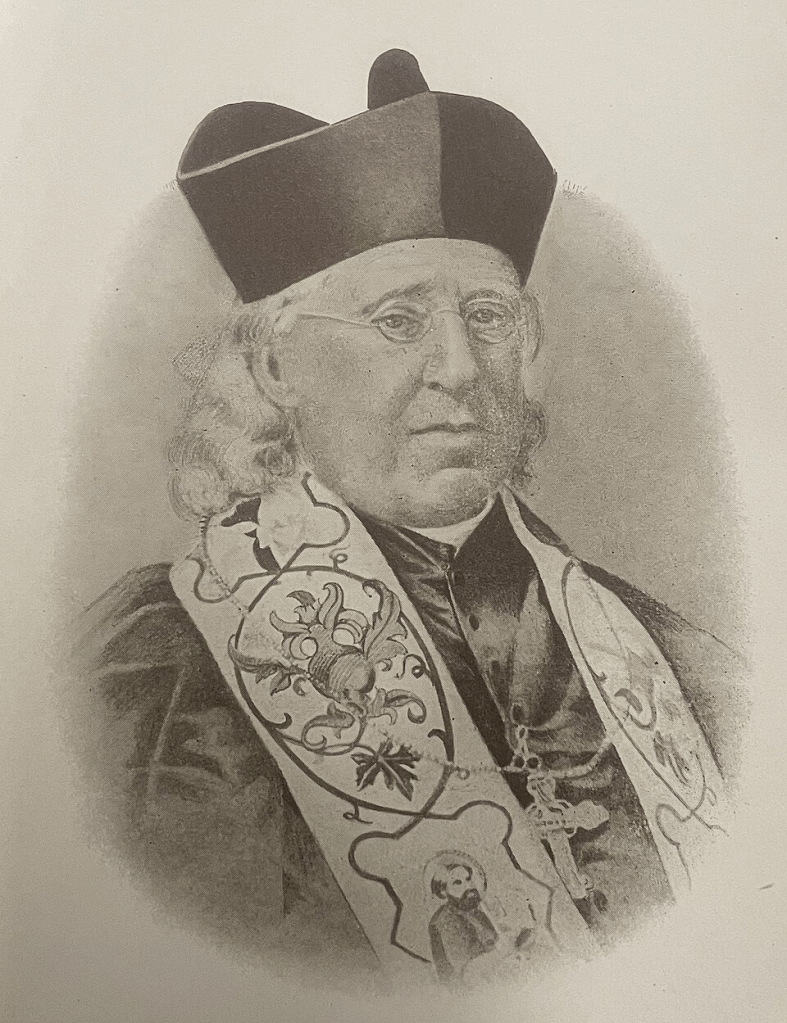
Bishop John Bede Polding (en.wikipedia.org)
In March 1838, Bishop John Bede Polding appointed Therry, then responsible for the sprawling Campbelltown Mission, to be the Visitor to Van Dieman’s Land. It was a convenient way of ridding Therry from New South Wales and trying to break the incredible bond that existed between the priest and his powerful lay supporters, known as Therryites. Earlier, Polding had sacked the first Hobart priest, Fr Philip Conolly, for his refusal to hand over church lands deeds held in his personal name. By that measure, Therry was an inappropriate appointee, for he had amassed more than 4,000 acres of land across Sydney and beyond; much of it had been granted to him in his official capacity but held tightly in his personal name.
In Hobart and Launceston, and in between, Therry was at his best providing pastoral outreach to convicts, families, men facing the gallows, and people addicted to alcohol, a cause close to Therry, who himself had taken the temperance pledge in faithful respect fo his friend, the ‘Irish apostle’ Fr Mathew Theobold. But Therry’s obsession with money and property, reflective of a merchant culture in his native city, Cork, blinded his judgement and impacted significantly on his work as a priest.
Between 1844 and 1858, a major dispute between the Bishopites and the Therryites split the Irish community and caused significant reputational damage to the Catholic Church’s reputation in the fledgling colony. At the heart of the dispute, which centred upon who was responsible for debts associated with the construction of St Joseph’s Church, Hobart, was the island’s formidable ex-Vicar General, Therry, and first bishop of Hobart, Englishman Robert Willson. The stalemate between the men and their supporters spilt over to the church in Sydney, Adelaide, and Melbourne, before being referred to the Vatican.
With the creation of the new Hobart diocese in 1843, Polding made it clear to Therry that his £650 annual role would terminate upon the bishop’s arrival. Therry had hoped that he might be appointed bishop and this bitterness underplayed his subsequent behaviour. True to his dithering form, Polding had given little consideration as to what Therry would do, or where he may go, after the bishop’s arrival. Willson, for his part, had earlier rejected the Pope’s appointment to Hobart, because of reports about Therry’s conduct and his inability to work harmoniously with most clergy and colonial officials, regardless of nationality or religion. It took a lot of persuasion from Polding before Willson finally accepted, and he did so only after Polding has assured him that Hobart had no debts and that Therry would vacate the island.
Accompanied by four clergy — including a new Vicar General, William Hall — Willson arrived in Hobart in May 1844 and found Therry ensconced. From the moment they stepped off the boat, the Therryites ganged up on the bishop. In the words of the Oxford History of the Christian Church: ‘Therry did everything possible to make his bishop’s life miserable.’ Because the presbytery was not completed, the English priests stayed for a time at Therry’s large personal house on the corner of Harrington and Patrick Streets. Within days Willson learned that Polding had been ill-advised of the true financial situation: St Joseph’s Church had a debt of more than £2,500, and the adjoining school and presbytery required significant funds to enable completion.
Tensions between Therry and Willson quickly escalated. When asked in writing for a response to the bishop’s questions regarding funds raised for the church, and what still had to be paid, Therry was evasive and would not commit to writing. Nor would Therry hand over the property title deeds until the St Joseph’s creditors — including the trustees, William Insley [Church Warden], John Regan, Thomas Allcock, and Therry — received appropriate payments for the debts they had incurred in completing the church.
This was the start of a 14-year war that divided the Irish community. Enormous efforts to resolve the matter by many parties occurred at a high legal cost. Time and time again, Therry agreed in writing to settle, in front of Polding and other clerical and legal witnesses, before reneging. With support from Protestant newspaper editors, Therry ran a brutal public campaign that demonised Willson, much in the same way Therry had hounded Fr Daniel Power to his grave in Sydney in 1830. John McEncroe, Therry’s loyal clerical supporter, might well claim that Willson being English was the root cause of the St Joseph’s matter, but nearly all Therry disputes, including this one, were not determined by nationality. Therry could speak and write four languages, but not Gaelic [Irish]. It is also notable that none of the five churches that Therry founded had an Irish saint’s name such as Patrick.
Attempts to reach agreement, including by external conciliation, and the Tasmanian Attorney General, failed. Therry could have easily resolved the dispute for he was earning thousands of pounds every year from cattle sales across his properties in New South Wales. Yet, he insisted on a £3,300 payment from Willson, whereas Willson would only give what everyone else concurred was the maximum liable, £2,300.
Indicative of Polding’s weakness. he told Willson that Therry ‘is not properly speaking my subject, nor your subject,’ a reference to Therry being on loan from the Diocese of Cork. A frustrated bishop withdrew Therry’s public and private faculties (rights to minister), which led the Irishman to sulk and plot in his home. Therry left Hobart in 1846, but after two years in Sydney and Melbourne, and with Polding’s complicity, he was back in Hobart. How anyone could have thought that Therry’s renewed presence in Hobart could benefit the unedifying dispute is mystifying. For the next decade Therry remained a divisive figure on the Hobart scene, but over time he lost support from all the local clergy and most of the parishioners.
Nevertheless, as Polding was his ‘protector,’ Therry had Willson snookered. Regardless of what Polding might say or write privately he would not make a move on Therry and force him to retire. Polding was too afraid of the Therryites across New South Wales, and also naively believed that Therry would leave a financial legacy that would enrich the Benedictine dream.
By 1850 the negative relations between Therry and Willson intensified, unsurprisingly. Endless argumentation and fixation about money had been symptomatic of Therry’s career, but for Willson it proved to be deeply unpleasant and damaging to his health. The impasse weighed heavily on the bishop whose health breakdown was a sign of the strain that he was under and the realisation that Therry had no intention of wishing to resolve the matter.
Willson’s accurate but private criticism of Polding’s lack of leadership sparked one of the archbishop’s worst acts of judgment. Instead of finally dealing with Therry, Polding, in an extraordinary turn of events, referred Willson to Rome for allegedly bringing ‘scandal to the faith.’ A deeply hurt Willson challenged Polding as to how he had been disrespectful to the archbishop or in what ways he had brought scandal, and whether the scandal pertained to New South Wales or to Van Diemen’s Land.
Polding, it appears, had made the formal complaint after taking advice from his Vicar General, Abbot Gregory, and McEncroe, the powerful de facto head of Irish clergy. The Vatican investigation proved little, except that Willson had kept meticulous records, and Polding’s complaint was superficial.
After further intervention from the bishops of Adelaide and Melbourne, Therry finally agreed to an offer, first made to him 13 years earlier. In September 1857, Therry received £2,300, much of it money that Willson had been forced to borrow. However, as usual, Therry was ‘vexatious.’ Rather than fulfilling a clearly agreed legal settlement, Therry continued to hold on to the church property deeds and did not release them until Friday 8 January 1858.
The 14-year saga was finally over, but it left Willson despondent; his offer to resign was refused by Rome. Willson laboured zealously for six more years before setting sail for England, where a stroke on the home voyage led to permanent paralysis, and he died within 12 months. It was a sad end for a well-respected and faithful priest — who despite the enormous distractions of the Therry saga — had served the poor, convicts, and people living with a mental illness in Van Diemen’s Land with dedication and empathy.
For Therry, back in New South Wales, life only got better. He was on the cusp of promotion to the rare position of Archpriest, making him the most influential Irish priest in New South Wales, and again the recipient of much adulation from an Irish-Australian laity whose knowledge of the sordid Hobart dispute was limited to or at best distorted by a Catholic press that had been manipulated by McEncroe. The ‘absentee landlord’ returned to find his property empire across New South Wales had continued to blossom and reap large financial returns, despite his familiar cry of being penniless and on the brink of ruin.
When he died at Balmain, Sydney, in 1864, Therry owned 4,500 acres of land, £5,000 in cash, shares, debentures, gold, a personal life insurance policy valued at £3,000, and a majestic house in Hobart, which his brother and sister lived in. A good proportion of the proceeds of the 1857 sale of Billy Bong, his 80,000 acre station, near Albury, that could not be accounted for, contributed to allegations by Therry family members against his executors.
During his lifetime Therry prepared more than 20 wills and codicils, none of them with legal assistance, despite his close friendship with solicitors who often represented him. In death as in life, Therry had been too smart for Polding and the Benedictines. The archbishop was devastated by the news that Therry had left him hardly a shilling in his will. Therry’s financial and property legacy left to the ‘Irish Jesuits’ enabled them to establish a Mission in Melbourne, followed by schools such as St Ignatius College Riverview, Sydney.
Did the ends justify the means? JJ Therry repeatedly caused division and disharmony amongst Irish communities in Van Diemen’s Land and New South Wales. Had he not been so wealthy, would the hierarchy have turned a blind eye to his poor personal behaviour for more than four decades?
Extracts from Damian John Gleeson’s John Joseph Therry: An Irish landlord, merchant and priest in New South Wales, to be published in July (2026) by Colonial Press, Goulburn, NSW. colonialpressorders@gmail.com
Dr Damian John Gleeson is an independent scholar and Australian Religious History Fellow at the State Library of New South Wales, 2022-2023.

