The Devlin Library Oration delivered on 24 July 2026 at Marcellin College Randwick.
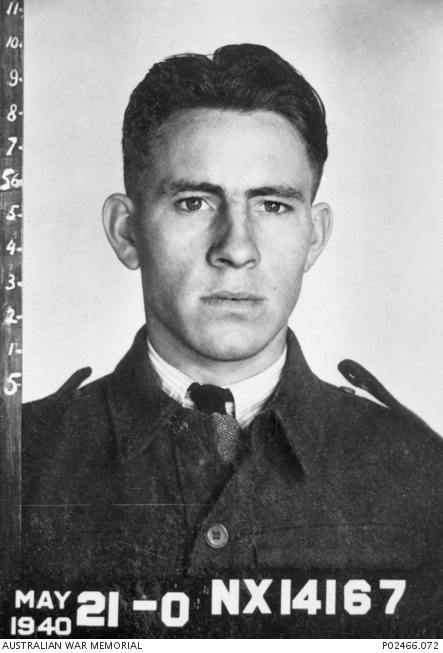
An Occasional Address by his nephew, Ralph Devlin.
William Charles Ralph Devlin, known as ‘Ralph’ within his family, was born in 1922 and attended Marcellin College, Randwick, in the early 1930s. A member of the College Athletics Team in 1934 and 1935, he was a strictly average student and left school at 13 years of age to find employment as soon as he could, in order to support his family. The early post-school years saw Ralph as an apprentice Barber who ran Greyhounds.
Ralph’s father William ran away to join the Royal Irish Fusiliers at the age of 14, served in the Boer War, in Egypt and in India. By 1914, he was doing a tour of duty in the Torres Strait, defending the Strait from any incursion from German New Guinea. William Devlin was an expert in military communications and was constructing communication towers on Thursday Island. He appears to have been on secondment from the British Army between 1910 and 1914. In early 1915, he joined the Australian infantry at Thursday Island and landed on Gallipoli with Australian forces on 25 April 1915, at the start of the ill-fated campaign. William was shot on about 30 April 1915 and was repatriated to a hospital in Manchester where his future wife, Nell, nursed him back to health. Upon his release from hospital in September 1915, he married Nell and emigrated to Sydney, Australia. Their family of seven children (born between 1918 and 1930) was poor; they lived at Middle Street in Kingsford near the Prince of Wales Hospital on a soldier-settlement block.
When William and Nell couldn’t afford to pay the school fees, Nell, a devout Catholic, would attend at Marcellin College to sew and repair the Brothers’ cassocks, as her way of donating back to the Marist Community at Marcellin.
In September 1939 Adolph Hitler invaded Poland and World War Two began. Ralph couldn’t wait to turn 18 in the following May. On his 18th birthday Ralph caught the tram to the city in his pinstriped suit, with his Mum, and volunteered for the Australian Army. His military number was ‘NX 14167’ and he enlisted in ‘Sydney’s Own’ Regiment, the 2/1 Battalion.
Ralph Devlin – the soldier, a true Australian patriot – was born : crazy-brave (which was to be his undoing), a linguist, a man of letters, a singer and deviser of theatricals, an athlete, possessed of a fatal charm, especially for the ladies, a direct manner, a warm personality, and loved by his peers. Today we might call him a polymath: he had many natural gifts.
Ralph soon shipped out to join the 2/1st in Palestine, near Gaza. He took with him his mother’s Bible, as her blessing for her young son. The Bible was later found in Annaburg, Germany, in 1952. Ralph also packed in his kitbag a copy of the Shorter Oxford English Dictionary. In the POW camps, later on, Ralph kept his fellow prisoners entertained with word games using this dictionary.
In January and February 1941, as part of the Australian 16th Brigade, Ralph’s Battalion waged its first campaign in the Allied advance from Egypt into Eastern Libya, in North Africa. A major objective in this military campaign was to protect the Suez Canal from being seized by Hitler and the Italians under Mussolini. Australian forces overran Bardia and Tobruk, taking over 70,000 Italian prisoners. These two battles were the only Allied victories for the whole of 1941 and Ralph Devlin was in the thick of it, aged just 18.
But things gradually turned bad for the victorious Australians; British Prime Minister Winston Churchill split up the 16th Brigade so the 2/1st and other elements could go to Greece and garrison that country, in March 1941, against the might of the German Army. In April 1941 the 2/1st retreated to the island of Crete; the Allies held the three airfields on the island and defended fiercely against a German airborne invasion, until one of the airfields fell to the Germans and tanks arrived.
Hitler never again in the War mounted an aerial attack by paratroopers, such was the ferocity of the Australian defence of their airfield, known as Retimo. At their surrender, in late May 1941, just after Ralph’s 19th birthday, the German forces had lost 350 paratroopers and the Australians had taken another 450 prisoners at Retimo. The fledgling soldier had experienced bitter warfare, and then came life as a POW. At this surrender, Ralph began four years as a prisoner of war in Germany. In 1945 he was to be the last Australian infantryman to die in the European theatre of war.
It was these four years of captivity which marked out Ralph Devlin as a truly brave and resourceful prisoner of war. The Devlin family has lengthy letters written by two fellow prisoners in 1946 which tell the full story of this remarkable and heroic young Australian who didn’t make it to his 23rd birthday.
Detailed accounts about an individual POW are usually hard to find. However, Scottish Airman John Darragh and an Englishman with Irish parents, Frank McCaffery, each wrote lengthy emotional accounts about Ralph’s exploits in captivity to Ralph’s grieving parents after the War ended. Ralph met Darragh and McCaffery in captivity at Salonika in Greece. At first they were treated well at a Luftwaffe airfield, but soon there was a 13 day rail journey into the heart of Germany. All prisoners were given a portion of bread and a tin of beef as their only food for the entire journey, standing up in cattle wagons. There was no water supply, no sanitation. By September 1941 the prisoners from Crete were just outside Berlin, emaciated and exhausted.
It was early winter. The Royal Airforce bombed nightly and their POW camp was close to a large railway yard. There, on 07 December 1941 the prisoners learned of the Japanese attack on Pearl Harbour. The war outlook was very bleak, but camp conditions improved; in an athletics carnival held there, Ralph won the High Jump and the 800 yards foot race. Maybe he was Marcellin College’s first international representative?
The Irish Twist
Then something strange happened : all prisoners with Irish names were packed off to a camp called Friesack. According to the letters of both Darragh and McCaffery, the prisoners didn’t pick up the signs that something unusual was afoot :
- Firstly, they were to learn over time that they all bore Irish names;
- Secondly, on arrival the prisoners straggled into the camp, to be met by a fellow inmate playing ‘The Soldier’s Song’ – a song with much emotional significance (as a result of being banned in Ireland as seditious by the British after the 1916 Easter Rising) – which would in time become the national anthem;
- The ‘Irish’ prisoners soon realised that a certain Sergeant Murphy was clearly a collaborator, a Nazi sympathiser who was directed to the task of ‘turning them’ to fight for the Nazi cause;
- What they did not and could not have known was that Friesack was run by ‘ABWEHR’, a German Intelligence organisation commanded by Admiral Canaris. Ralph and his comrades finally realised that their captors assumed they were all from the Irish Republic and that they therefore hated Britain and would eventually be a public relations coup for Germany by fighting for the Nazi cause. Ralph was not a collaborator. He was the first prisoner to belligerently query to challenge what was going on with Sergeant Murphy and his efforts to ‘turn’ them. Ralph and his comrades were offered many inducements to change sides. According to Darragh and McCaffery, Ralph gave the loudest response – ‘I’m Australian – Go to Hell’.
There followed a tricky period during which they did not really know which prisoner was a collaborator and which prisoner wasn’t. An internal ‘war’ developed between the ‘patriots’ like Ralph and the ‘traitors’ and ‘collaborators’. Life at Friesack became dangerous.
Five Escape Attempts
Ralph and his mates decided that they would escape at the first opportunity. Soon the dissenters were moved to a very large POW camp, Stalag XXII. In summer they worked in the fields. A ‘ladies man’, Ralph fell for a Polish lass. Every lunch break he would seek her out by swimming along the nearby canal, out of sight of the armed prison guards. He risked getting shot for fraternisation. His fellow prisoners were in awe of his audacity. Right at the end of the lunch break, they would see him backstroking calmly back to his work squad.
The first escape was in September 1942. A team was formed to organise the escape and three prisoners were chosen to go under the wire. The others organised the escape for them. The escapees were caught a week later, 500km away.
During this period, as part of his campaign of resistance and defiance, Ralph had a pistol pointed at his head on countless occasions. His courage won the admiration of his fellow prisoners.
At the Camp Christmas Concert of 1942, Ralph sang songs performed by the great African American Artist, Al Jolson, to great acclaim from his fellow prisoners. The ‘Christmas Truce’ ended and the escape preparations resumed.
The second escape was in February 1943. One of Ralph’s many roles in each escape was that, using his skills in the German language, he was the main man for causing diversions so the escapees could get away in the ruckus. Then, he could argue endlessly with the guards in their native language, or simply distract the guards with a long conversation in German. He was also adept at covering-up for the escapees at Roll-call in the prison.
A third escape attempt soon followed. This is how Ralph was seen by the other prisoners, according to his mate John Darragh:
Ralph was possessed of a high standard of intelligence. His idea of an escape was one which had every angle covered. He couldn’t see the sense of going out into the country without a proper stock of food, maps, compass, civilian clothes, passports, money etc. Quite rightly too!
Ralph was one of the most hated prisoners, frequently threatened … he was completely unafraid of anyone or anything … )
(letter to Ralph’s parents, April 1946)
When a large poster depicting German victories was erected by the Guards, Ralph tore it down and threw it at the Guards in their orderly room. He was sent to solitary confinement for 5 days and emerged defiant, to the cheers of the other prisoners.
On 6 June 1944, the prisoners got news of the D-Day landings at Normandy in France, as the Allies began their liberation of Europe, which was to take almost a year.
Meanwhile, Ralph was the star goalkeeper of the Soccer team, won the boxing competition, and was lead singer for the camp jazz band.
There was a fifth escape attempt in preparation; in September 1944 it was Ralph’s turn. By this time Paris had been retaken by the Allies but things were slowly getting more dangerous and unstable in Germany.
Ralph escaped with Sgt Patterson by clambering through a tunnel which ran under the latrines. It was rated as ‘easily the most daring escape’ of them all. The two escapees had to swim through some latrine water, popped up through a hole just on the other side of the wire and legged it into the forest while another diversion was staged inside. They were at large for six days and committed to solitary confinement. Said Frank McCaffery: ‘Ralph was delighted with his escape and was keener than ever to try again’.
Depression and Summary Execution
By December 1944 Ralph’s pow camp was merged to a camp holding 20,000 prisoners. It was here that John Darragh, the Scot, saw him visibly affected by a melancholy: it ‘came over him like a cloud’. Ralph decided, against strong advice, to leave the relative safety of a large camp and join a small work party as its interpreter.
Darragh greatly feared for his friend as he stepped out into the slow but violent fall of the German Reich. The prisoners had an emotional parting. Ralph entrusted John Darragh with his Shorter Oxford dictionary. Ralph had orchestrated word games from the dictionary with the prisoners to keep their spirits up, but, in his deep melancholy, parted company with it.
Frank McCaffery, the second letter writer, went with Ralph to the work camp. He described the scene :
Some British prisoners in the work camp were very sick. One prisoner was completely unable to work but was pushed on by a civilian guard. Ralph stepped in between them, telling the Guard to ease off because it was clear the prisoner was too ill to work. Ralph was pushed aside but he persisted. ‘You can’t order a sick prisoner to work’, he said. An argument began but Devlin, being the guy he was, wouldn’t give in. The German civilian pulled out his revolver and shot Ralph Devlin, who fell to the ground. A further two shots ended his life … Two days later an advance party of Russian tanks suddenly entered this part of Germany. The German guards disappeared, leaving the POW’s to be liberated and the body of Ralph Devlin to be buried.
The date was 21 March 1945 and he was 22. I inherited his name exactly 10 years later. Sgt John Darragh said in tribute : ‘It was Ralph’s fearlessness and self-sacrifice that brought about his death. I shall never forget him.’
The Devlin Centre, Marcellin College Randwick, opened in 2015. The Library preserves the memory of 31 Old Boys of the College who gave their lives in the fight for democracy in World War Two, 1939-1945. Ralph was one of the last to die. He missed his own liberation by two days but died trying to save the life of another human being in distress.
On behalf of the Devlin family, I pay our respects to the descendants of all 31 Marcellin Old Boys who paid the ultimate sacrifice in defence of democracy and who are honoured by your Library and Learning Centre.
Ralph Devlin AM KC.
Ralph is the nephew and namesake of WC ‘Ralph’ Devlin. He practised as a barrister in Queensland from 1978-2022. Ralph was President of Surf Life Saving Queensland (2011-16) and Deputy President of Surf Life Saving Australia (2013-16).

