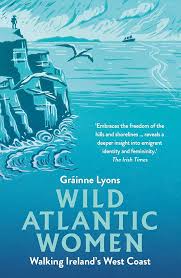
I came across this book in the recent coverage of Edna O’Brien’s passing. Wild Atlantic Women by Gráinne Lyons is a walk along Ireland’s western coastline in consideration of famous Irish women such as Edna O’Brien, Peig Sayers, Granuaile, Kate O’Brien, Charlotte Grace O’Brien, Úna McDonagh, Queen Maeve and Maud Delap. At the same time, the journey is a personal reflection for Gráinne Lyons on her identity in growing up English with parents who were born in Ireland. And also raised are issues for women travelling alone. It’s a lot to cover in 227 pages. I find myself wanting to read more about Gráinne Lyons the writer than I do about these famous women.
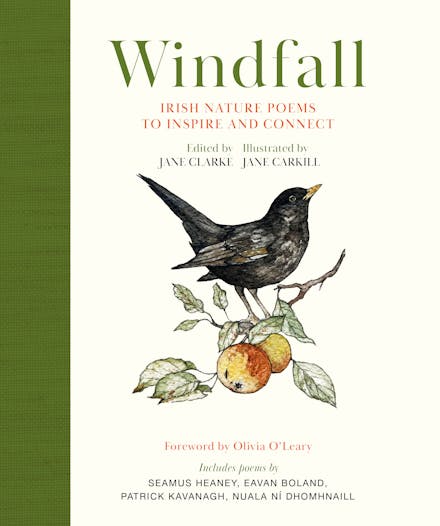
This book is on loan to me by a friend. I see that it is available as an e-book as well as a hard cover. The cover mentions the well-known Irish poets Seamus Heaney, Eavan Boland, Patrick Kavanagh, and Nuala Ní Dhomhnaill, but the surprise for me is the number of Irish poets I have not read before. Also interesting is how many have come from other countries to settle in Ireland, and how many born in one part of the country have ultimately settled elsewhere. Indian-born Nida Zak/Aria Epie’s ‘wandersong’ follows Yeats’s ‘The Song of Wandering Aengus’ revealing that poem’s influence. Seamus Heaney’s ‘Planting the Alder’ is chosen for the section on ‘Woods and Trees’ and we see and hear this tree, this ‘Streel-head in the rain’. I love the opening of Mark Roper’s ‘Owl’ – Owl/is that part of a tree/ which peels away at dusk/to float out over a field.’
There are around seventy ‘nature’ poems, including three Irish language ones. The book is separated into chapters on Birds and Trees, Birds, Lakes, Rivers & the Sea, Animals, Hills and Mountains, In the Garden, and the Land. These poems are illustrated by Jane Carkill who lives in The Burren. The editor, Jane Clarke, is an award-winning poet. I may just slip this book into my collection until my friend asks for it back.
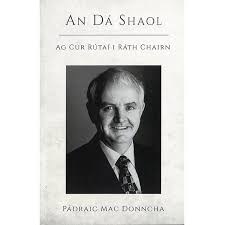
This is an Irish-language memoir of Pádraig Mac Donncha who has lived the ‘two lives’ of a Connemara family that was transplanted by Éamon de Valera’s government in the 1930s to land in County Meath, the idea being that if such a transplantation ‘took’, the Irish language would spread across the country. The idea did not work, mostly because the Land Commission miscalculated how much land would be needed to support the families. Many members of these transplanted families had to emigrate in the end. Nor did the government foresee resentment of people who were given land and resources not available to locals. And finally, the new settlement had to fight for official recognition as a Gaeltacht.
The author Pádraig Mac Donncha became an advocate for Rath Cairn throughout his working life. An Dá Shaol is also a wonderful story of Mac Donncha’s own life, his family history and the history of small developing communities revealed through anecdotes such as the coming of indoor plumbing along with the idea of dining outdoors on the paitió; and the dilemma of whether to speak in Irish or English over the new-fangled telephone to a relative working in London. So much Irish history remains hidden from most Irish people because of language loss and the need for ‘de-anglicising’ Ireland. When we think of the constraints that have been removed over time with regards to playing and promoting English sport, isn’t it time, and isn’t there enough money now to embrace Ireland’s bilingual heritage so that a book such as this is automatically available in English?
Dymphna Lonergan
October 2024
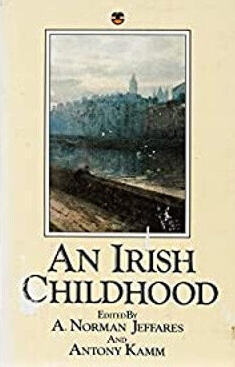
This is a book I’m rediscovering, and I’m delighted that it’s easy to find as a second-hand book. Published in 1985, it is mis-titled as what it offers are over one hundred autobiographical cameos of ‘childhoods’, as different from one another as they can be. A. Norman Jeffares (an Irish literature specialist) and Antony Kamm (an historian) have assembled often touching insights into growing up in Ireland. They start in the Dark Ages with arguably mythological accounts of Cuchulainn’s boy exploits and move quickly forward to Finn’s escape from his family’s murderers. Despite their status as legendary, these tales bear some kinship with the tale of the escape from Dublin Castle and survival against the odds of the truly historical c17 Red Hugh O’Donnell.
Most of the stories date from the nineteenth and twentieth centuries, and many deal with miserable school experiences. You won’t be surprised to read of Bob Geldof tormenting the priests at Blackrock College by asking inconvenient religious questions, or Edna O’Brien recounting how she sinned by the hour – ‘the sin of devouring an illicit jam tart…the sin of smiling at a nun and having bad thoughts’, the ‘sin’ of ‘hawing on the mirror’ to give oneself ‘a dreamier look’. There are more serious narratives: of exposure to deaths of loved fathers (T. R. Henn and C. S. Lewis); of children being coerced into childminding younger siblings by servants who tell gothic horror tales of pigs eating infants; of the joy afforded lonely children (Swift’s close friend Letitia Pilkington) by mastering reading, and in Micheál MacLiammóir’s case, of discovering the theatre. That many of these tales have the glamour of nostalgia about them — backyard jungles in a remembered Youghal have a way of turning in adulthood into tattiness, a derelict rooming-house, and the romance has died. But even in this realist narrator’s adult mind the thrill of Saturday afternoon outings to one of Cork’s five (!) cinemas and its Hadji Bey’s Turkish Delight Factory, the simple joys of childhood can still be resuscitated. I’m finding it a wonderful way to end a busy day.
Frances Devlin-Glass
October 2024
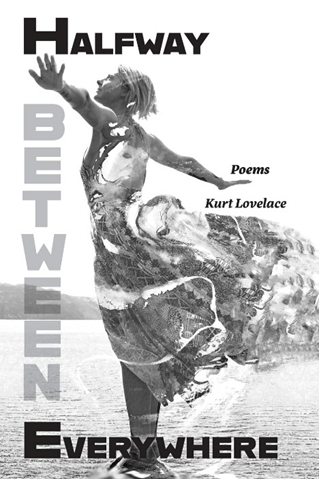
Halfway between Everywhere, poems essays and translations by the poet and writer Kurt Lovelace is a stunning book. The book includes poems on love, poems on nature, experimental poetry, political/social commentary, and poems of war. It is an extensive collection which includes some translations from French and Latin, with the English translation side by side. As a fellow poet who finds translated work intriguing, this book is thoroughly enjoyable throughout, with each poem varying in colour, shape, mood and originality. The poems embody a rich fluency with some confronting images and pounding introductions, evoking a range of emotions as one reads. The lush descriptions and vivid metaphors stay with one long after putting the book down. The book includes poems written throughout his life, some as early as when he was 17 years old.
‘Everest’ stood out for me.
I grasp the impulse that might be driving you
to pity me in some odd way for being flabby and fifty
to your skinny and twenty, but you know, I like most
people stopped ageing in my head at twenty-one,
A poem that reflects the passing of time, the wisdom gained through experience. The words convey a sense of frustration and connection, suggesting a conflict of communication or empathy. The lines express a struggle between the speaker and the person they are addressing, highlighting themes of alienation and the consequence of past action.
You listen to nothing we say, all day, with piercing eyes
As we watch you climbing our mistakes.
The imagery of the transformation of the physical body, the inevitability of change and acceptance. How one might still have an image of themselves which may be at odds with their physical selves. There is a wisdom here, it seems, of the value of the older self.
There is a lyrical quality to this book making it a profound exploration of the human condition. I find myself reflecting and contemplating after each piece, as Lovelace brings us from one powerful piece to the next.
Halfway between Everywhere is available from a plethora of sites online.
Julie Breathnach-Banwait
October 2024


“Many would say that one of the most laudable achievements of the Commission at this time was the decision to establish the Rath Cairn Gaeltacht/Irish speaking area in Co. Meath in 1935, an area where Irish is still the predominant language spoken today, almost ninety years later”
This is at variance with the comments in “Windfall” above.