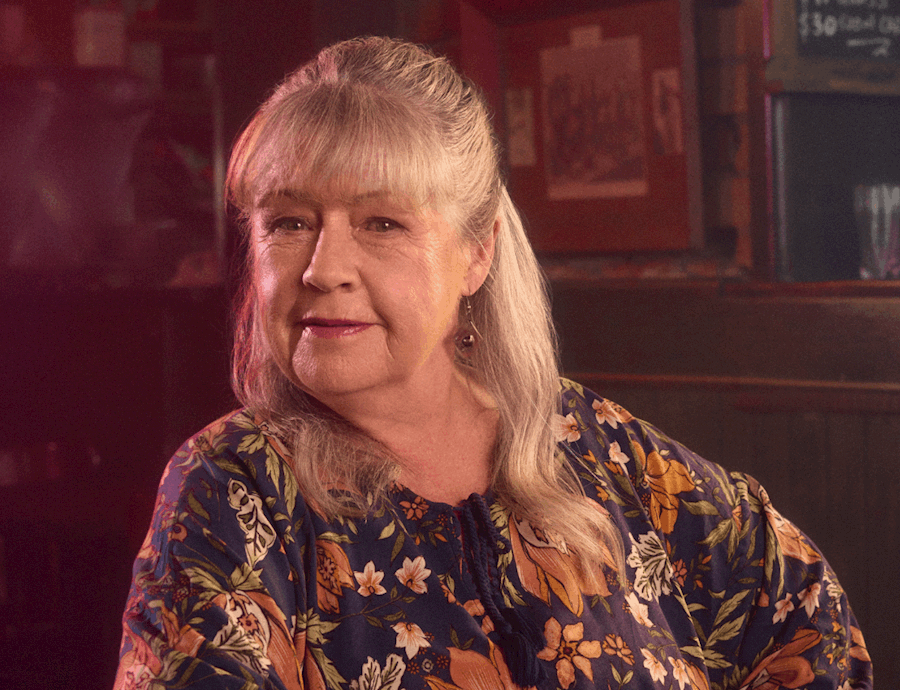
Daniel Keene: The Lark, starring Noni Hazelhurst, directed by Matt Scholten. Arts Centre Melbourne, 3-20 September 2025
I loved The Lark. Though set in familiar Fitzroy, I could have been in Ireland.
Both Daniel Keene, who wrote the play, and Noni Hazelhurst who plays its only character, Rose Grey, are brilliant. Keene’s script captures perfectly the vibe of a pub from that distant time, its dialect and its eccentric regulars.
Hazelhurst then delivers equally perfectly what is a 70 minute, non-stop soliloquy. Her age, worn out look, accent, mood changes and body language all authentic, the latter including scratching herself and favouring her hip by using a walking stick, leaning on the bar and having to sit down for spells. The set was minimalist. Trying to put her past behind her, Rose finds herself back in the empty bar, carpet worn with beer stains and the shuffling of the years, still ruled by the ghost of her dad. She loved him but, also haunted by him, has to exorcise him to be free.
The name of the pub hints at Rose’s dream of freedom. Now and again she hears a lark singing and is comforted by the light she sees filtered through the stained glass of the pub’s front door. It’s also, of course, a reference to flight, if not quite Vaughan Williams’ Lark Ascending. Otherwise, the play is a lament of loss.
I have a wee reservation about the title. Neither the play nor the pub are a bit of a lark, in the sense of harmless fun. In my experience, pubs from the time depicted in the play were the pits. I witnessed the drink’s human wreckage when I lived in a country pub for three years in the 1950s, a culture, if that’s the word, that was a direct transplant from Ireland. As in Ireland, blokes visited to escape daily life and drown their sorrows leaving the mess to their wives to clean up. ‘Ladies Lounge’, scoffs Rose. ‘What were they supposed to be!’ Fitzroy, where the play is set, once had no less than 35 pubs.
But how satisfying to attend a totally Australian creation. When the AFL for the grand final has to import someone from Trump’s US called Scruffy Mongrel, or something like that, Melbourne’s very own Arts Centre offered our very own local masterpiece.
The world premiere of The Lark is playing at The Arts Centre, 3-28 September 2025.
Pat Walsh

Having read that another of Claire Keegan’s stories was to be turned into a film, I set out to find that story. Luckily, ‘Walk the Blue Fields’ is also the name of a short story collection that was published in 2007, so it was easily found in a Google search.
Although published early in her career (2007), Walk the Blue Fields has all those elements we love about Claire Keegan: rural Ireland, failed love, unrealised dreams, quiet desperation, and roaring protest.
Then there are those sentences, those fragments, that catch the reader’s heart: the sound of the wind ‘A tender speech…combing through the willows,’ clouds in a sunny sky ‘throwing legitimate shadows on the lawn,’ ‘Laughter…clear, like birdcall over water.’
Keegan’s humour is another aspect to savour: ‘springs coming up like mortal sins through the mattress,’ and the black humour of a mother’s revenge in not washing the frying pan after the dog had licked it clean: ‘Let them all get sick.’; Women’s minds are ‘enough to attract a man and frighten him all at once’; and then the last line of ‘The Long and Painful Death’ that comes after a suspensful tale of a writer living in isolation and an unexpected male visitor.
Walk the Blue Fields comprises seven short stories. The fourth, ‘The Forester’s Daughter’, was published separately in 2019 and would make a good film. Martha, the forestor’s wife is a storyteller. When the neighbours came to visit she is ‘plucking unlikely stories like green plums that ripen with the telling at her hearth.’ The second story, ‘Walk the Blue Fields’, is a surprising pick to me for a film. The short story has a priest as the central character and is told from his point of view. The upcoming film promotes the female in the story, the bride on her wedding day, to be played by Emily Blunt, and a love triangle that is not mentioned in the short story. It will be interesting to see how the script is developed. The director will be John Connolly who directed Brooklyn, and the promotion says the film will be based on ‘Walk the Blue Fields’, and will be coming to a cinema near us, next year.
Dymphna Lonergan
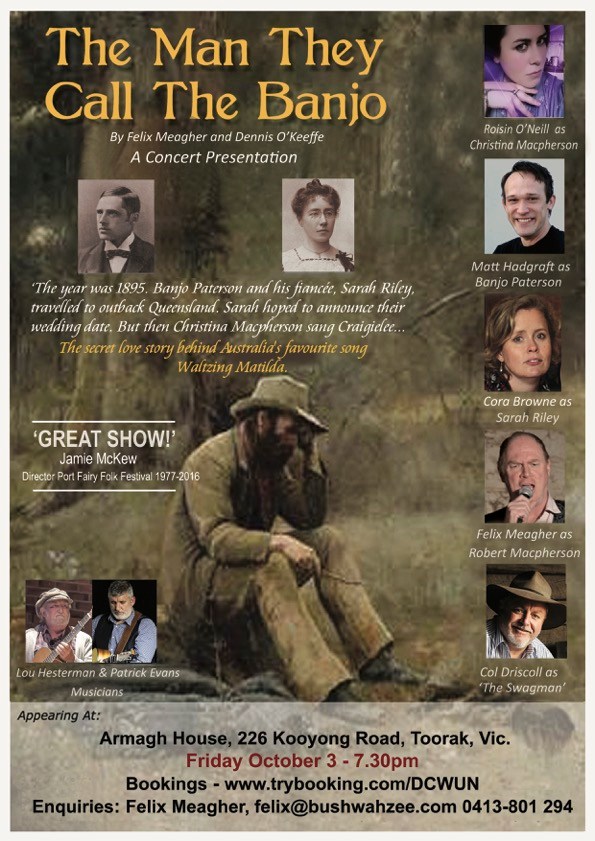
Concert Performance of (the bush musical) The Man They Call the Banjo by Felix Meagher and Dennis O’Keeffe. A one-off performance at Armagh House, Toorak, on 3 October 2025.
Featuring Matt Hadgraft (as Banjo Patterson), Cora Browne (Sarah Riley, his fiancée),Roisin O’Neill (the squatter’s sister), Felix Meagher (the squatter) Col Driscoll (the Swagman), and Ewen Baker and Patrick Evans as musicians.
This play with music has at its heart the story of the making of ‘Waltzing Matilda’. Is it a lovesong or a political song? It turns out in this light-hearted tackling of the story behind the iconic Australian song, it is both.
It’s terrific to see an astringent and comedic take on bush nationalism and for it to be spun also in the context of a love-story. I loved the offbeat construction of the Banjo as a preening narcissist. He’s very keen on his reputation as a Lothario and has a fiancée to whom he hasn’t committed in seven years. His new romantic flame shares his radical politics and his love of poetry. She also brings to the party an ability to remember tunes by ear, but cannot annotate them.
The other crucial frame in this play is the fallout from the Great Shearers’ Strike of 1891 in Barcaldine, in which shearers rose up in armed rebellion against their wages and conditions, providing the spark for the establishment of the Labor Party and a motive for the murder. The spokesman for this position is of course, the Swaggie and his’ ‘suicide’ is questioned in the play. The play wades into a wealth of debate about the contest between squatters and the workers they depend on, as well as contested versions of the story behind the song, and does so on the back of Dennis O’Keeffe’s and Felix Meagher’s research on the subject.
The play also paid attention to the music of the song and its origins in the new squeeze’s memory of hearing the old Scots tune, ‘Craigielee’, significantly a love song, during a visit to Warrnambool. In this play, the variations matter, and the song is a joint creation by Christina (the squatter’s sister) and the politicised Banjo, who identifies with a different class of worker and hates his own job as a towny and a solicitor.
The contest between the women was entertaining and not a little acerbic on Cora Browne’s part, and she enjoyed the opportunities to be villainous, desperately hanging on to ‘her’ man.
The music is toe-tapping and brilliantly and often delicately played on a variety of instruments by cast and two accompanists. This team is hugely musically talented. There was a mix of original compositions, and others riffing wittily on ‘After the Ball is Over’, and the audience gets to have a go, too.
If you get the opportunity to see this play, I’d strongly recommend it.
Frances Devlin-Glass
House of Guinness
Streaming on Netflix – 8 episodes
This fictional period drama from creator Steven Knight of Peaky Blinders fame has been compared to a cross between Peaky Blinders and Succession. There is not that much to compare though, other than sibling dynamics and powerplays. House of Guinness lacks the wit and grit of the other two. the Guardian noted British and American critics gave House of Guinness rave reviews but Irish critics hate it. I’m going to side with the Irish critics here.
The first episode sees the funeral procession of Anglo-Irish patriarch Sir Benjamin Lee Guinness with a backdrop of Fenian protestors. This sets the scene for the sometimes violent or otherwise tortured conflict between the main characters. Herein lies the problem with this loosely based version of history. The Irish Times denounced the show as exhibiting a ‘stunning lack of appreciation for who the Anglo-Irish were and where they fit (or didn’t) into Irish society. Furthermore, the Fenians were depicted as ‘feral leprechauns.’ The show quickly descends into cliché. When the character, Byron Hedges is introduced, I did ask myself, ‘what is he wearing?’
I know this is fictional history, but I did find myself doing a fair bit of ‘googling’, such as ‘did it snow in Dublin in the 1860s?’ Or ‘were abortions a ‘thing’ in mid 19th century London? Was Byron Hedges a real person?’ Apparently not.
Was there anything I liked about House of Guinness? I liked the soundtrack, I liked the juxtaposition of rappers and contemporary Irish bands with historical fiction, it gave off a bit of a steampunk feel. I liked that there are Irish-language subtitles and I liked the big bold captions comparing money amounts to today’s equivalent.
That’s all.
Linda Rooney

