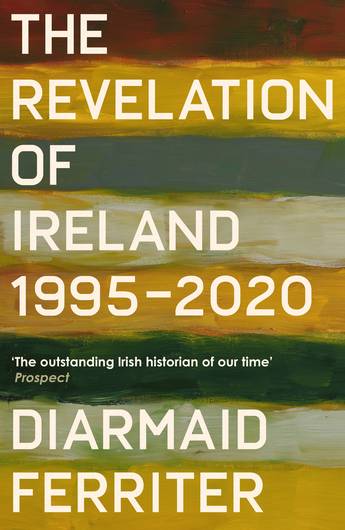
Diarmaid Ferriter: The Revelation of Ireland 1995-2020, Allen & Unwin, A$55
ISBN: 9781800810945
RRP: $55
Book Review by Séamus Bradley
It is no secret that between 1995 and 2020, Ireland went from bust to boom and back again; from war to peace; from emigration to massive population growth.
Anyone paying attention knows that the influence of the Catholic Church crumbled as historical abuses were brought to light.
National confidence grew, diminished then grew again; swearing became a national pastime and Ireland winning at international sport quite common.
Ireland’s place in the world changed, and even the power dynamic between the Republic and Britain briefly flipped after a majority of UK voters (mainly in England, but also in Wales) chose to leave the European Union.
Ferriter, perhaps best known to those of us outside Ireland as an engaging and informative Irish Times columnist, covers all of that and more in 418 action-packed pages (with 133 pages of detailed notes, sources, bibliography and index).
He writes with the immediacy of a reporter and the fine eye for detail of the historian; there is barely a sentence that isn’t referenced, yet the forward thrust of the narrative remains urgent and uninterrupted.
Ferriter admits that such instant history may barely qualify as history at all. He draws in FSL Lyons who argued that contemporary history ‘suffered from fundamental disabilities, which place it firmly and irredeemably outside the cognisance of the historical profession’.
The Revelation of Ireland may have more in common with ripped-from-the-headlines journalism than considered, long-view history, but is no less valuable and engaging for all that. It is definitely not irredeemable.
What Ferriter describes happened, and what happened has a significance that may yet resonate through time. As Chinese Premier Zhou Enlai is reported (perhaps mistakenly) to have said in 1968 about the importance of the French Revolution, it is too early to tell.
The collapse of the Catholic Church in Ireland and elsewhere, for instance, will be viewed in monumental terms. The expectation is that we will eventually perceive the true context of this period of Irish history, even if only in a century or two.
Meanwhile we have The Revelation of Ireland, a follow on from Ferriter’s own Transformation of Ireland 1900-2000.
Naturally, Ferriter defends his approach, maintaining that ‘there are legitimate reasons for historians to attempt to make sense of recent events, including to challenge the infuriating mantra ‘We are where we are’, which invites a closing down of much historical perspective’.
Delaying the judgement of history also helps the guilty avoid blame and responsibility.
Ferriter defence of his approach is aimed more at his fellow historians than casual readers, who mostly won’t care:
Reflecting on recent experience also makes the historian think about the extent to which the upheavals of the early twenty-first century will fundamentally alter how the fortunes of the two Irish states over the course of their first centuries will be framed historically in the long-term.
And upheavals there were aplenty. Sometimes decades happened in weeks, to paraphrase another likely misattributed quote, this one to Lenin.
In documenting the Northern Ireland peace process, Ferriter reminds us how fragile it all was. The massive effort, the US interventions, the compromises and the creative ambiguity that was needed to silence the guns.
He describes how those who did the early heavy lifting for peace, especially John Hume, were muscled aside as the prospects for peace and glory grew, but only once most of the reputation-threatening graft of opening a ‘new space for a different type of dialogue and a balancing act between principle and pragmatism’ had been done.
Ferriter brings together the views, works or words of politicians, bureaucrats, the public, artists, singers, novelists and journalists. Nothing and no one is beyond his hoovering up of fact, insight, anecdote or opinion.
On the horrors of the Magdalen Laundries, he quotes novelist John Banville who observed in The New York Times: ‘Everyone knew but no one said. Perfectly decent people can know a thing and at the same time not know it. We knew and did not know. That is our shame today.’
The Irish public as a sort of frog boiling slowly in a thick broth of power, misery and denial.
The journalist and commentator Fintan O’Toole, an internationally respected giant of Irish journalism who captures many aspects of the Irish approach to unbearable facts went further.
As quoted by Ferriter, O’Toole wrote of ‘a system of feigned ignorance’ where ‘you have one eye open and one eye closed, and we hadn’t yet decided whether we wanted to look at the country with both eyes open’.
While acknowledging historical, cultural and power-dynamic contexts that can damage individual perceptions, the old blind eye, throughout this work, Ferriter not only keeps both eyes open, he looks around with a piercing acuity, pointing to telling detail after telling detail.
Without stating so baldly, he demonstrates that the ability for ambiguity that helped bring peace to Northern Ireland also had a dark, unreconciled side.
But Ireland didn’t get everything wrong.
Brexit, where Ireland’s nearest neighbours decided to quit the European Union and then its rulers chose to thumb their noses at Brussels, was handled delicately and well by Dublin.
The great fear was a resurgence of violence in Northern Ireland as the rift threatened the return of a hard border with the Republic, damaged Anglo-Irish relations and ‘reopened many issues around which there had been accommodation or acceptance’.
Northern Ireland voted 55.8 per cent remain, so a tiny part of the UK was pulled out of the EU against the will of the majority of its voters, creating great resentment, and maybe some opportunities for comic irony.
Ferriter describes an interaction between English-born writer Ian Sansom who lives in County Down with his wife. In 2019 they had the following exchange. ‘My wife says I have started referring to “The Brits”: “you do know you are an actual Brit”? she says.’ Maybe not anymore.
Meanwhile down south, early twenty-first century Irish society was being transformed by immigration. The population and religious diversity soared, and despite economic turmoil there was ‘a remarkable degree of social stability’, at least at first.
By 2021, across the whole island, the population surged to seven million, the highest recorded since the 1841 pre-Famine census (which was 8.2 million, with the 1845 population estimated at 8.5 million).
Ferriter lays out the details of immigration, emigration, social cohesion and Ireland’s ancient preparedness to ‘scatter their children around the world in order to preserve their own living standards’, a critical economic safety valve that again provided a new release of pressure during and after the global financial crisis.
The end of The Revelation of Ireland 1995-2020 is, of course, not the end of Irish history. Events, perceptions, society and culture continue to evolve and hopefully Ferriter will persist in chronicling, with his cold eye and telling detail, the travails and triumphs of the complex peoples co-habiting on a small island at the edge of Europe.
Looking forward to his next book, it will be interesting to explore his take on what Brexit in the UK and Trump in America has done to the evolving and increasing versions of Irish identity.
Certainly many will identify as more European. But will they still say, when asked if they went abroad for their holidays ‘no, I went to America’?
Right now, it’s too early to tell.
Ferriter’s instant history of Ireland’s recent past will likely be used by future historians to inform their own works and interpretations of that period. For the rest of us, we can simply enjoy his brisk journey through recent events.
SÉAMUS BRADLEY
Séamus Bradley is an Irish-born award-winning journalist and crisis communications professional based in Melbourne, Australia. He is a former news editor at The Age and associate editor at The Sunday Age.

