By Frank O’Shea
On the back cover, it says that the price is ‘£1.95 or in Australia $4.95 (recommended)’. Perhaps that is a hint as to antiquity, but it has travelled back and forth across the world and has lived in Dublin, Sydney and Canberra before settling here in Melbourne.
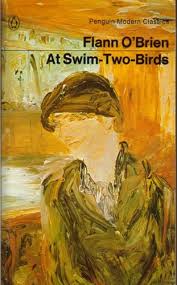
Correction. It was first published in 1939, so the word antiquity is probably not appropriate, but it is well to note that it has travelled extensively without losing its back cover
Anthony Quinn’s learned account of bird-man Sweeney and his representation of that worthy’s rumination through art persuaded me that I should re-read the great Flann’s work.
It may be relevant here to point out to our readers that among the other members of the Tinteán collective are experts on and enthusiasts for Flann’s contemporary James Joyce, who made laudable but unsuccessful attempts to have Two-Birds reviewed in the French media.
Nature of collective expertise: sapient, academic, panoptic.
To return to our muttons, I read it slowly and carefully and as I went along, began to think I had not read it before. I got to like Trellis and the way that his characters took over his life and put him through much suffering. The incident of the rustlers in Ringsend was vaguely familiar, but since I worked for some years in that general area of Dublin, my recollection may have been no more than revived domesticity.
I loved the story of King Sweeney who made ‘a great run out of the house without a cloth-stitch to the sheltering of his naked nudity’ and did not stop until he had attempted to consign a local saint named Ronan and his psalter ‘to the lake, at the bottom.’ Fortunately for the saint, the king was called away to a battle, and an otter returned the psalter to Ronan ‘unharmed, its lines and letters unblemished.’ Ronan put a ‘malediction on Sweeney by the uttering of a lay of eleven melodious stanzas.’ At this stage, Mr Quinn does his explanation of the story.
The main focus of the book is the way that the characters created by Trellis took over from their writer and we learn about each of them – Furriskey, Lamont, Shanahan and the Pooka MacPhellimey – and their determination to punish their soporific creator.
The longer the book went on, the more convinced I was that I had not read it before, but then I found on the bottom of page 189 a note in my pencilled handwriting. It referred to an incident where Furriskey is explaining his learning to the Pooka. ‘A gas expands to the extent of a hundred and seventy-third part of its own volume in respect of each degree of increased temperature centigrade,’ he says.
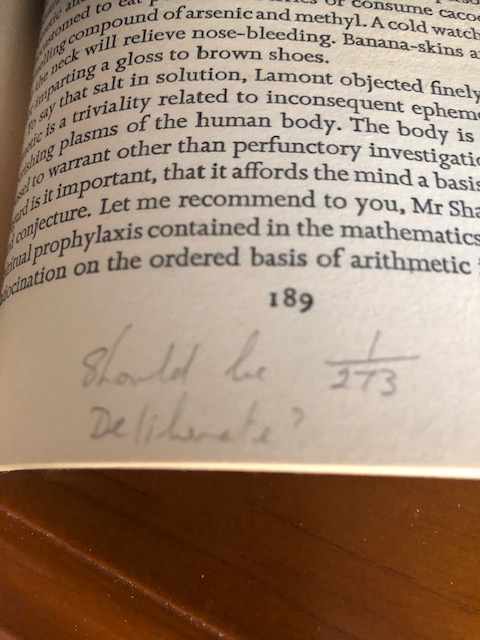
My pencilled comment at the bottom reads ‘Should it be 1/273? Or is it deliberate?’ The comment may be an oblique advertence to when I first met the book, a time when there was still a UCD physics theatre in Earlsfort Terrace; though reading it now, I feel it is nonsense anyway.
Nature of nonsense: pretentious, deliberately bombastic.
My bookshelves have most of the great Flann’s works, including some recent collections of his contributions to The Irish Times as Myles na Gcopaleen. He died of cancer in 1966 at the relatively young age of 55.
Snámh-Dá–Éan is said to owe a debt to Joyce and Sterne and even Lewis Carroll, but that is for American postgraduates to discuss; they might even investigate its influence on modern writers like Tom Robbins and Jasper Fforde. A more satisfactory thesis would be to say that the book is unique.
Like his contemporaries Brendan Behan and Patrick Kavanagh, Flann O’Brien had what we benignly call a drinking problem. It was a contributing cause to the untimely deaths of all three within a few years of each other, though only Flann managed to die on 1 April.
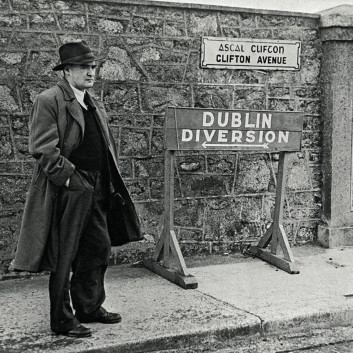
Frank is a member of the Tinteán editorial collective
 Tinteán