by Anthony Quinn
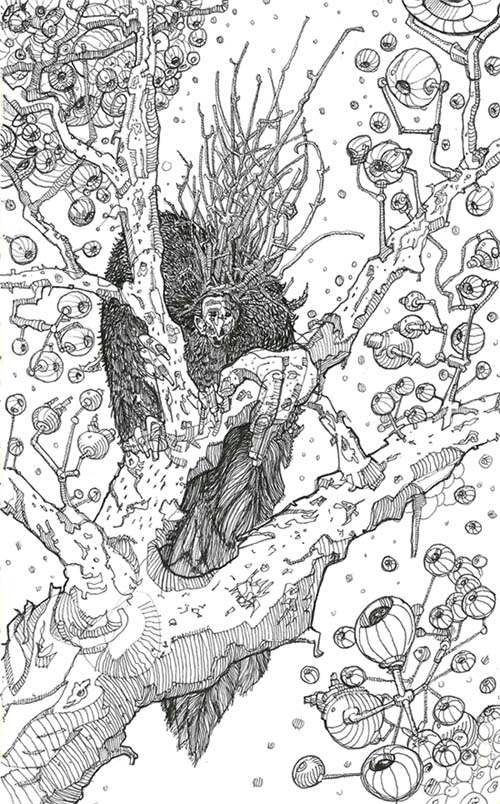
After a prolonged travel and a searching in the skies, Sweeny arrived at nightfall at the shore of the widespread, Loch Ree, his resting place being the fork of a tree of Tiobradan for that night.

Irish author Flann O’Brien’s At Swim-Two-Birds is a work of metafiction – a story about writing stories, a chaotic comic story. At least three storylines all play out at once. The book’s structure and long tracts of ‘found text’ from seemingly unrelated sources make it a disorienting read that is difficult to describe.
The book satirises the ‘Irish Revival,’ a literary movement that came to the fore in the early 1900s. The Revival was a response to English colonialisation. It celebrated Ireland’s literary heritage which had been actively undermined and overwritten with colonial values.
In At-Swim-Two Birds, a student of Irish literature pens a novel that includes the character of the mad King Sweeny. Matters spiral out of control when the student becomes distracted by the temptations of Dublin’s pub life. He does not notice that the main character of his story (Trellis, also an author) becomes overwhelmed by characters from his novel. Chaos ensues.
I cannot remember exactly how I discovered the book in my teens. What I can remember is the experience of reading it for the first time, of getting lost in its marvellous, frenzied chaos and laughing aloud. It holds a unique appeal for me as an artist because, like a spiral staircase, it tricks you into thinking that you are simultaneously working towards a destination and moving away from it. It is a non-linear journey towards a conclusion that often lies outside our grasp, tantalisingly close. Each step on the staircase, or each reading of the book, opens a new perspective.
So too for Buile Shuibhne, a medieval Irish myth, roughly pronounced as ‘Bwill-eh Whiv-neh’ which means ‘The Frenzy of Sweeny.’ Suibhne Mac Colmáin was a king cursed and condemned by a Christian saint, becoming half-man, half-bird. Stripped of his worldly wealth, he suffered the harrowing loneliness of a life on the fringes of society.
Sweeny survived on watercress, drank from freezing rivers, and slept in the wind-torn branches of yew trees and thorn bushes. His mind was unhinged as he flitted between treetops, lamenting his suffering. He watched as friends, family, and society moved on and changed. Sweeney took comfort in reciting poems inspired by nature’s beauty. He defiantly refused to come into the fold until his dying moment.
What is the connection between Mad Sweeny and surveillance capitalism?
My drawings join the dots between my interests and experience. They are unplanned journeys. This one started on a threshold: the edge of the Australian bushland and the suburbs of Sydney’s Upper North Shore.
One morning, I watched the sunrise edge along sandstone valley walls over tangled treetops, highlighting the houses with the best vista on the opposite side of the gorge where I stood. My eyes followed wandering gullies to the distant horizon. All of this is just a few steps from the street.
You can be utterly lost within reach of a phone.
Amid this wilderness, you could grab your phone and drop a pin on your location in Google Maps. Thinking I would share the experience, I composed a photo. Framing the scene with this little slab of technology, I visualised:
a ping to a silently watching satellite
a datum registered by an algorithm
running on a machine
sitting in a humming data warehouse
who-knows-where?
These fragments of ‘me’ are catalogued and shared with whomever in the ether:
my picture
my camera settings (not that I know them)
my location and time of day
my turn of phrase on social media
my friends
Enter Mad King Sweeny
‘Not this time,’ I thought, pocketing my phone. I settled back to staring into the trees, letting my mind wander. Noticing whatever I noticed.
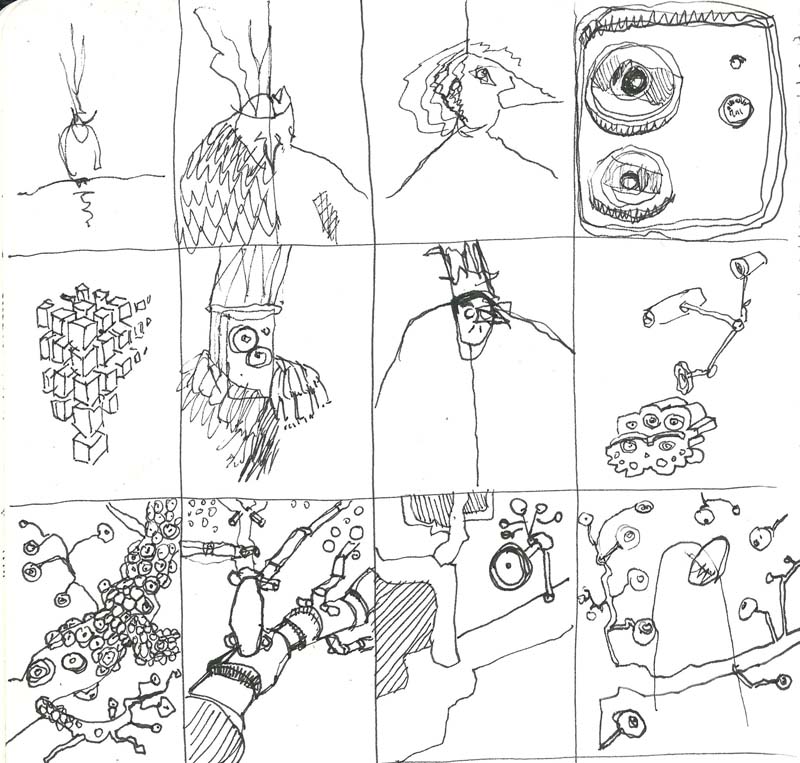
In the following days, an image of King Sweeny surfaced in my sketchbook. I like to divide a page into postage-stamp-sized grids and then draw whatever comes to mind. Sometimes an idea or theme emerges that takes on a life of its own. Channels open. Ideas flow.
Sketch 1
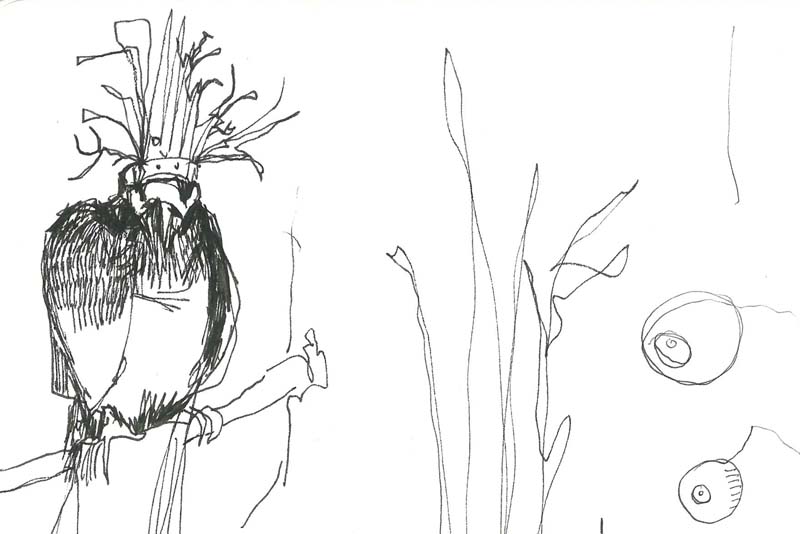
King Sweeny and other bird-man transformations emerge in my sketchbook. Making these drawings took me back to when I first met Mad Sweeny in the pages of At-Swim-Two Birds.
Sketch 2
Ireland experienced the First World War, the 1916 Rising and War of Independence, the formation of The Republic and a divisive Civil War in quick succession not long before At Swim Two Birds was written. The book exudes confidence in form and deft use of language. There is also tension between people wanting to move into the modern world while tying up the loose threads of the past. Resonance with today’s tug of war between interconnected networked devices and our natural need for solitude.
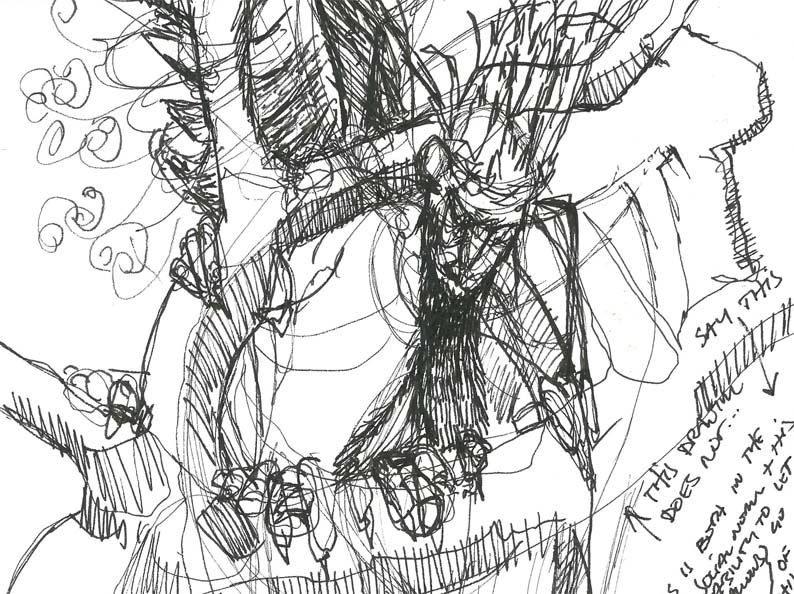
Sketch 3
The character of this raving bird-man, this fallen king who lived in the treetops, somehow made sense. Sweeny, the fallen king holds my lasting attention. He is both repellent and intriguing
Sketch 4
I explored the concept of revelling in the wilderness, featuring Celtic spiral motifs. However, I felt the image was too derivative of Van Gogh’s starry night.
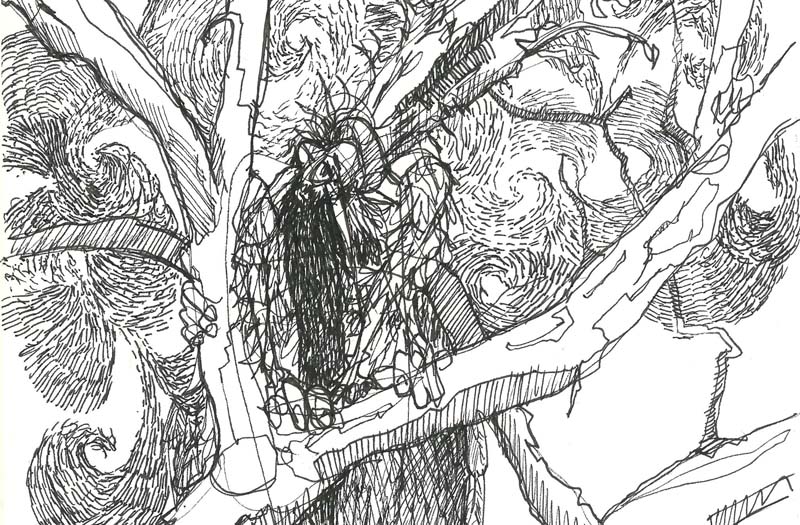
Sketch 5
King Sweeny wears a cloak of leaves perched in a tree with a sky of churning spirals in the background. He stares from the branches of his treetop sanctuary watched over by millions of cameras.
Anthony Quinn, Artist
My art explores a parallel universe where Irish mythology crosses over into today’s world. I’m native to Ireland and also an Australian citizen, living in Sydney. I draw and write for people curious about myth, symbolism, machine intelligence and making art.
We are influenced by the images and words we experience. I make art that’s positive, encouraging, and optimistic. It’s important to engage with the world as a critic. It’s also important to recognise the goodness in humanity and our potential for betterment.
You can follow my journey here
 Tinteán