A Post-Bloomsday Feature by Frances Devlin-Glass

Another June 16 and another Bloomsday has been celebrated around the world. For those who did not get to celebrate at a local event, a Sydney website http://www.bloomsdaysydney.com/ is still available. It includes readings from the novel that is the central focus of Bloomsday, named for the chief character Leopold Bloom.
Here in Melbourne, the enthusiasm for Joyce was high, and in a rare departure from usual practice, we mounted what became, much to our surprise and joy, a sell-out season of his only play, Exiles. It hadn’t been performed in Australia for over 40 years, and such is the caché of Joyce (and not exclusively among the literati), and the hunger to be empowered to read Ulysses in particular, that folk were curious to see the play because Exiles is a stepping stone to Ulysses, and of interest in its own right for its forthright version of love and marriage.
Tinteán readers who might be thinking of one day trying to read James Joyce’s Ulysses could start by browsing the online edition at https://www.gutenberg.org/ebooks/4300 before borrowing or buying a copy of the book. And there are many fine editions around you might choose. There probably will never be a definitive edition, because of the conditions under which it was produced: Joyce was meeting his self-imposed deadline, his 40th birthday on 2 February 1922 ; he kept correcting and adding to the novel, even at a late stage of its writing; it was typeset by a non-English-speaking printer, Darantière, and so is full of errors, and subsequent editors have squabbled for 100 years about his intended text.
I met Ulysses as an undergraduate at the University of Queensland, among the first generation of readers to do so there. A single week was devoted to it in a third-year course, by somewhat bemused lecturers (they coped a lot better with A Portrait of the Artist as a Young Man, a much more formally conventional novel than Ulysses). I don’t think I understood a lot of Ulysses after a week and a bit’s study, but it was enough to ignite a spark. We were reading in 1968 with only one aid, Blamire’s The Bloomsday Book, and I knew even as a 18-year-old that he was misinformed (though pontifical) about Catholic culture, so that was a spur to debate with him, though I’d never any longer recommend Blamires as an aid. A good starting point for a general introduction to Ulysses is Declan Kiberd’s Ulysses and Us: The Art of Everyday Living. What liberated me when I was considering teaching the novel, and wondering if it was too difficult for undergraduates, was a meeting with Professor Clive Hart at LaTrobe University, a notable Joycean, who advised me that even highly literate university professors who were first-time readers needed a simple synopsis (many are available on the internet) to make progress with it, but that that crutch would be abandoned for a second reading. It
What did I love about the novel as a first-time reader? It’s undoubtedly the comedy of Ulysses, and I thank those early professors for alerting me to it, giving me permission to laugh. ‘Great works’ come freighted with the (unintended often) message that they are serious. Progressively, the novel became a lens through which to understand a culture I’d inherited, Irish culture, but that did nonetheless seem ineradicably foreign, though never as foreign as some.
I also loved its libertarianism on sexual issues. The big ferment in Queensland in my late teens was state interference in many areas of life: the right to protest about conscription for Vietnam, and right up there, censorship. When I was recommended (oddly, by a Sacré Coeur nun) as a representative, younger literature-trained book-lover to read books on behalf of the Commonwealth Censor (under Don Chipp’s liberalising leadership), I readily agreed, imagining being able to influence their decisions, and feeling quite sure that having read de-bowdlerised Shakespeare and Joyce, I was well-equipped. I wasn’t at that age, but Joyce was my touchstone for a different take on sexuality aged 21. They also knew I was opposed to censorship, and it didn’t deter them from sending the books.
I’ve taught Joyce to all manner of students for more than 50 years, even second-language speakers, and those not trained in literature, and the obstacles are not too difficult for most people with time to invest in the novel. Let me offer my nine (really ten) best tips for those who want to make Ulysses their own. Maybe by next Bloomsday you’ll have discovered it is not as formidable as its reputation.
Nine Top Tips for Reading Ulysses
- Listen to the novel – the 1982 RTE version is gold standard, so download this free version. Bloomsday in Melbourne’s 2020 slam version, a short short film festival, might also be useful (see for 18 short, short films and a blog and reflections on the Bloomsday website. There are a 22 CD set by Naxos and RTE and a 4 CD set of highlights by Naxos – both excellent. But RTE 1982 is best.
- Two full-length films – Ulysses by Strick (on YouTube free) and Bloom by Stephen Rea (2004) – are also a compromise. The Strick is generally regarded as superior and will give you some guide-ropes and make palpable the comedy. It’s a tad weird. It was low-budget and does some curious things with costumes (sometimes vintage 1904, sometimes modern and 1960s). The most imaginative sequence is the scene in the brothel.
- Expect little plot, and very complex, multi-faceted (but comprehensible) characters. They are somewhat cubist in construction – lots of facets. The plot is simple: Molly engages in the first extra-marital tryst in her 16-year marriage and her husband Bloom has to work out what he’ll do about that, and does. The third central character, Stephen, is wracked with guilt about refusing his mother’s dying wish and confronts her ghost in imagination. That’s it. Much of the profound pleasure of the book is how Joyce builds character and tells the story.
- It may seem a bit weird, but I strongly recommend for a first reading to start either with the last chapter (Penelope in which you’ll meet the free-spirited Molly Bloom) or the fourth (which is your introduction to Leopold Bloom). The Bloom and Molly chapters (especially 4, 5, 6, 8, 10, 18 are very user-friendly, though they get more demanding, sophisticated and parodic from episodes 11, 12, 13, 15, 16, 17. The Stephen chapters (1, 2, 3, 7, 9,14), are the most difficult (the very most difficult are in bold), and can be read last, or patiently, in your second reading of the novel, because this is a novel that needs at least two good readings, and the second could be an A-Z reading. I’ve been reading it intensively year in and year out since 1968 and still finding new stuff in it.
- If you need convincing this is an organised book, and you probably will do, you would do well to study the Linati Schema, an account of the novel given by Joyce to a journalist Carlo Linati, by way of helping readers to surmount the difficulties posed by this astonishingly transgressive novel, which breaks almost every rule of novel-writing systematically. The Linati Schema is not entirely satisfactory, and you will puzzle over some bits of it, but in my experience, the most enlightening columns are Episode, Time, Scene, Technique, Correspondences (if you find parallels with Homer suggested by the episode headings engaging), Science/Art, and Organ. It’s good for finding your way and for realising how supremely well-organised this apparently baggy novel is, and how architectural. An organ for each chapter? What might Peristaltic or Incubism mean as Technic (or Style)?
- Linati (see 5 above) alerts you to expect stylistic differences chapter by chapter. For example, episode 17 uses a question-and-answer style (of the catechism) and instead of the language of theology uses that of science; episode 15 is in the form of a playscript (which is not a playscript but something more akin to a surrealist or expressionist filmscript); episode 11 explores how language and music work; many episodes use variations of inner monologue, and most radical in its stream-of-consciousness technique is episode 18.
- Expect a radical and transgressive book: it analyses all manner of social institutions and their modes of operation…. It systematically questions religion, the literary tradition, nationalism and the norms of romance, gender and sexuality. Joyce’s big project is to explore the body in all its glory and grunginess.
- It’s also a Literary Demolition Job: From episode 7 and more intensively from 9, Joyce sets out to demolish the received literary tradition, parody much that is sub-literary or not literary at all, and push the boundaries of what a novel is.
- Most importantly, give yourself permission to laugh. It’s a very funny novel, which refuses to take anything at face value or to take itself too seriously. Once on the inside of the joke, it’s a gift that keeps on giving.
I hope that these strategies encourage you to start enjoying Ulysses. Wherever you are in the world, you should find June 16 Bloomsday celebrations, from readings from the novel in pubs, clubs, and libraries, to the more extensive celebrations such as those in Dublin, Sydney, and here in Melbourne. If you are a Melburnian or could make your way here, you might think of doing one of Bloomsday in Melbourne’s intensive introductory or Advanced in-depth courses, or better still, do what thousands of Joyce-hooked Melburnians do, and come to Bloomsday annually, where the actors will demystify Joyce in the theatre. We select a new topic and approach to Joyce each year, so it’s always fresh and trenchant and not always reverential. To become a Joycean, subscribe here.
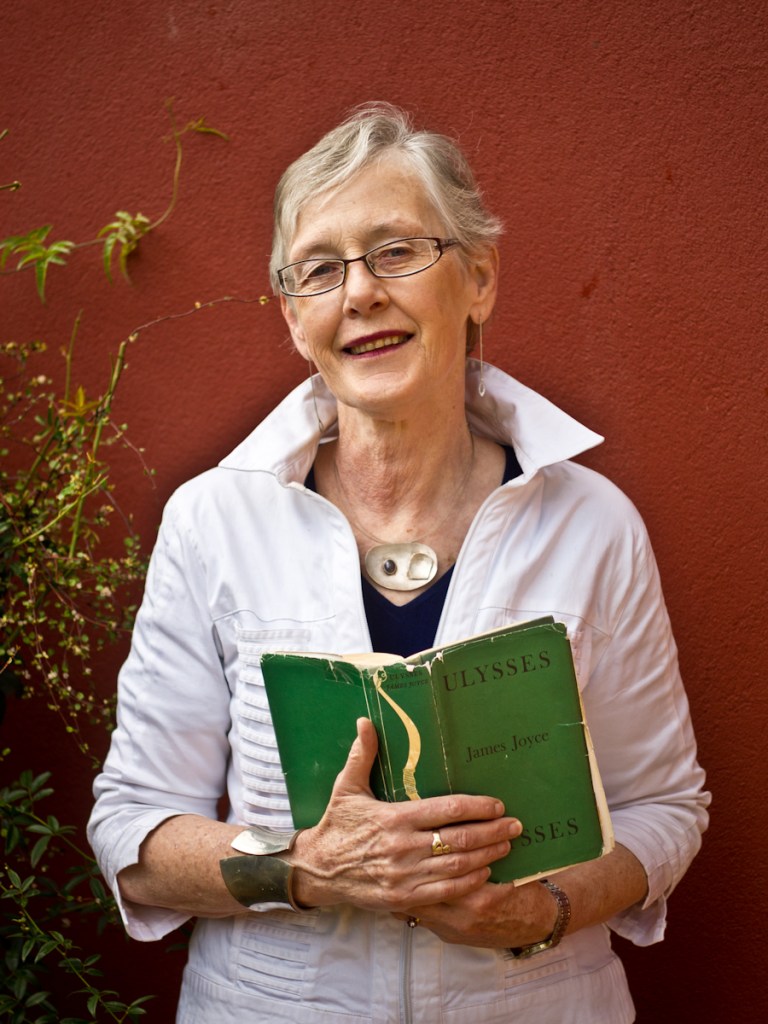
Frances Devlin-Glass
Frances was a founding member of Bloomsday in Melbourne in 1994, and has been creating scripts for Bloomsday for 30 years. She is a member of the Tinteán collective.
 Tinteán