A film review of Kneecap by Isla Sutherland
Kneecap, Screen playwright and Director, Rich Peppiat, Starring Liam Óg Ó Hannaidh, Naoise Ó Cairealláin and JJ Ó Dochartaigh, Cinematography by Ryan Kernaghan, Distribution by Wildcard [1](Ireland) Curzon Film (United Kingdom), 2024.
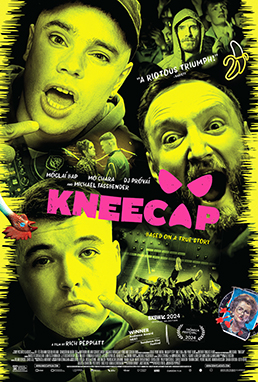
Kneecap explores Northern Irish identity and what it means to be part of the ‘ceasefire generation’ amidst lingering sectarianism. Capturing a youthful and energetic revolutionary spirit, it is a boisterous, rebellious battle cry for preserving Indigenous language for cultural acknowledgement.
Kneecap screened at the Melbourne International Film Festival (MIFF), the debut directorial feature for Richard Peppiatt. Liam Óg Ó Hannaidh, Naoise Ó Cairealláin and JJ Ó Dochartaigh play themselves: a trio of Irish language hip-hop artists
Reportedly, the three had just six months of acting classes to prepare them for cinema. All three make the transition from stage to screen appear seamless – a testament to their skills as performers and entertainers.
Challenging the biopic genre, the film takes extensive creative liberties in what could best be described as a film involving real-life characters with fictionalised origins.
Set against the backdrop of political debate surrounding advocacy for the recognition of the Irish language in the United Kingdom, the film is conspicuously political; but despite its serious message, it’s full of good craic.
Liam and Naoise, who go by stage names Mo Chara and MóglaíBap, are children of the ceasefire generation, growing up in Northern Ireland in the 1990s where the hangovers of Catholic-Protestant sectarianism are still keenly felt.
The pair is portrayed as having grown up together, learning to speak Irish from Naoise’s father Alro (played by Michael Fassbender), a former republican paramilitary in exile after feigning his own death to evade British authorities.
Flash forward to 2019, Liam and Naoise are dealing drugs at a party that is forcibly shut down by police. Naoise escapes while Liam is detained and spends the night in police custody. JJ meets Liam when he is asked to serve as an Irish interpreter after Liam refuses to speak English to British police. During the interview, JJ surreptitiously steals back Liam’s journal, seized by the police, containing hand-scrawled song lyrics in Irish (and a sheet of acid tabs) written by him and Liam.
JJ, who works as a music teacher in an Irish-speaking high school, is impressed by the contents of the notebook, seeking out the pair to encourage them to record their music and offering his garage for a studio space. And thus, ‘Kneecap’ is formed.
Their music is characterised by energetic and quick-wit lyrics with a confrontational style inflected with anti-establishment sentiment. The trio uses hip-hop as a vehicle to bring Irish language to modern audiences, internalising Naoise’s father’s mantra, drilled into the boys from an early age: ‘Every word of Irish spoken is a bullet for Irish freedom.’
In the film, the trio’s subversive messaging offers an interesting counterpoint to conventional forms of advocacy, as embodied by JJ’s girlfriend Caitlin, who is involved in the campaign for an Irish Language Act. JJ conceals his involvement in the group from Caitlin, who is concerned that the band’s antisocial behaviour and rough-and-ready self-presentation might harm the cause.
JJ, or as he is known to audiences, DJ Próvai, invokes hip-hop as a tool that gave a voice to Black Americans during the Civil Rights Movement, suggesting it, too, could offer a form of resistance, rebellion and solidarity for Irish speakers against British imperialism.
The film’s cinematography is anarchic: the visuals are energetic, chaotic, and highly stimulating. Narrated by Liam, the film feels highly idiosyncratic, supplemented with frenzied hand-written flourishes, and even an MTV-style Claymation vignette.
Named after the infamous IRA torture technique practised during the Troubles, the film is predictably violent and profane – criticisms that were made against the band themselves from their inception. The film is peppered with profanities, drug use, sex and ‘antisocial’ behaviour, but it’s raucous, devilishly funny, charmingly irreverent, boisterous and politically motivated.
The band members are staunchly critical of British imperialism (the boys are depicted playing darts using a portrait of Lady Thatcher’s face for a target, and DJ Próvai, while depicted wearing a balaclava to conceal his face, brandishes his bare buttocks donned with the legend ‘Brits Out’) and lingering sectarianism is palpable in the film; but the storyline is playfully optimistic for a future unification, as characterised by Liam’s romantic entanglement with Protestant girl Georgia (Jessica Reynolds).
Unlike cliched biopics that highlight the star’s descent into addiction (Walk the Line, Elvis, Back to Black) Kneecap is not a salutary lesson on the dangers of drug use and hedonism. On the contrary, the drug-laced film is something of an anthem for the loss of inhibition, rebellion, and creative freedom enabled by illicit substance use that will have you reaching for a swig of Buckfast and a fat rack of ketamine before the closing credits.
Problematic as it may be, the film is charmingly rough around the edges, like the band members themselves. Kneecap might be best described as part biopic, part political comedy-drama, but far from fictionalised is the film’s portrayal of the band’s impact on the Irish language.
Language-learning platforms like Duolingo have seen surges in the interest in Irish Gaelic; in 2021, it fastest-growing language on the platform, and from the end of 2022 to the end of 2023, Duolingo saw a 70% per cent increase in daily active learners in the Irish course.
Kneecap might appear to be unlikely figureheads in a political battle to preserve their mother tongue, but as the first Irish language film to be featured at the Sundance Film Festival, their efforts are nothing to sniff at.
Isla Sutherland
Isla Sutherland is a content and communications specialist for a global architecture and design firm. Isla’s expertise includes strategic content development, writing for print and digital genres, industry engagement and program delivery. Isla is also a member of the Celtic Club Cultural and Heritage Subcommittee, passionate about preserving Celtic culture and traditions.
And another Film Review (of The Outrun) by Peter Gavin
The Outrun is a 2024 drama directed by Nora Fingscheidt from a screenplay she co-wrote with Amy Liptrot, based on the bestselling 2016 memoir of the same name by Liptrot. Starring Saoirse Ronan.
A co-production between the United Kingdom and Germany, it stars Saoirse Ronan, who also serves for the first time as a producer. The film premiered at the 2024 Sundance Film Festival on 19 January 2024, without winning any awards. It has been scheduled to screen in a gala presentation at the 2024 Cinéfest Sudbury International Film Festival in Ontario which begins on 14 September.
After living on the edge in London — Rona (Saoirse Ronan) loses her job and boyfriend in harrowing scenes — and resorts to exreme drunken binges. These were very uncomfortable for me: her brawling with friends and her boyfriend; being booted out of venues because of her behaviour; and the attempted sexual assault after she accepted a lift from a stranger when drunk. All of which forced her to go to hospital. One wonders whether alcoholics who see the film would be prompted to think about attending AA meetings, because the early scenes and some flashbacks are overpowering.
Recently out of rehab for alcoholism, Rona attempts to come to terms with her troubled past. Hoping to heal, she returns to the wild beauty of Scotland’s Orkney Islands where she grew up and which she had left a decade ago.
Saoirse Ronan transmits Rona’s anguish, tapping into the despair and abject fear that she ‘will never be able to be happy sober’. Her desperate attempts to resist her desire to drink convey how tightly she is wound and the enormous self-control she must exert at every moment: dipping her finger in a glass of wine and saying things like ‘I miss how good it made me feel’ at an Alchoholics Anonymous meeting.
The film chronicles her struggle to maintain her sobriety as she returns home to her parents in Scotland’s Orkney Islands. One would think that a strong community is key to staying sober, but Rona finds her refuge in desolate isolation, journeying even further out into the Orkneys to research birds and take in the elements. There, Rona communes with the waves, the seaweed, and the rugged landscape. She finally finds healing and connection in the island’s frigid ocean waters. Orkney is very dramatic and brutal. She loves swimming in the cold water, and she also has a Master’s degree in environmental science, so she is at home with birds and seals, and in the end professes a desire to do a doctorate in some aspect of environmental science.
American-born Irish actress Saoirse Ronan is clearly very talented, and makes the film a success, for it is a very mundane story so if she were not in it, the film might not be regarded highly. She has the advantage of being attractive, so the camera is often focussed on her face, so her emotions when drunk, happy, belligerent, or at peace with the world shine through.
Peter Gavin
Peter is the convenor of the Cultural Heritage Sub-Committee of the Celtic Club and a longterm member.
 Tinteán