A Theatre Review of Samuel Beckett and the Rainbow Girl by Philip Harvey
Steve Carey, ‘Samuel Beckett & the Rainbow Girl’, directed by Carl Whiteside, at Irene Mitchell Studio, St Martins Youth Arts Centre, South Yarra, 13-23 June 2024
The symbiotic relationship between an artist and their work is notorious in the case of James Joyce. Himself, his family and friends make major character appearances in his great fictions, albeit oblique, typified, parodied, and exaggerated to serve the author’s purposes. Similarly, his family and acquaintances are caught up in the creative act itself, for good or ill. This relationship, and its real-life consequences, was the driver of this year’s Bloomsday in Melbourne play, an informed drama about Joyce’s daughter Lucia (Mary Agnes O’Loughlin) and the unknown young turk fresh from Dublin, Samuel Beckett (Jeremy Harland).
Steve Carey’s play employs varied modes to dramatize the conjunction between the everyday and high art. A comic café dialogue between litterateurs using a cornucopia of famous English quotes may be followed by a scarifying domestic argument direct from the realist school, or a chaotic song-and-dance routine that teeters on the verge of incoherence (read: madness). Carey takes a leaf from Joyce’s book, it could be said, with this confident mixture of style devices. For a brief while we find ourselves again inside the way Joyce variously transposes the world in words.
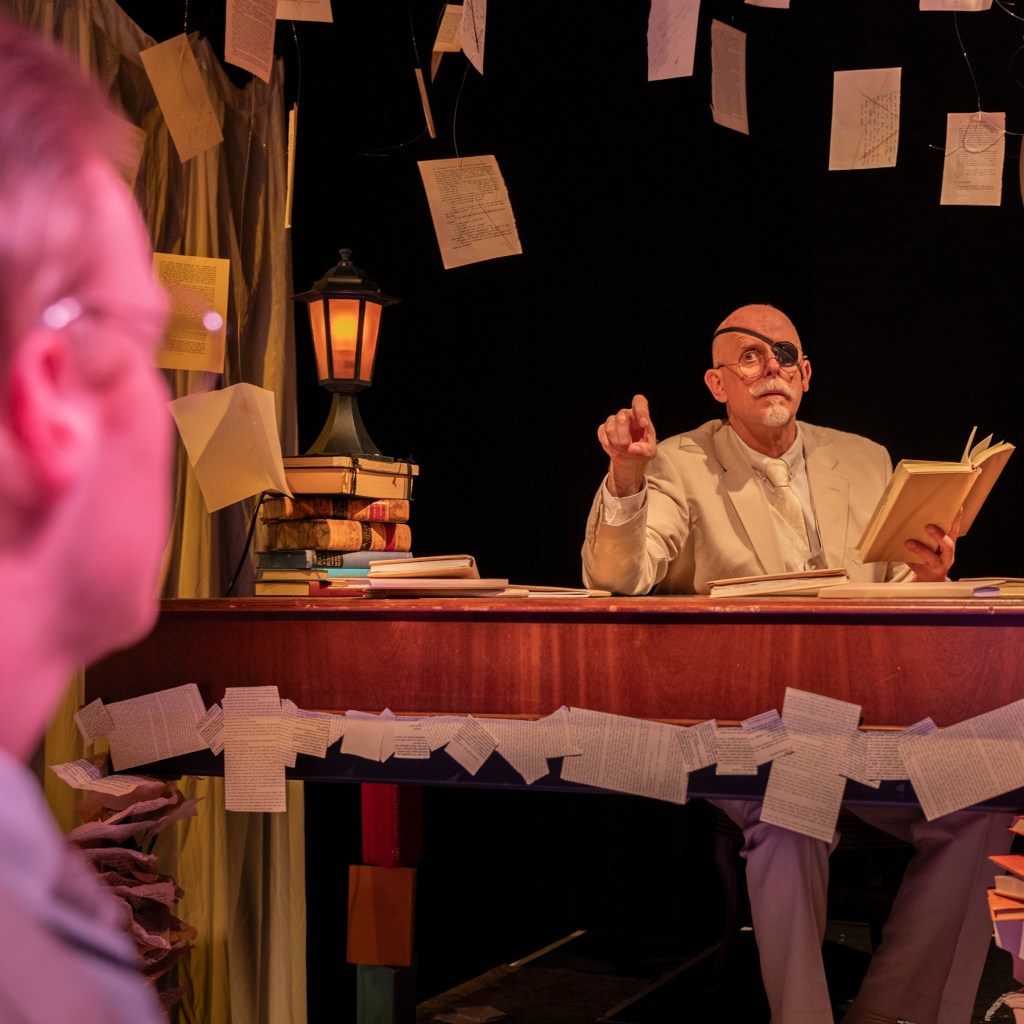
With the aid of Beckett, the audience steps into the secluded, highly protected world of the Joyce family. Nora (Carissa McPherson) and Giorgio (Daniel Cook) must manage a household determined by the unpredictable Lucia and her father, the aloof, kooky, and imperious magus whose novel Ulysses is now the sensation of twenties Paris. The set designer (Silvia Shao) positions Joyce (Tref Gare) at a desk elevated on a pedestal of hundreds of books and surrounded by a galaxy of depending pages, the object of his perpetual creative gaze. This symbolism of power and remoteness is the still point around which a great deal of energy and craziness turns, most significantly from Lucia.
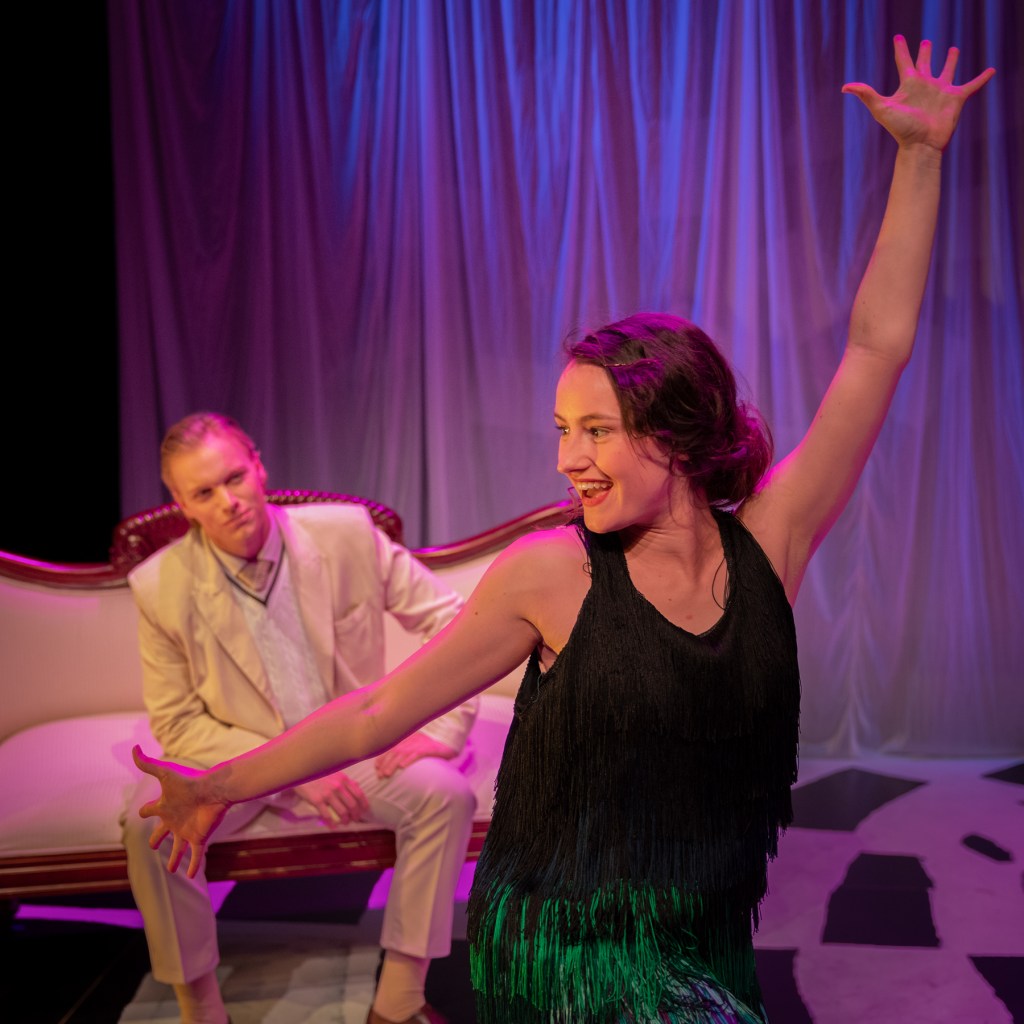
Attention shifts regularly to the next drama in Lucia’s growth as a person seeking agency and validation. O’Loughlin’s performance pushes the boundaries. Her instinctive ambition to be a dancer, understandable in a city alive with modernist dance crazes, gradually turns into a manifestation of Lucia’s selfhood, a cry for help, and a test of her ability to meet the adult world. Her slinky, iridescent dance costumes, superbly designed by Frida Moss, cut across the others’ conventional dress sense, even that of the dandy Joyce. O’Loughlin meets the physical and verbal demands of the central role with gusto, depicting a woman who at one level is living in a world of her own while at the same time being extravagantly on show.
Gare’s Joyce tippy tiptoes through the fragile family relationships, Himself in a world of his own. Bloomsday in Melbourne has seen all manner of stage portraits of the artist. This year’s model must be simultaneously the literary lion in his den, the wordsmith gone half-crazy with the materials of his trade, and yet the responsible father who somehow understands his daughter, and her difficulties, in ways no one else can. This balance between hauteur and profound human sensitivity is ably achieved by the script and director Carl Whiteside’s timing and placement of scenes.
But it’s Beckett’s name in the play’s title, Beckett who is more or less the last person standing. (Ironically or not, Lucia Joyce’s name is not in the title; she is the rainbow girl, ‘fading out … you can’t see her now.’) His apprenticeship assisting Joyce with transcribing the tarantella of ‘Work in Progress’ brings him into close proximity with Lucia. A fascination, a rapport, a friendship develops between them that might be something more but is nevertheless kept precarious. Harland plays the part with excellent formality, a necessary foil to the lithe cavortings, both linguistic and terpsichorean, of the wakeful Lucia. Carey’s close attention to biographical clues are the turning points of the play, Beckett gifting her a pair of dancing shoes that affirm her private ambitions while confirming the odd couple’s artistic commitments. She is given power to move, but at what cost?
Yet while Beckett’s encounter with Joyce teaches him he must follow a different creative path to Joyce to achieve his purposes, the same cannot be said of Lucia. Her parents’ exasperating inability to perceive Lucia’s inner creative drive not only leads them to stop the dancing mania in its tracks, nor can they offer a way forward for her pent-up energies of mind and body. We know Beckett will go on to produce his tense, spare works in French and English; Lucia will go into asylums. The concluding reprise of the opening scene has Beckett reconnecting with his friend years later during visiting hours. They relive the motif of dancing together, lucidity breaking through the miasma of weird crosstalk and sleep, like a page of Finnegans Wake. There’s something going on, but what is it? The play leaves us in a state of wistful, or perhaps that’s despairing, uncertainty.
Charming comic relief is brought to bear on this whole hothouse atmosphere in the form of Tomasso Grigio (Paolo Bartolomei). Not a name you will find in an Ellmann index, the colourful Grigio is an inspired hybrid of different literary types in the Joyce world, seemingly written with the stylish Bartolomei in mind. Italian was the language the Joyces spoke at home and Italian buoys up Ulysses, so bella figura is both appropriate and welcome in a drama that is a downward spiral towards Inferno. As Beckett’s counsellor and sidekick Bartolomei lifts the tempo, lends perspective, while his performance as a psychoanalyst who appeared to walk without aid of bone joints had to be seen to be believed.
Director Carl Whiteside and playwright Steve Carey appreciate that Lucia’s story not only has a lot of missing clues, it also lacks closure. The play engages with the existing debate about this intrinsic factor in the Joyce saga, knowing that many things remain conjectural. One theme of the play is how in death, as in life, Lucia is being sidelined and misunderstood. The theatrical resolution is to present a series of scenes, each one of which includes epiphanies (in the Joycean sense of the word) but also necessarily conundrums. Beckett’s entry into the Joyce inner world is the catalyst for a rich storyline, but one that quickly becomes Chekhovian in its conflicting desires and unintended consequences, with circumstances that are at once either ludicrously comic or painfully disastrous, depending on how we see them. As a contribution to Joyce studies this landmark play artfully leaves open the questions. As theatre, Whiteside and Carey have created a fast-moving enactment of social disintegration, a dance that bops till it drops.
Philip Harvey
Philip Harvey is a long-time reader of Joyce and often performs as a Seminarian at Bloomsday in Melbourne’s annual celebration of Joyce and his fiction. He is also a poet.
 Tinteán