Theatre Review by Daniel Boyle
What is genius? A reasonable definition would be the ability to transcend a given form or medium. James Joyce was a genius. The wilful and the literary worthy insist that he was. What is genius in dance and when would you know you had attained it? Can it be displayed in rehearsal? Must it be vouchsafed, only in performance, by perceptive and suitably credentialled critics?
Lucia Joyce, daughter of Joyce was regarded as potentially a great dancer, whose life was destroyed by mental illness or neural divergence if you will.
Bloomsday in Melbourne June 2024 featured Steve Carey’s ‘Mr Beckett and the Rainbow Girl’, a biographical drama revisiting the Paris of the late 1920s, where a touchingly young Samuel Beckett makes his way from Dublin to sit at the feet of his literary master, James Joyce. This cosy situation is complicated by the unsought-for and, alas, doomed attraction of Lucia to the shy and socially awkward Beckett.
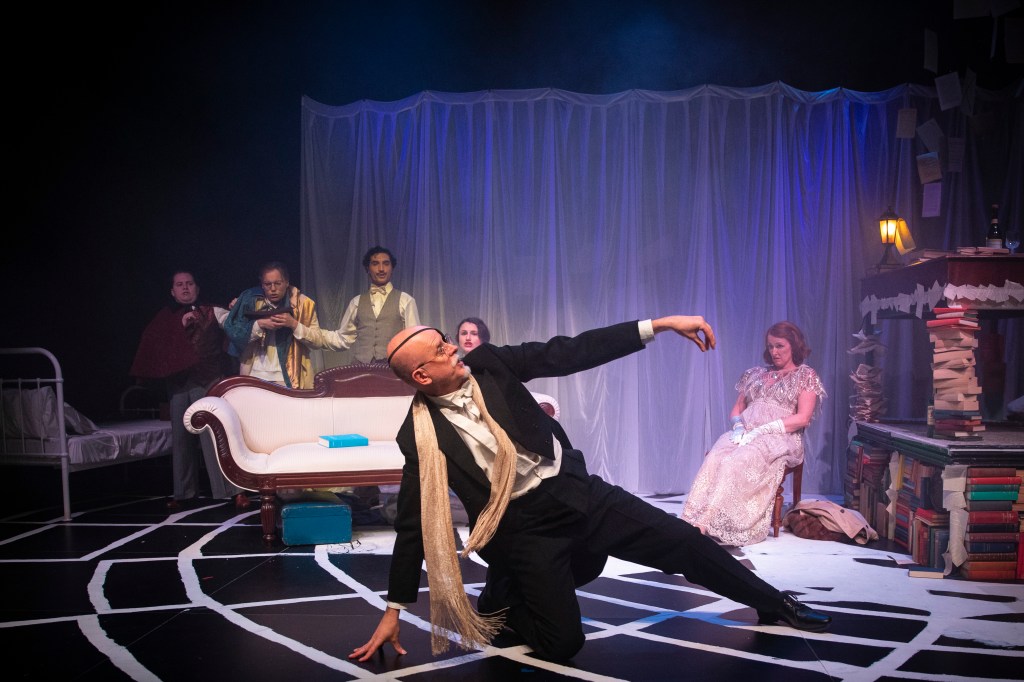
The play was performed at the end of a repurposed storeroom with one entrance and no wings. The scene furniture was covered with pristine sheets. Prompt side, there was an astonishing construction, a writer’s desk with stacked books for legs over which a veritable tangle of literary pages hung suspended by wires! (Silvia Shao was responsible for the set).
To begin: we discover Lucia Joyce (Mary Agnes O’Loughlin) in bed, a long-time resident of a sanatorium in England. Samuel Beckett (Jeremy Harland) is ushered in by a nurse (Carissa McPherson) and the play’s framing device is established. Lucia struggles to remember Sam or anything at all and they stumble to remember and misremember a song and dance.
The scene changes: the actors remove the remaining sheets on the furniture and the past is also unwrapped. We are transported to the giddying Paris of the late 1920s. Two situations are simultaneously presented. Younger Samuel Beckett, still green and forever orange from Ireland, is meeting his friend Tomasso (Paolo Bartolomei) who has already substituted the foot of Italy for the erstwhile mentioned feet of the great writer, James Joyce. The scene swiftly transitions to the Joyce family domicile where we meet Norah Joyce (Carissa McPherson) the superbly realized, long-suffering companion of Joyce, their son, Giorgio (Daniel Cook), Lucia and the great man ‘Himselves’, James Joyce (Tref Gare, who displays his gift for unexpected comedy).
Playwright Steve Carey has crafted a conventional biographical drama that takes discreet liberties and avoids the controversial aspects that other latter-day writers have sought to disinter. The familiar framing device of a ‘flashback’ structure sets up an ‘effect’ and ‘cause’ in the personal history of Lucia Joyce. Safe as glass houses.
Director Carl Whiteside has employed a theatrical strategy beyond hitting the obvious plot points. The production veers intriguingly between naturalism and the Theatre of the Absurd. We notice the spider web painted on the floor. Joyce the spider king repairs to the highchair behind his desk and holds court. He toys playfully with the literary pages suspended above him like tasty morsels. It is newbie, Samuel Beckett, and he will be having him for dinner.
Lucia must have it otherwise. Lucia (Mary Agnes O’Loughlin) in a wonderfully energetic and heart wrenching performance, drives the show forward. Failing at the dance of romance in real life, her love for Sam takes over her fantasy life. Lucia, the child-woman, has never learnt to be hushed and be still. To be frightened and neurotic but to have an indomitable will is a recipe for personal disaster. Her frustrations as a woman and dancer find outlet in her increasing bizarre body contortions and stretch poses. (Jaimee White, choreographer). The elaboration of her dance charts the dynamic of her condition.

Something must be done. Something happens. Sam is expelled from the society of the Joyce family because of a misunderstanding concerning his actions regarding Lucia. Sam is distraught. In a bizarrely comic incident, he is almost stabbed to death by a pimp (Daniel Cook once more). Sam is attended at the hospital by an oddly gaited doctor. (Paolo Bartolomei, again) who elicits laughs from the audience with a lurching walk. Art is cruel. In another literary nod the doctor’s name is Godot.
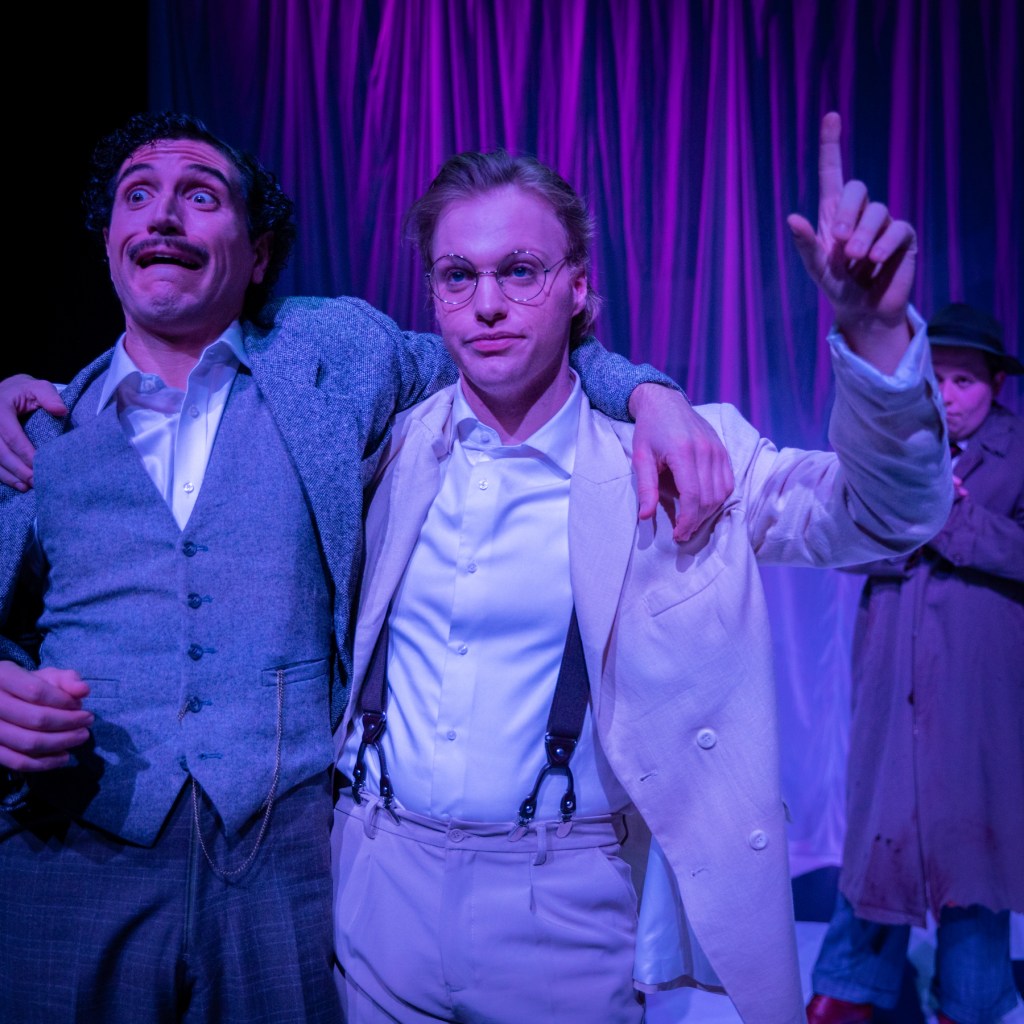
The good news is that Sam will live. The bad news is Sam will live and need to continue to find a way to write. The writer Beckett will become, starts to emerge. Nothing is funnier than unhappiness. Well, in the theatre, anyway.
Life is suffering. Art is suffering. Beckett’s friend Tomasso reminds us that Joyce suffered for his Art and now it is Beckett’s turn, but that it is a choice not a fate. Playwright Steve Carey reinforces this proposition with an overlong first half.
All are punished. It is difficult to be the child of a genius. In real life, both Lucia and her brother Giorgio the tenor faltered in their chosen fields. Lucia became embittered and increasingly erratic until institutionalised for the remainder of her life. Giorgio surrendered to La Dolce Vita.
Norah Joyce had to content herself as the great woman behind the great man. Joyce, bereft, had only the consolations of literary renown and the kindness of patrons to sustain him and, of course, Norah’s unswerving devotion.
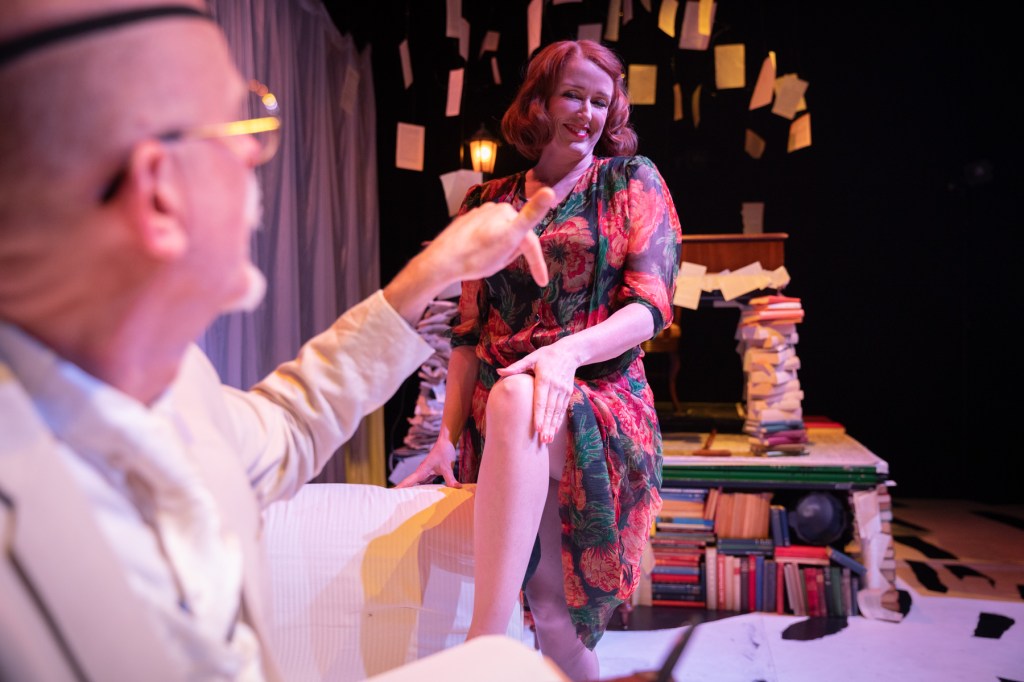
‘Mr Beckett and the Rainbow Girl’ ends at the beginning where it must. The play’s framing is complete. Lucia a career-less casualty of dance; faintly, saintly, literary ‘good for nothing’ Samuel Beckett, ministering tender mercies.
Director Carl Whiteside got the most out of his talented cast and limited material resources. The lighting and sound could have played a greater part in the production. (Lindon Blakey, Tom Kunz).
Costuming (Frida Moss): smart twenties form-hugging skirts and overcoats for the ladies with cloche hats for going out. Rehearsal clothes for Lucia and then the coup de theatre, the fish outfit. Joyce is impeccably attired in suit complete with an eyepatch worthy of a Wotan! Street casual for Samuel, Tomasso and Giorgio.
The relating off this difficult history and the depicting of the iconic figures of Joyce and Beckett credibly on the stage must be recognised as one of the production’s difficulties. Joyce: an aeolian windbag of psychological conflicts; fiendishly intelligent, neurotic, nasty and sweetly sentimental. Tref Gare adds absurdity to the mix. Beckett: a myopic seer ruminating upon solipsistic commonplaces. Art is a null sum gain. Jeremy Harland presents a young Beckett lost in the Lost Generation.
Lucia Joyce: the audience views a child woman in an eccentric orbit about her kin. Mary Agnes O’Loughlin is a Revelation or perhaps a Pentecost of unacceptable truths now erased from history.
Doubled parts. Carissa MacPherson bookends the show as a fussy English nurse. She then takes her place magnificently as the beating heart and centre of the show as Nora. Daniel Cook serves as indolent son, Giorgio, then segués uproariously into Prudent the impudent pimp. Paolo Bartolomei charms as Tomasso and then unhinges as a loitering Dr Godot.
To be an artist is to accommodate yourself to a degree of failure. Even, James Joyce had failure like greatness thrust upon him. For Samuel Beckett, however, failure became his driving force, his default position, his recognition of a condition known to all humanity; the will to succeed scuppered by a lack of talent, effort or luck.
Daniel Boyle is a Melbourne actor/performer/ director who has done everything from Shakespeare to the Broadway musical. He has been an undercover Joycean and Beckettian for decades. Once more he dons the cap of theatre reviewer.
 Tinteán