An Occasional Address by His Excellency Tim Mawe, Irish Embassy, Canberra.
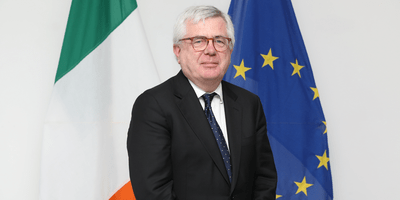
Irish Studies Conference December 2023 – Opening Remarks
In some ways standing in the Julien O’Connell Lecture Hall talking about Irish Studies makes me feel like Michael Knighton, who once got to kick a ball around in front of the Stretford End as he shaped up to buy Manchester United before shuffling quietly off the stage when he turned out not to have the funds and the deal fell through.
At the outset, I want to acknowledge the traditional owners of the land we meet on today, the Wiradjuri people of the Kulin nation and pay my respects to their elders, past present and emerging as well as any aboriginal or Torres Strait islanders here or looking in.
It is some achievement to maintain a series of conferences for 26 editions, and I want to thank Mathew Ryan as Chair, the organising group and all the leadership of ISAANZ for producing such a high-class event with an impressive diversity of speakers and topic.
I can’t think of many places where you might find Flann O’Brien cheek by jowl with Ange Postecoglou, Sr Liguori and Lord Craigavon’s tour of the Antipodes.
But you have them, and many more, all here for the next couple of days. It’s a jam-packed programme that might have been better labelled Disruptions, Transition and a Test of Intellectual Stamina.
Actually, one place you might have found such an assortment of characters is in the imagination of the late Shane McGowan. His passing last week, along with the earlier death of Sinéad O’Connor has made it a tough year for Ireland and for Irish people.
But any of you who saw reports of the funeral or indeed the many video clips might wonder if anyone at all had died, or whether in an example of life imitating art he would, to quote the Sickbed of Cuchulainn, ‘stick his head back out and shout “We’ll have another round“‘.
I had an aunt in Bandon, who was pretty conservative, and who maintained there were three things that should never be – abortion, divorce and clapping in the church. I’m almost glad she wasn’t around to see the dancing down the back and up the front at Shane McGowan’s funeral.
In the inevitable eulogies, obituaries and think-pieces about Shane in the wake of his demise, there was a lot of discussion on his identity. Not much debate though, as most people had a fix on him as being English-born Irish.
In the immediate days after his death, there was a lot of coverage, in the Irish media at least, of his London background and career but almost like a funeral making its way home, the later coverage was all about his time in Tipperary and the people he knew down there. By the time he was out of the church of St Patrick in Nenagh, I think many of the congregation and media had forgotten his Englishness and had reclaimed him entirely for Ireland and for Tipperary.
From an Australian perspective, his death made a strong impact and the night after he died Rage on ABC had a Pogues special, with 10 tracks in a row. Unusually too, ABC Canberra rang me looking to comment on his passing. Which I was happy to do, and to note that he once shared a bill with Jimmy Barnes at a festival in Tipperary. Always get the local angle.
And I know that within Irish communities all over the world, the pictures painted by the Pogues of good-time music, hard-living and poignant portraits of marginalisation struck home. Especially for those who might be doing alright on one level, but on another might feel they belong “neither here nor there”. (My own pointed experience of that was walking up Fifth Avenue in New York at about four o’clock one Thanksgiving)
And that’s a reality, and in preparing for today, it’s a theme I came across more and more. In the context of this country and New Zealand, it is “where does Ireland fit in?” Are we a particular group? Are we a subset of Anglo or Anglo-Celtic settlers? Are we one group amongst many multicultural ones?
And by extension, where do Irish studies belong? Are they particular to Ireland? Are they a subset of broader English or even European studies? Are they one component of a series of comparative studies alongside other nationalities?
Here I might stop with the questions and hold myself back from trespassing too much further into your garden. However, on the basis of about two years’ experience of being in Australia, I get the sense that we are perhaps navigating between two worlds – we’re not Anglo enough to be the establishment, and we’re not different enough to be multi-cultural.
It got to the point that when I was on a visit to a state that is not Victoria, I asked the State minister for multiculturalism whether Irish groups or associations qualified for multicultural funding.
If I was quicker on the draw with my camera I would have snapped the bewildered look on his face. It was clearly something that he had never thought about before and couldn’t really articulate an answer, falling back on language as a point of distinction.
At the same time, I have asked of various Irish groups if they had applied for such community finding and got pretty much similar reactions.
Maybe it’s time to quote Joni Mitchell, who is still with us:
I’ve looked at life from both sides now
From win and lose and still somehow
It’s life’s illusions I recall
I really don’t know life at all
So maybe to anchor our identity and by extension the study of Irishness (aka Irish studies) we should start from a position that some of the lies are true, and that it may well be the case that for some people here – maybe in particular the 50% who have a heritage that is not Australian – it can be difficult to differentiate between Irish and English or Scottish and Welsh.
From time to time, you can hear commentators lamenting the homogeneity of modern cultural life, often defined as the disappearance of regional accents or local stores or even the prevalence of pizza where it never prospered before.
To me, this olagóning is sometimes overdone, but I can see where they are coming from and also that this can lead to a blurring of identities.
So in the few minutes remaining, I thought I would suggest some areas of distinction between Irish and Anglo. To be clear, this not to suggest some sense of Irish exceptionalism or even superiority. But areas where someone in Australia, if made aware, would recognise that the island on the west is different to the one on the east.
And in an additional disclaimer – I accept that many of them are pretty obvious to the people here and on-line but maybe less so to the standard Collingwood or Essendon fan, or in the absence of a Clapham omnibus, however the typical Aussie might be described.
The first is obviously language. Unlike my predecessor, ní gaeilgeoir mé, ach aithním luach ár dteanga féin. I recognise the value of our own language and while it is often overstated I subscribe to the underlying maxim of Níl tír gan teanga (there is no country without language). Even if it is no longer the vernacular.
A second point of distinction might be our economic model. While sharing an underlying largely capitalist approach, the outward-facing posture in Ireland sees us generate exports to the value of 135% of our GDP whereas the equivalent stat for the UK is 33%. In Ireland, we have a much different-size market; we do not really have much in the way of heavy industry; or the legacy challenge of rusted heavy industry.
Related to this is our outlook on the European Union where we continue to be at the top end of Europhilia whereas many parts of the UK never really felt they belonged in the Union and that it was something that was somehow done to them. In Ireland, this goes well beyond economic benefits and I’d say that in my lifetime, we discovered “the Continent” all over again. For its culture, its society and in times of need its solidarity.
In discovering Europe “entre gimés”, we never sought to colonise it, which is another point of distinction between us and our neighbours. Indeed, if there is a point of greatest contrast it is in the Coloniser – Colony relationship (used most broadly) that is yet unresolved and in many ways not even addressed.
When it comes to the outlook of Irish people in Australia, I think it can fundamentally differ from that of people of English origin. Leaving aside those convicts who had no choice in their migration, the motivation of many Irish people coming here was borne more from necessity than their English counterparts. Coupled to this, and without getting into sectarianism, there has been more of an outsider status about Irish people here than English ones. As someone pointed out to me recently, this situation means that Irish people felt the need to pull together, noting that while there are many Irish clubs across Australia, there are no English ones.
The Irish political cultures, both North and South are also distinctive from Britain. Not just the electoral system, but also it seems to me a much closer connection, or the expectation of a closer connection, between the electors and the elected.
As our population grows and as politics evolves, our tradition of different flavours of centrism may be moving towards a more standard left/right axis. In this, John McGahern may have been correct when he said that Ireland “was a nineteenth-century society up to about 1970 and then it almost bypassed the twentieth century”. (Although I’d put it a little later with the transition coming with the Celtic Tiger).
Clear blue water (or green water) lies in the very distinctive sports in Ireland, as well as our attitude to sports. While recognising a tendency towards Irish chauvinism, the magical sport of hurling is distinctive from anything across the water, with all due respect to shinty. Our attitude to horse racing is also very different as can be seen each year in Cheltenham.
More broadly, there is also a widespread sense in Ireland that sport is not a branch of entertainment but of identity. And not in the sometimes ugly way you can find in certain English audiences or indeed Glasgow ones.
There are many more of these points of differentiation, many of which I concede are arguable or debatable and are certainly not binary. Religion, despite a massive falling away since around 1980 is one such, and the continuity of history is another. As my wife put it the other day, an Irish farmer looking over his land can get a sense of long history and a sense of locality stretching back many hundred years. A farmer in Shropshire or Suffolk could probably do likewise, but I think that the sense of connection or history she might get would be very different to the one her Irish counterpart feels.
All of this taken together shows that the tendency hereabouts to lump us all together in a form of ethnic shorthand is also short-sighted. And it is people like you and events like this that enable us all to shine a light on elements of Irishness that are distinct from the broad Anglo-Celtic grouping or at the very least distinctive within it.
So despite some lingering uncertainty as to the viability of Irish studies and the challenges of promoting it (or indeed any humanities) in today’s almost mercantilist universities, there is a solid core of learning and knowledge that is distinctively Irish that deserves to be studied everywhere, including in Australia and New Zealand.
In this I concur with the conclusion of Elizabeth Malcolm’s 2019 survey of Irish studies
Searching for the Irish and Irish Studies in Australia – where she says that:
But scholarship evolves ceaselessly, often in unexpected directions, and so there are grounds for optimism that Irish Studies may yet join the mainstream and, in the future, find its insights and interpretations better appreciated by new and larger Australian audiences.
And underlying that optimism is the Irish Studies Association of Australia and New Zealand.
I commend you on your efforts individually and collectively, I wish you every success with the conference and I stand ready to support you in the development of Irish Studies in Australia in any way I can.
Thanks for listening.
Críoch
H.E. Tim Mawe
Embassy of Ireland
 Tinteán