Book Reviews by Frank O’Shea
POOR. Grit, Courage, and the life-changing value of self-belief. Katriona O’Sullivan. Sandycove 2023. 287 pp. $42
A comment on the back page of this book describes it as ‘fearless, funny and searingly honest.’ Two of those words describe the book well, but funny it most certainly is not. It is a story of survival against the most appalling background, in this case working class areas of Coventry and Birmingham.
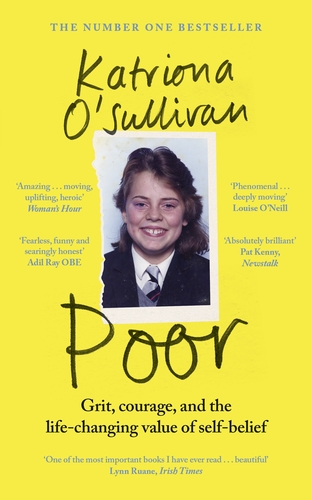
After graduating from the once-prestigious Belvedere College in Dublin, the author’s father turned down a chance to study in Trinity in favour of the wilder life in England. By the time we meet Katriona, she is almost six years old, with two older brothers and a younger one who is her favourite. They live in an environment of substance abuse – both parents are addicts – where drugs are sold and consumed and are as much part of the house as the cups and saucers.
Then the mother Tilly is pregnant again; her husband is in prison and she is so high that she is unaware that she has given birth while sitting on the toilet. The baby is partly dragged around by the umbilical cord as they wait for the ambulance that is in no hurry to this notorious part of town. ‘When the baby came home my parents were at their worst. The house was a flow of bad. It was a pit of filth, with needles, shoelaces, spoons, ashtrays, bottles, stained carpets, brown ceilings from smoke, a red couch covered in stains of piss and vomit, and scorch marks on everything from hot spoons, dropped cigarettes and hot rocks from joints. People came and went from our house, drugs were dropped in and sold out of it.’
There is a danger in writing a review like this that you give away too much of the story, so I will add just one more incident. With her father in prison, Katriona, aged six, is abused by one of his friends, a man named Bob. She is with her mother as they drop off her younger brother to Bob and she is scolded ‘Don’t be rude’ because she doesn’t want to meet Bob when they arrive at his door. ‘He raped me,’ she tells her mother, having learned the meaning of that awful word. ‘Yeah … well, he raped me too,’ the mother replied. End of story, though in fairness, when her father comes out of prison, he visits Bob and beats the daylights out of him.
In time, the family move back to Dublin to Katriona’s grandfather’s house in Clontarf. Her disorganised life continues until she hears about the Trinity Access Programme which encourages latecomers to return to their studies. Her attempts to get on that program and her subsequent studies take up the remainder of the book. After seven years, she is presented with a PhD in psychology by Trinity Chancellor Mary Robinson, a triumph for her and for Trinity. After working there for some time, she is now at Maynooth College school of Assisted Learning.
This is in many ways an extraordinary story, with as many slip-ups and falls as slow successes. The reader feels that what is written is often to the writer’s discredit, because she makes no attempt to try to explain her own inconsistencies. At the end is a long chapter where she acknowledges that her main problem and that of her parents was poverty. ‘Drugs and alcohol kept people going until it outran them, and that’s how it was for us too, over and over. In our house, most of the time, every spoon was singed black from cooking gear.’
Some months back, I reviewed on these pages Maureen Sullivan’s book, Girl in the Tunnel, with a strong recommendation. In some ways this book is a pair for that one, with the exception that in this case, things work out better
in the end. In many ways it is a story of survival, the kind of book that you will find hard to put down when you get in to it. Go out and find a copy; you won’t regret it.
TELL NO ONE Brendan Watkins. Allen & Unwin 2023. 356 pp. $34.99
This is the story of the attempt by Melbourne man Brendan Watkins to find his parents, one a Catholic priest and the other, according to the publicity, a nun. That gives the immediate impression of convent misbehaviour or some form of unusual naughtiness by both parents. In fact, though the mother was in a convent for a few years before her pregnancy and subsequently joined another order where she stayed for 25 years, she was not a nun when the actual affair took place.
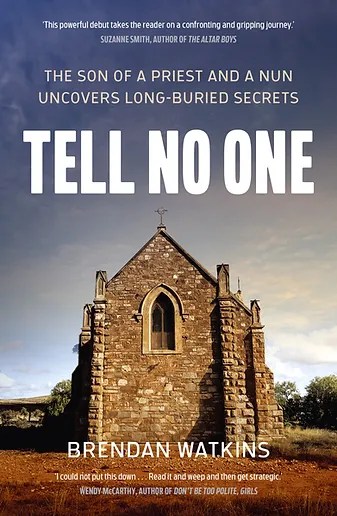
The author was eight years of age when he and his brother were sat down by their parents and told that they were both adopted. They were not told who their real parents were; the remainder of the book tells of the author’s attempts to find out who his parents were. That effort takes up most of the book, but towards the end, the story seems to descend into a tirade against the Catholic church and the way they blocked all his efforts to find out who his father was.
By the time Watkins began to search seriously for his parents, his father had died at the age of 90, but his mother was still alive. Her name was Maggie Becker and he managed to get in touch with her, helped by his patient partner Kate, the mother of their two children. A DNA test showed that Maggie was 78 per cent Irish, her family originating in the area of Kilkenny. He promised that he would not tell the world that this kindly lady, now in her sixties, was his mother and though they met on a few occasions, the meetings were formal rather than affectionate.
He had great difficulty finding his father, who turned out to be a well-known outback priest name Fr Vin Shiel. As a young man, he had qualified as an architect and then went in to building and business. The Great Depression affected him and his work and he decided that, now aged 30, he would join a seminary and become a priest. The War caused him to abandon his first attempt in Rome and he went to isolated Mount Mellary monastery in the Knockmaeldowns in Ireland instead. Seven years later, he was ordained in Kilkenny and returned immediately to Australia.
It appears that Shiel was a good priest, a builder who made the bricks and plastered the structure and painted the walls of church and presbytery. In ‘one of the largest and most inhospitable territories for any priest on the planet, Vin was a missionary in a desolate terrain of blood reds and bleached whites, where the only white inhabitants were miners and railway workers and their families, men on the run and half-mad clerics like my father.’
The author’s attitude to finding out about his parents was ‘contemptuous disappointment. A nun and priest, exemplars of the compassionate Catholic faith. I’d been sacrificed for a sin committed against their God. How pathetic.’ This reaction is carried through the book and interferes with what starts out as a wonderful read, the short chapters taking the reader on a vivid journey of discovery. Unfortunately, that attitude towards celibacy and the Catholic church in general takes from what is an intriguing read.
Frank is a member of the Tintean editorial collective.

