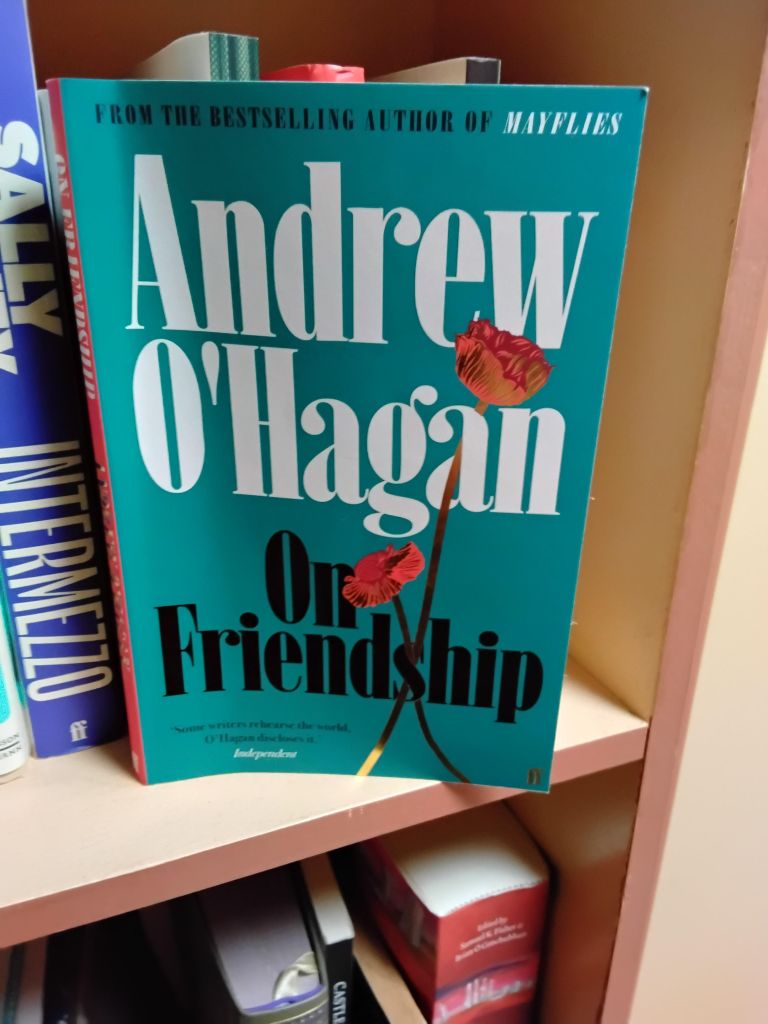
Andrew O’Hagan”s On Friendship (Faber 2025) is dedicated to Colm Tóibín one of several friendships discussed in this collection of essays. O’Hagan is a Scottish writer of seven novels and three other non-fiction works. He has been nominated for the Booker prize three times. His novel Mayflies (2020) is a fictionalised account of a teenage friendship written during Covid and no doubt the inspiration for this collecton. On Friendship starts with such early intense friendships but also explores friendships throughout one’s life, including internet ‘friends’, workmates, the friendship of animals, and even imaginary friends.
As Editor-at-Large of the London Review of Books and a Fellow of The Royal Society of Literature it is not surprising that O’Hagan includes some writers among the friends memorialised in On Friendship: Seamus Heaney, Edna O’ Brien, and Colm Tóibín in particular.
Friendship as something to be sought and treasured O’Hagan found as a child through Charlotte’s Web (as a film), The Little Prince, and Peter Pan with characters in their own ways in search of friends, hoping to find someone who seemed to share a ‘capacity for wonder.’ One early real friend is Mark who lived across the road from O’Hagan in Glasgow. After the day’s adventures and then back in their respective houses and bedrooms, they would shine their torchlights across the divide and flash a goodnight. Ten-year-old Mark was an oasis of ‘cool water after a fever’ when compared with O’Hagan’s intense family life.
While boys were the main cohort of friends for O’Hagan, he also remembers the sweet five-year-old Elizabeth with ‘a willingly demonic streak’ who shared the journey to and from school through new estate building sites. When he was a teenager, it was Audrey, ‘an accidental genius of adolescent comedy’ with ‘blazing red hair’ who shared the school journey.
Moving on to adulthood, O’Hagan recalls a tour of Scotland reciting poetry along with Seamus Heaney and two Scottish friends. Although coming from different cultural and racial backgrounds, they ‘laughed a great deal, and parried with native difficulties…’ Heaney’s personally inscribed and handwritten poem ‘Postscript’ has pride of place in O’Hagan’s hall and is included in full in chapter two.
Other Irish literary friendships are those with Edna O’Brien and Colm Tóibín. Later in their friendship, O’Hagan accompanied O’Brien on a trip to Ireland to see her old home and the island she had chosen as her burial ground. Edna O’Brien is the only writer in On Friendship given a separate chapter, perhaps heralding a future biography? He first met her by chance as she was emerging from a taxi, ‘…a vision in black velvet and volumised hair’, recognising O’Hagan as ‘that Scottish boy’ and his response in kind, ‘And you’re that country girl.’
Generosity is Colm Tóibín’s defining quality: ‘the keys to his flat,’ a ‘box of oranges from Spain,’ a generous cheque written on the spot on hearing about a friend’s illness. Other well-known names discussed are Christopher Hitchens, Lillian Ross, and Julian Assange, but there are also the unnamed ‘beloved English friends’, ‘stars of London and beyond’ who turned up at O’Hagan’s mother’s funeral and served as a soothing balm in that moment to ‘the fractured zone’ of O’Hagan’s childhood.
On Friendship is short (137 pages), but long-lasting in its effect, not least because of O’Hagan’s writing: sentences that ‘stop you in your tracks’ as Graham Norton found, and replete with what Hilary Mantel found to be ‘surprising’, ‘pleasurable’ and ‘thought-provoking. ‘Please sir’, we want some more.
Dymphna Lonergan
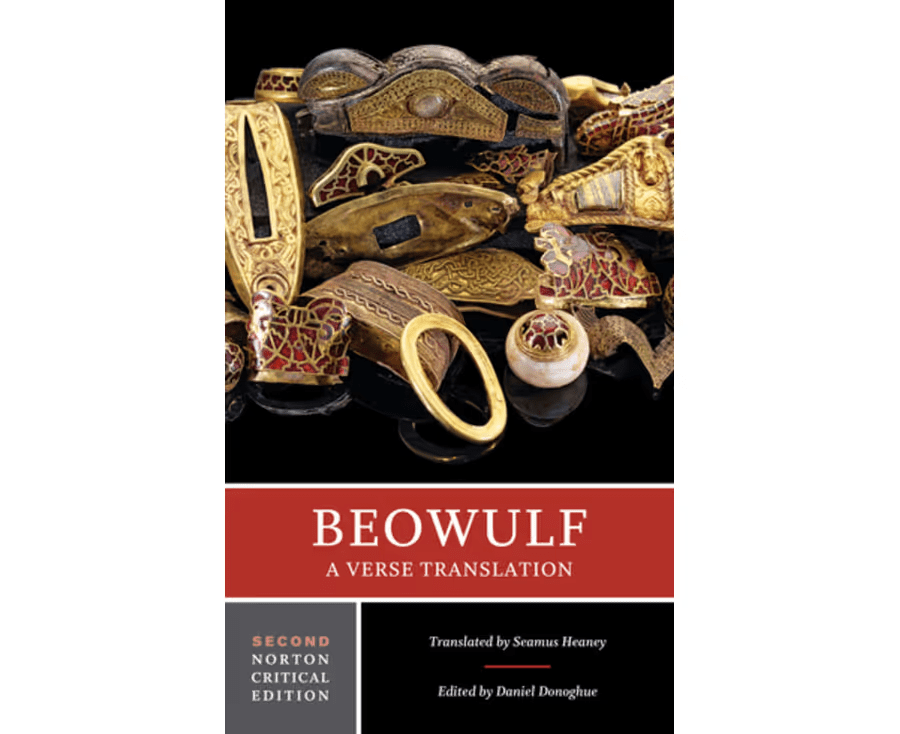
Re-reading Seamus Heaney’s Beowulf in Daniel Donoghue’s magnificent Second Norton Critical Edition.
I had the impulse recently to return to an arcane pleasure afforded all serious students of literature in my era: the Anglo-Saxon masterpiece, Beowulf, written in the original language (Old Norse was also required). A dalliance in a marvellous newish internet site, Old English Aerobics, designed with young learners in mind, informed me that to retrieve what I learnt of the language 60 years ago would need a great deal more time than I have, and was regrettably low on the priority list. It was, however, a delightful site: who knew that a certain kind of reader would want Alice in Wonderland in Old English? So, I pulled my head in, and contented myself with Seamus Heaney’s very racy translation of Beowulf, wondering all the while why he was drawn to it. The excellent edition by Daniel Donoghue offers a lot to the newcomer to Beowulf, as well as the scholar and answered my question in a very elegant essay by the Man Himself. He talks openly of his difficulties in ‘rais[ing] it [the ‘rock-sure feel’ of the poem] to the power of verse’, by which he means contemporary verse, and to my delight he candidly admits to the difficulty of mastering the language, and more pertinently, discovers in the process that from his first poems he was unconsciously conforming to the poetic requirements of Anglo-Saxon metrics: the two balancing halves of the line with its two-stressed syllables in each half, its alliteration, and the occasional yoking together via alliteration of the first and second half of the line. He had been writing in Anglo-Saxon, in its Ulster English dialect, all his life, part of his ‘voice-right’. And he makes common cause with Joyce in admitting that the Irish language should also have been his birthright. Always the quiet diplomat, he thereby collapses the Irish/English antithesis. I’d add that his sensibility, his feel for the ‘this-ness of things in the physical world, the suck and pull of peaty diggings, also has affinities with the directness and earthiness of Anglo-Saxon language. He delights in using Ulster English when they add extra ‘body and force’ and alienate and remind of the historical nature of his text.
Heaney’s Beowulf is racy, exciting, beguiling (the narrative pelts along), and very much pitched at an engrossed hearer. When Beowulf reports how he mortally damaged Grendel, he is direct:
He has done his worst but the wound will end him.
He is hasped and hooped and hirpling with pain,
limping and looped in it. Like a man outlawed
for wickedness… (lines 975-7)
The tone can be magisterial, conferring dignity on the warring tribes, on their unstable hybrid Christian and pre-Christian personae. It can command respect for the Heat’s noble, generous, selfless hero, who having decapitated the Grendel’s dam, the monster’s mother, awakens and arouses a third, the ‘hoard guardian’ Dragon, meeting molten venom / in the fire he breathes’, trusting entirely on his own strength and refusing to expose his retainers:
Then he gave a shout. The lord of the Geats
unburdened his breast and broke out
in a storm of anger. Under grey stone
his voice challenged and resounded clearly.
Hate was ignited. The hoard-guard recognized
a human voice, the time was over
for peace and parleying. Pouring forth
in a hot battle-fume, the breath of the monster
burst from the rock….
…the outlandish thing
writhed and convulsed and viciously
turned on the king, whose keen-edged sword,
an heirloom inherited by ancient right,
was already in his hand. Roused to a fury,
each antagonist struck terror in the other. (lines 2550-65)
To compare Heaney’s translation with the one I met way back last century is to compare chalk and cheese. This is now a poem for a multi-generational family: the poet has no worries about sliding between a super-imposed layer of Christianity (blame the medieval monks) and his own and our secularism. The modern world comfortably incorporates both and is well-placed for a treatise on ethical heroism.
Frances Devlin-Glass
Podcasts
The Irish Books Podcast launched in February 2026 and is dedicated to in-depth conversation about contemporary Irish writing. Dr Murray, a Senior Lecturer at Monash, Fellow of the Royal Asiatic Society, and Irish literary critic, brings both scholarly expertise and a genuine love of books to each episode. The show goes beyond standard reviews, exploring the historical complexity, textual nuance, and creative genius behind Irish literature, from global bestsellers to overlooked gems. The podcast is a deeply Australian-Irish collaboration: it’s produced by East Coast Studio, supported by Monash University, and funded by the Irish Studies Programme through the Irish Department of Foreign Affairs and Trade, with the support of the Embassy of Ireland, Australia. And it’s made right here in Melbourne.
I listened to a discussion of The Prophet’s Song, a book I had read and loved. Spoiler alert if you haven’t read the book, but if you have, you will enjoy hearing extracts from the book as well as discussion.
………………………………………………………………………………………………………………………………………………………………………………..
Netflix: How to Get to Heaven from Belfast

This television series is scripted by the Derry Girls writer, Lisa McGee, but what I loved most about it was experiencing the Irish language subtitles. Usually when I need subtitles for an English language programme, it’s because it’s difficut to hear or the accent is difficult to understand. This time, I understood the Irish language subtitles almost as well as the English audio to the extent that I had to put the audio on ‘mute’! This was an academic exercise to compare words in both languages. While Irish English uses the F curse word a lot, mostly as an intensifier, it was largely left untranslated in the Irish subtitles. So far, I’ve only seen two translations: Damnú and Dia Linn for the F word. the online dictionary foclóir.ie provides foc and damnú (foc indicated to be ‘vulgar’) for the English F word.
How to Get to Heaven from Belfast is a black comedy about three friends who need to solve mysteries around another friend’s death. It is fast-moving, with interesting characters, and the profanity is part of the charm, if you like that. Otherwise, if you are learnng Irish, it’s a good way to pick up vocabulary by way of the Irish language subtitles.
Dymphna Lonergan
 Tinteán