A Feature by Elizabeth Malcolm
Introduction
For a country with a relatively small population, Ireland over the centuries has made a remarkable contribution to world literature in the English language, and it continues to do so today. Recently, The Conversation (6 March 2026) pointed out that Irish writers Paul Lynch, Anne Enright and John Banville have all won Booker Prizes in the last two decades, while others such as Colm Tóibín, Claire Keegan and Sally Rooney are major international bestsellers. Yet Ireland’s population is only about the size of Melbourne’s.
Irish-born and -descended writers have also worked throughout the diaspora, and they have been studied extensively in the United States and Britain. However, little attention has been paid to them in Australia. This is despite the fact that many of this country’s earliest and most significant writers––especially its women writers––have had Irish ancestry.
Australia’s first important female poet was Eliza Hamilton Dunlop (1796–1880) from County Down; the first novel published by a woman in this country was written by Limerick-born Anna Maria Bunn (1808–89); and detective-story writing was pioneered by Belfast-born Mary Fortune (1832–1911). Later well-known writers, such as Henry Handel Richardson (1870–1946), based her major novel, The Fortunes of Richard Mahony, on the life of her Dublin-born father, while Miles Franklin (1879–1954) drew upon her Irish family history for her novel, All That Swagger. And there are many others who could be cited as well.
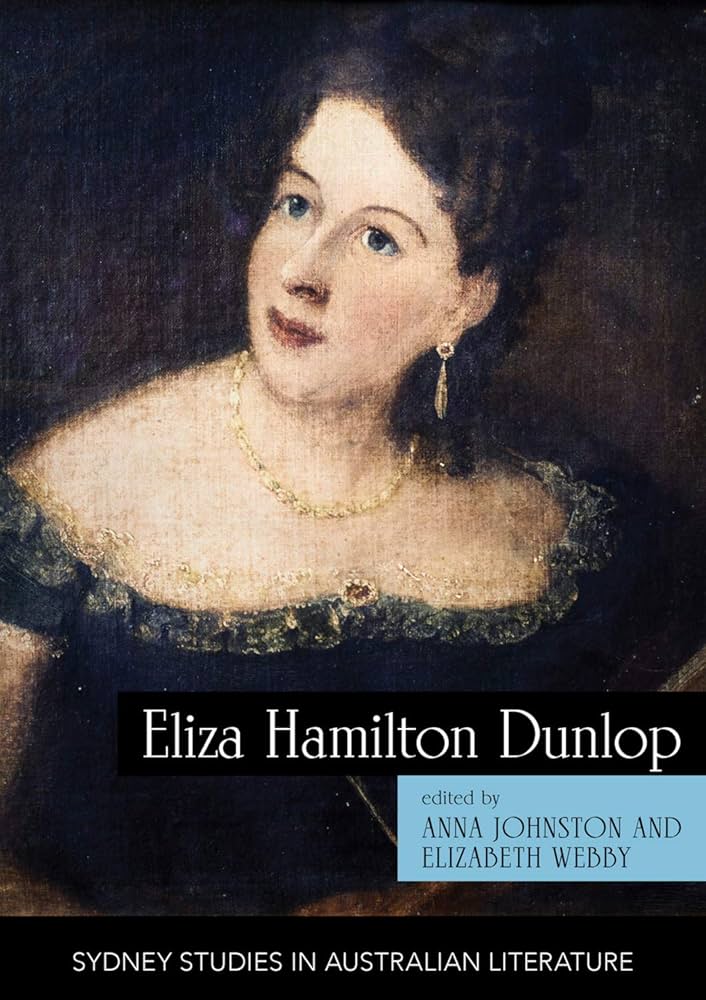
With the aim of making some of these women better known, I want to start by a sketching the life and work of the poet Eliza Hamilton Dunlop, who surprisingly not only wrote in English but also employed the Irish language and Indigenous languages in some of her works.
Life
Eliza seems to have had an unsettled childhood. She was raised by her grandmother near Rostrevor, on the shores of Carlingford Lough, a beautiful area whose landscapes she often wrote about in her poems and also painted. Her mother died when she was very young and her father, Solomon Hamilton, a Protestant landowner and lawyer, was often absent. He was politically progressive and Rostrevor was a centre of United Irish support in 1798. While still a child, Eliza read the works of Voltaire, Rousseau, David Hume and Tom Paine in her father’s library, as well as the romantic poets, especially Lord Byron. Her father eventually settled in Calcutta (now Kolkata), where he worked as a judge and started a new family with an Indian wife.
In 1812, aged only 16, Eliza married and had a daughter, but the marriage was not a success and, by 1816, she and her husband had separated. She set out for India in 1820, but when her father died before her arrival, she returned to Ireland, although not before meeting her two Indian half-sisters of whom she became ‘very fond.’ She married again in 1823, this time a Coleraine book-binder called David Dunlop. Presumably her first husband was dead by then, or perhaps they had obtained a divorce.
David Dunlop came from a politically radical family. His father, William, a United Irishman from north County Antrim, was brutally lynched by British soldiers during the 1798 rebellion and his body buried in an unmarked grave. William’s family later transferred the body to a churchyard, and in 1865 Eliza wrote a moving poem about his grave. She described the poem as a ‘requiem of red ninety-eight’, hailing her father-in-law as ‘martyr’d’ during a ‘fierce reign of terror.’ David Dunlop continued the family’s involvement in Ulster progressive politics in the 1820s, supporting Catholic emancipation and national education. But as the province became increasingly dominated by conservative unionists during the period, his politics made him enemies and hindered his employment. The couple had four surviving children, but by the late 1830s, they had decided to start a new life in the Australian penal colonies.
The recently-appointed governor of NSW in 1838 was a liberal soldier, George Gipps, and David Dunlop obtained a letter of recommendation to him from a friend who was a British MP. This led to Dunlop’s speedy appointment as a police magistrate in Penrith, west of Sydney. However, when he delivered judgements favouring Catholic convicts, Dunlop became unpopular with local Protestant free settlers and, in 1839, he was transferred as a magistrate to Wollombi township in the Hunter Valley, west of Newcastle. There the Dunlop family built and settled in a homestead they called ‘Mulla’ (from Irish mullach, ‘Summit’), living there until David’s death in 1863 and Eliza’s in 1880.
Works
Eliza never published a book of poetry. She prepared a manuscript in the early 1870s entitled ‘The Vase’ containing many of her works, which was eventually deposited by her descendants in the State Library of NSW. It has recently been digitalised and made publicly available. Most of her Australian poems appeared in newspapers over her initials and, although some were popular at the time––a number were set to music––they were quickly forgotten. Today they can be accessed through the Trove Australian newspaper database. But, without a published volume of her work readily available, it was easy for Eliza Hamilton Dunlop to be overlooked by readers and scholars alike, as she was for many years.
Eliza was obviously interested in people who came from different cultures, and she tried to understand them by studying their languages. We see this in some of her first poems written in Ireland. For instance, she made a point of using Irish placename spellings, rather than anglicised ones, when describing the impressive natural features of south County Down, including the Mourne Mountains. In one of her Irish poems, ‘Slievedonard’ is ‘Slieve-dhonard’, while ‘Cloughmore’ is ‘Cloch-mhor.’. Her poem, ‘The Irish Mother’ (1838), shows a mother trying to hush her child to sleep using the Irish language. When the poem was published in a newspaper, Eliza explained in a note that Irish ‘expressions of fondness’ were far more ‘tender’ than English ones. Writing about Indian funeral pyres on the banks of the sacred river, she used the name of the Hindu goddess ‘Ganga’, after whom the river is named, not the English word, ‘Ganges.’ And arriving in Australia, she quickly sought to understand and employ Aboriginal languages.
The Dunlops reached in Sydney in 1838, weeks after the notorious Myall Creek massacre in northern NSW, in which dozens of Indigenous men, women and children were killed by a party of convicts and ex-convicts––some of them Irish––led by a pastoralist’s son. Later in the year, although she had been in the colony only a few months, Eliza published a poem about the incident entitled ‘The Aboriginal Mother.’ It presented the killings from the perspective of an Indigenous woman, lamenting the deaths of her children, and it condemned settler violence. Already Eliza was using Indigenous words in her work: ‘gooroo’ for ‘possum cloak’ and ‘koopin’ for ‘battle axe.’ As the colony’s Irish-born attorney-general, H.J. Plunkett, had––most unusually––decided to prosecute the white men responsible for the killings, the case became highly controversial. And when some of the convicts, although not the pastoralist’s son, were convicted and executed, Eliza’s poem attracted criticism from many of the Dunlops’ fellow settlers, being ridiculed by conservative newspapers.
In Wollombi, Eliza took an increasing interest in local Indigenous languages, compiling a lengthy word list. She reproduced Aboriginal songs and translated some of them. But, although she eventually became attached to the society and landscapes of colonial NSW, it is clear that she always missed Ireland, or ‘Erin’ as she usually called it––portraying the country as feminine. In ‘I Bless Thy Shores’ (1840), written after only two years in the colony, she expressed her nostalgia and deep regret at leaving her ancestral home to find employment in NSW.
I bless thy shores––my native land–– …
Alas! the shadows of thy hills––
Lie dark across my heart; …
I know that household hearths are cold;
That my kindred’s graves are green;
I know I know, the Churchyard mould––
Tells where my race have been …
What dreary doom is mine!
Unblest ‘mid Austral-wilds to roam––
A slave at Mammon’s Shrine; …
Further Reading
Anna Johnston and Elizabeth Webby (eds), Eliza Hamilton Dunlop: Writing from the Colonial Frontier, Sydney: Sydney University Press, 2021.
Elizabeth Malcolm is an honorary professorial fellow at the University of Melbourne.
 Tinteán