A Book Review by Frances Devlin-Glass
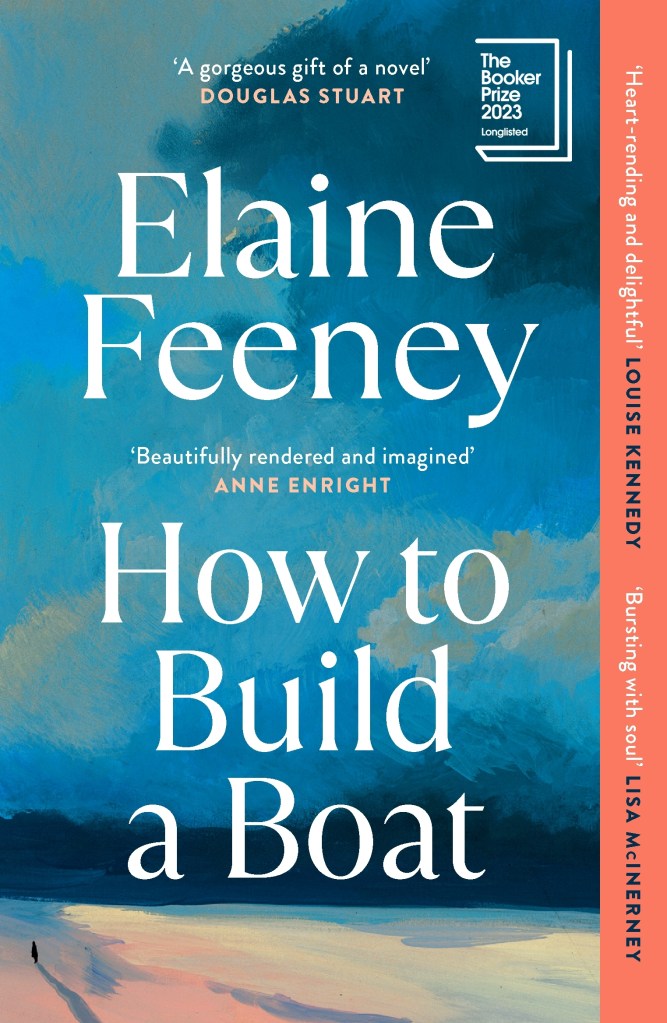
Elaine Feeney: How to Build a Boat, Vintage 2023
ISBN: 9781529920093
RRP: $25
This oddly-titled bildungsroman tells the story of young man entering high school who is different. What makes him so is never named or pathologised, and the reader is drawn into his world partly by descriptions of him, from the points of view of his teachers, his headmaster, his father and grandmother, and most importantly, via his ‘intense’ inner monologues.
Non-verbal until three, his over-protective father describes him to his son as a ‘busy boy’ who is noise- and company-averse. He is his father’s project, and in the manner of a ’60s parent, his monthly targets include topics like ‘Turn-Taking. Wait and Listen Time. Develop and Maintain Peer Relationships’ (p.4), and managing Jamie’s moments of intense anxiety and discombobulation. Eoin seems never to lose faith in Jamie’s potential though he is often frustrated by the son’s inability to let go of his obsessions. The father refuses to see him as anything other than another variant on a childhood, rather than in terms of deficits. When he can master his own anxieties about his child, he is adept at reframing and making explicit the resistance the child meets in the real world, and the frequent collisions between anxieties and reality.
Jamie’s intimate inner thoughts are pell-mell, associative, obsession-driven, literal, and culturally well-stocked. His special favourites are the Iranian mathematician Maryam Mirzakhani, the theoretical physicist Pasterski, and as well Edgar Allan Poe whose Complete Tales and Poems is the only book earning five stars from Jamie. He’s a child who is driven to investigate and understand what troubles him about Life, and in particular whether or not he caused his mother’s death 55 minutes after his birth. On the random day he begins secondary school, he is assailed by what he’s learnt from the internet (one assumes) of his mother’s physical condition.
He intends/wants to prove that the probability of connected cycles between all of his life’s events, and the energy that he obsesses with
(and M Theory to Perpetual Motion Machines and Infinity)
means
that there is an above average probability that there exists a complex web of interconnectedness of everyone who had ever loved him, with everyone that would love him,
and he is the link …
and even the energy of those whom he hasn’t met is circling about the planet, even the energy of those unknown who will find him through his life [.] (p.20)
This quotation with its non-standard punctuation and formatting gives a flavour of Jamie’s thinking, remote as it is from his grief for his loss of his mother, and it also functions as a proleptic hint of the direction the novel will take. At a human level, what he has of her as a person (but not as a mother) is a 2-minute 8-second video of her winning at a swimming gala. He fixates on a moment at the end of the film when it seems she smiles at him. He pins his hopes on finding patterns in a chaotic world, and trusts Mirzakhani’s mathematical theories might assist him in building a perpetual motion machine which might return his energetic mother to him. At this point he cannot know how or grasp how the energies of others will assist him. He is thinking solipsistically.
Jamie’s trajectory in life, because of his gifts and difficulties with social engagement, put him into relationships with just two understanding teachers and some remarkable peers, but his alliances (except for his father and grandmother) are often themselves unpredictable. The teachers who offer support to him are themselves caught up with cross-currents generated in their own lives, which are far beyond the child’s capacity to influence. And he has intellectual templates that he needs to question to avail himself of their wider vision.
The novel is set in the Galway area, and the too lightly-sketched deus ex machina of the plot is a craftsman from Aran, Tadhg Foley, who is newly arrived at the school, formerly an ambitious academic school, to teach woodwork. Woodwork is not a high priority for the Principal, and nor is supporting Special Needs children whom he is forced to accept. However, Jamie’s high-level competence in mathematics may be the reason he is admitted to the school. Tadhg’s first rescue of Jamie circumvents sexual abuse on the part of the headmaster by fearlessly insisting on a chaperone. Experienced in building currachs as a member of a meitheal (a group that meets to accomplish a skilled task like harvesting or cutting turf), Tadhg assembles an intentional group of differently able individuals, including some older boys to construct a curragh. The chief obstacle to building the boat for Jamie is the child’s unwavering commitment to precise measurement, and his doubts about his peers’ inexperience and sloppiness – he initially finds the finished product ‘crude’. Despite Tadhg’s careful explanations, Jamie also has problems coming to terms with the idea of a currach as a perpetual motion machine. Mirzakhani, the prematurely dead mathematician, is instrumental in teaching him about the significance of the meitheal as a mode of communal construction of a complex artefact, and as a way of bringing chaos under some provisional control. The chaos is often of his own making, as in his inexperience, he can bend rods and timbers to the point of destruction, and he slowly realises that breaking rods is part of learning the craft of currach-construction. His job is to ‘coax’ and not ‘force’ the sap-filled rods to exploit their ‘wild natural tension’ to build the gunwales which constitute the skeleton of the craft. More importantly, Jamie acquires insight into the destructiveness and chaos that are part of his own nature (p.159), something his father and grandmother had tried to control in their socialising of him. He has to abandon habitual ways of thinking about a construction and trust to his and others’ experience.
The Headmaster is yet another force for chaos in the novel and we are exposed to Jamie’s critical private thoughts about his weekly sermons on Manliness, as refracted through the teachings of the Canadian conservative psychologist, Jordan Peterson, who teaches on YouTube and in his books a version of toxic masculinity and misogyny. Jamie’s comments on the priests’ teachings are unintentionally comical but enlightening:
Father Faulks carries on talking with great gusto as though no research has been done on the human condition since the Middle Ages (which it has in abundance), though I have yet to start my research into it fully, but this obsession with one perspective is often the way of adults who I now know are closed-minded. From investigation with Terry [his peer] (on Google] we know that Father Faulks went to school in this very College, and then on to a seminary (a school with only boys who learn about theology, which is a subject based almost entirely on fiction; allegory and opinion) and then he was sent back here as a teacher of Latin and religion and then he became the President. So Faulks is, by very definition of being enclosed for a lifetime in one space — closed minded, though he tells us about his life as though he has been on one big mad adventure. And if we look at it objectively — it is not his fault. (p.165)
Another subplot concerns the failing marriage and the refusal of IVF by Tess, the other teacher who has a pivotal role in guiding the young man. Tess’s sadness is far from being a simple matter of having a partner more attentive to his job than to her, being emotionally remote (he is), but is caught up, as Jamie is to a lesser degree, with class issues in Ireland. Her father, an alcoholic, is on the streets, and Tess cannot and will not ignore him just to please her husband’s aspirational family. She feels marginal in ‘a substantial school with an elaborate church, golds and mahoganies, polished parquet floors, and right next to it, an extravagant cathedral with the tallest steeple of any church in the West of Ireland’ and queries that it was built ‘during the years of the Famine’. Having acknowledged the value of her interventions for Jamie, I remain unreconciled to Elaine Feeney’s IVF subplot: Paul gives her sufficient reason to divorce him without the author’s making of Jamie a ‘substitute child’. His own mother has a firm place in his heart despite his never having met her in person.
Tess’s value to Jamie is that she treats him as her equal, and has no issues with revealing her vulnerability in minor ways to an astounded young man who has been schooled by his father in matters of appropriateness and protocol. Being open with Jamie about her private grief enables the child to understand that confusion and emotional chaos are not peculiar to him. Both Tess and Tadhg, in questioning Jamie’s ‘rules’ and rigidities, function as part of the novel’s project to interrogate labels like autism and neuro-diversity, labels which are significantly never applied to him.
Jamie, because of his difference, attracts bullies, but in such instances, his debating skills come to the fore, and he can well defend himself (it helps he is tall and strong). When accused of being ‘a fucking Gay Boy‘, Jamie keeps his cool:
I’ve just entered puberty…. So I’m actually like a volcano [he is quoting a friendly adult].
The boys fell quiet.
It is not an insult it if proves itself true, Jamie said, and it is something that does not insult me in any case, the sexual preferences of humans. (pp.59-60).
Jamie similarly resists the priest/headmaster’s moral programme to inculcate his own standards of masculinity (‘no visible boxer shorts, no gaudy elastics on braces, no long hair… no girls in chats, tie neat (Oxford knot), and nose-rings are for dragging bulls, not gentlemen’. Recognising the energising effect of the rant on his peers, the ‘new kind of courage’ it is designed to elicit, Jamie rejects it as ‘both distracting and powerful. And ‘dangerous’ (p.55).
I enjoyed this novel. It educated me about how rich and empowering and funny the mind of such a child can be, and the kinds of supports that are useful — the need for patience, for listening non-judgmentally to, and debating with the hyper-rational child. The importance of clarifying irony and black humour, and recognising that all of us have our compulsions.
This novel is very much of our moment when nearly every crime detective on the box is neurodiverse, and autism-spectrum-disorder (ASD) is so much in the zeitgeist. It usefully refuses to pathologise such conditions, and although it cannot demonstrate how catch-all definitions of ASD tend to be, it nonetheless suggestively demonstrates the uses of an intentional community, (the meitheal is a great symbol of this) to the child’s socialisation and independent functioning in an imperfect and often challenging adult world by cleverly focussing on a crux in his development, his first year at high-school.
Frances Devlin-Glass
Frances is a member of the Tinteán editorial collective, and has taught Literary Studies for over 50 years, mainly in universities.
 Tinteán