How the Anglo-Irish Treaty was Undone 1922-1949
A Book Review by Séamus Bradley
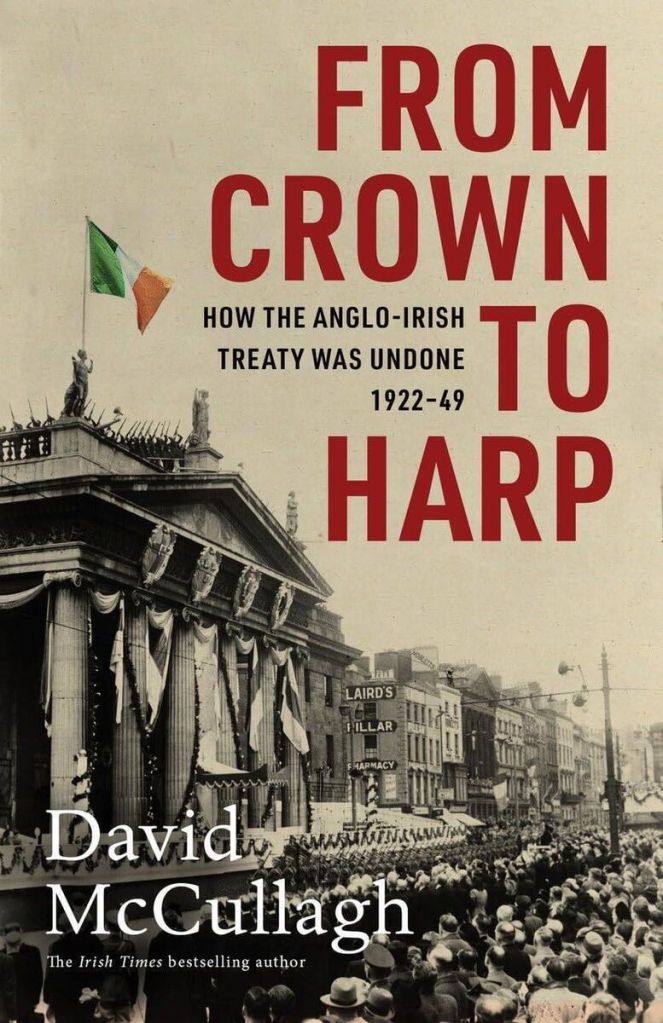
David McCullagh: From Crown to Harp: How the Anglo-Irish Treaty was Undone 1922-1949, Gill Books, Dublin, 2025.
RRP: €26.99
ISBN: 9781804581469 gillbooks.ie
In Irish secondary school history books, the journey from the signing of the Anglo-Irish Treaty – that set up the Free State – to the declaration of the Republic of Ireland at a press conference in Ottawa seems inevitable and logical, if maddeningly odd.
In the Treaty, the British insisted that members of the new Irish government would take an oath to the English monarch. Anathema to republicans.
Not enough people listened to Michael Collins, who argued that what the Treaty provided was “not the ultimate freedom that all nations desire and develop to, but the freedom to achieve it”.
An 11-month civil war with 1,425 dead was followed by generations of division and a century of rule in the South by two opposing centre-right political parties whose main difference was their pro- or anti-Treaty origins and stance on corruption.
The oath to the English King mattered until it didn’t. And it turned out you could take the oath with your fingers crossed, so no one should have had to die.
In those school histories, instead of a well-publicised process, the 1937 Constitution seemed to come out of nowhere, a clever move by Éamon de Valera to capitalise on a British constitutional crisis sparked by the abdication of King Edward VIII.
But none of it was quite as simple as that.
David McCullagh’s sharply written, detailed and well-researched chronicle of how the Treaty was undone shows that the Irish republic wasn’t delivered, as many had then feared likely, through violence and bloodshed.
Sure, in early talks, the British threatened re-invasion and war. But the republic emerged out of hundreds of boring (occasionally fraught) meetings with the Westminster government, involving arguments as detailed as the use of prepositions such as “of” and “from” and the placing of a comma in the monarch’s title.
Sovereignty through syntax and guile.
McCullagh – who presents the main evening news on RTÉ television, the Irish state broadcaster – writes with the narrative energy of a journalist and the eye for detail of a historian.
He frames his project neatly. “This is the story of why the Crown was so central to the Treaty settlement and of how that settlement was unravelled; of how people who claimed that the Treaty blocked peaceful progress towards full sovereignty proved themselves wrong by dismantling it without firing a shot; of how people who fought a Civil War to defend the Free State against republicans themselves declared a republic; and of how the symbol representing Irish sovereignty changed from Crown to Harp”.
The erasure of the crown and promotion of the harp started as soon as the Free State was founded.
The new government painted the post boxes green, changed the design of the money and the stamps and erased as many symbols of the British state as it could.
Within Free State territory, the Union Jack and crown soon began to disappear, to the point where the crown was eventually only mentioned in relation to external (foreign) affairs, and then obliquely and only when absolutely necessary.
By insisting through the Treaty that the Irish Free State remain as part of what is now known as the Commonwealth, Britain gave a powerful say in Commonwealth matters to a state that was by definition antithetical to structural inequality inherent in the feudal idea of monarchy.
One of the British signatories, Winston Churchill, prematurely declared that the Treaty ‘stands for all time as a measure and symbol of the relationship which should exist between these two islands’. As McCullagh observes wryly, that symbol barely lasted 27 years.
The British plan was that Dominion status (or Commonwealth membership) would change Ireland, which it did. But Ireland – over time – also changed the Commonwealth, using its position to negotiate or inveigle significant gains.
Even for those well versed in the sequence of what happened when, how McCullagh arranges the narrative and presents each telling detail means that From Crown to Harp is nigh on impossible to put down.
There are anomalies and ironies aplenty in the history, of course. Ireland’s example would empower and dismay the other dominions, sometimes simultaneously.
The British rightly feared that what might happen in Ireland (freedom, a republic) would inspire India; the Indians wanted to use the practical precedent of Ireland’s External Relations Act for its own purposes and were dismayed when Ireland abolished the act as unworkable.
While From Crown to Harp deals with life-and-death situations – war, civil war and the threat of war – McCullagh teases out a lot of incidental humour.
Patrick McCartan (a TD, or MP in English) referred to ‘the noodle they call the King’, only to be reprimanded by his colleagues; the Governor General’s residence was initially dubbed ‘Uncle Tim’s Cabin’, because its first resident, Tim Healy, was chosen for the role by his nephew, Kevin O’Higgins.
McCullagh observes that the Free State observed the British forms where it had to and diluted or ignored them where it could.
From the earliest, the new government maintained that the constitution “contains the trappings, the insignia, the fiction and the symbols of monarchical institutions, but the real power is in the hands of the people”.
A republic in faux ermine.
McCullagh’s summing up of the Dominion Conference of 1926 is illustrative of his style.
South Africa wanted an explicit statement of Dominion equality; Canada wanted the governor-generalship reformed; Ireland wanted anachronisms that implied subordination removed; Australia and New Zealand wanted things to stay the same; and nobody cared what Newfoundland wanted.
Elsewhere, McCullagh recounts how Edward VIII’s father, George V, told British PM Stanley Baldwin: ‘After I am dead, the boy will ruin himself in twelve months’. In fact, McCullagh observes, Edward was more efficient than that, taking just ten months and three weeks to fulfil his father’s prophecy. Sparking the abdication crisis that proved useful to Irish ambitions.
Churchill – the Conservative who became a Liberal and then a Conservative again – was erratic in many things, McCullagh observes. Lloyd George compared Churchill with a chauffeur “who apparently is perfectly sane and drives with great skill for months, then suddenly he takes you over a precipice.”
At one point, Gavan Duffy suggested the King’s representative in Ireland should forego the title of Governor General for the Irish language title of An tAmadán Mór (The Big Fool), an idea that failed to fly.
Many in power in Ireland – perhaps even de Valera – wanted the Republic of Ireland to remain in the Commonwealth for trade and other reasons
In a parallel to more recent EU warnings to the UK over Brexit, Britain cautioned that Ireland couldn’t retain the benefits of Commonwealth membership (free trade, movement of people) once it left the club, though many of those benefits persisted due to the stance of the remaining dominions and the reality of proximity.
But what is deemed possible is always subject to change. In the aftermath of the American Revolution, the British freely granted Canada most of the freedoms that Americans had fought and died for.
Ireland’s declaration of a republic automatically ended Commonwealth membership but the rules were quickly changed and the Republic of India remains in the Commonwealth.
And what of Northern Ireland? The North and its status are integral to McCullagh’s narrative; for the briefest moment, it was part of the Free State but quickly exercised its opt-out power.
As McCullagh points out, almost every time an Irish government or its people had a choice between sovereignty and unity, they picked strengthening sovereignty. Even something as banal as rejoining the Commonwealth (a move that would surely guarantee Ireland some morale-boosting Commonwealth Games gold medals) is strongly opposed.
In 2025, 67 per cent of people were against the idea and just 11 per cent in favour.
‘In other words’, McCullagh writes, ‘even to help secure unity, most people in the South are not prepared to have anything to do with the Crown, no matter how tenuous in practice the link might be.’
SÉAMUS BRADLEY
Séamus Bradley is an Irish-born award-winning journalist and crisis communications professional based in Melbourne, Australia. He is a former news editor at the Age and associate editor at the Sunday Age. He is also newly elected to the Board of Management of the Celtic Club.
 Tinteán