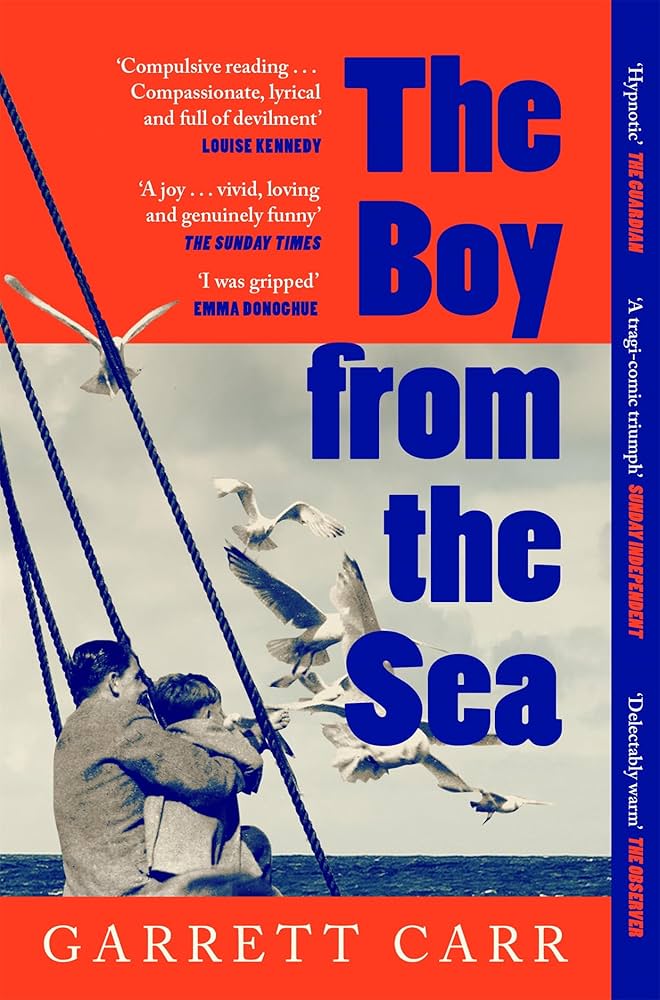
Book Review by Roxanne Bodsworth
Garrett Carr: The Boy From the Sea, Picador (2025)
RRP: $35
ISBN: 9781035044559
Much of Irish novel writing has descended into Celtic Noir in rejection of Irish romanticism, foregoing any shades of light and dark. This novel keeps the reader shifting through it all. It has all the charm of Rosalie Ham’s The Dressmaker and The Tailor and Antsy by Eric Cross, as well as the raw reality. If there is magic, it is because sometimes people need to believe in something extraordinary just to get through the everyday grind.
The story begins when a child is washed up on their shores in a barrel. The gift from the sea invites mythological comparisons, but they are a pragmatic people. ‘The baby had startling black hair but there was no talk of fairies or spirit children in our town, you’d go to Galway if you were after that kind of thing.’
Nevertheless, it is a town that looks after its own. The baby is passed around until it is decided that the Bonnar family will keep him and he will be called Brendan. It is a good fit for the seafaring folk of this fishing village.
We were a hardy people, raised facing the Atlantic. A few thousand men, women and children clinging to the coast and trying to stay dry … We knew there were more pleasant and forgiving places, we saw them on television, but they seemed meek in comparison.
There is a collective identity for the town, and the narrator speaks in the first-person plural, telling their story. While I have tried to avoid using too many quotes in this review, the voice is so uniquely Irish that the book cannot be adequately described without its orality. Yet there are also strong parallels to Irish literary tropes; the book is arranged like an annal, each chapter beginning with an accounting of what has taken place since the last time:
The season turned. A king wave hit the St Colette taking most of her gear but the lads were safe, thank God. A draw was organized by the local Mentally Handicapped Association and Sheila Gallagher won a hamper. Marie Cotter died of heart disease and there was a big turnout for her funeral, reflecting our high regard for her. Declan Bonnar started school.
Declan Bonnar is Brendan’s big brother, though he rejects that role. While others might regard Brendan as a gift, Declan is always suspicious of this interloper and so is able to see Brendan more clearly than the others, and to see the inhabitants more clearly for the way they are affected by this stranger, reminiscent of the voyeuristic fascination with the stranger in Synge’s Playboy of the Western World.
Brendan could affect us like that. Most said it was because we remembered his tough start, left abandoned and defenceless, it reminded us of our own vulnerabilities and gave us perspective. Just looking at Brendan could cause you to reassess your priorities. A few people went further and claimed Brendan had an ‘aura’ that compelled a person to examine their way of being. Most of us rejected such mad talk; we weren’t given to superstition, but they’d go on insisting.
Declan takes to following Brendan and makes disturbing discoveries. Paradoxically, this is where their relationship shifts and Declan starts acting more like a guiding big brother, but meanwhile the outside world finds its way to this place, sometimes in the guise of alternative lifestylers, and there is a danger that Brendan could become caught up in their particular brand of unreality. Living in a rural community frequented by such visitors, I found the narrator’s description particularly enjoyable:
Some went for hippy clothes, but many dressed like us, normal, and you’d be talking to them like normal, but then they’d say something peculiar, and you’d know … They’d often say they wanted to live close to nature and it’s true we had plenty. Some said they were attracted to our simpler lives, but we’d soon set them right on that, we only made it look simple.
The community were as accepting of Brendan’s vagaries as they were of each other, having to get along after all. They understood he had a ‘bad start in a barrel’ so it was no surprise that he was going a bit wild. And they had compassion for the parents of kids who went astray because it happened to others as well:
They had learned, fundamentally, every child comes in from the sea, washes up against the ankles of their parents, arms outstretched, ready to be shaped by them, but with some disposition already in place, deep-set and never quite knowable.
This narrative might follow Brendan ambling through his life, sometimes racing, but it does not centre on him. This is about all the people of the town, whether the one who wins the chook raffle, the one who reaches above themselves in acquiring a bigger boat, the lonely widow, or the bitter sister who sacrifices her life to care for a cranky father:
Eunan was against anything without a set purpose and complete predictability and a human tended to fail on these requirements. He was against surprises, he hadn’t allowed a telephone in the house for many years, as you never knew when it might ring on you.
The narrator describes these people for us with tenderness and affection tinged with exasperation and dark humour. It is about ordinary life and ordinary people living in an ordinary way in an ordinary community, and it is remarkable. Carr uses humour with a deft touch, draws the place with tiny details that bring it alive, breaks our hearts and puts them back together again. Eventually, the narrator does reveal the grim reality behind this gift from the sea, but it is not about where we come from, it is about who we become.
Dr. Roxanne Bodsworth, Charles Sturt University
Roxanne Bodsworth is a writer, poet, sheep farmer and celebrant who completed her PhD by Creative Project at Victoria University, Melbourne.
 Tinteán