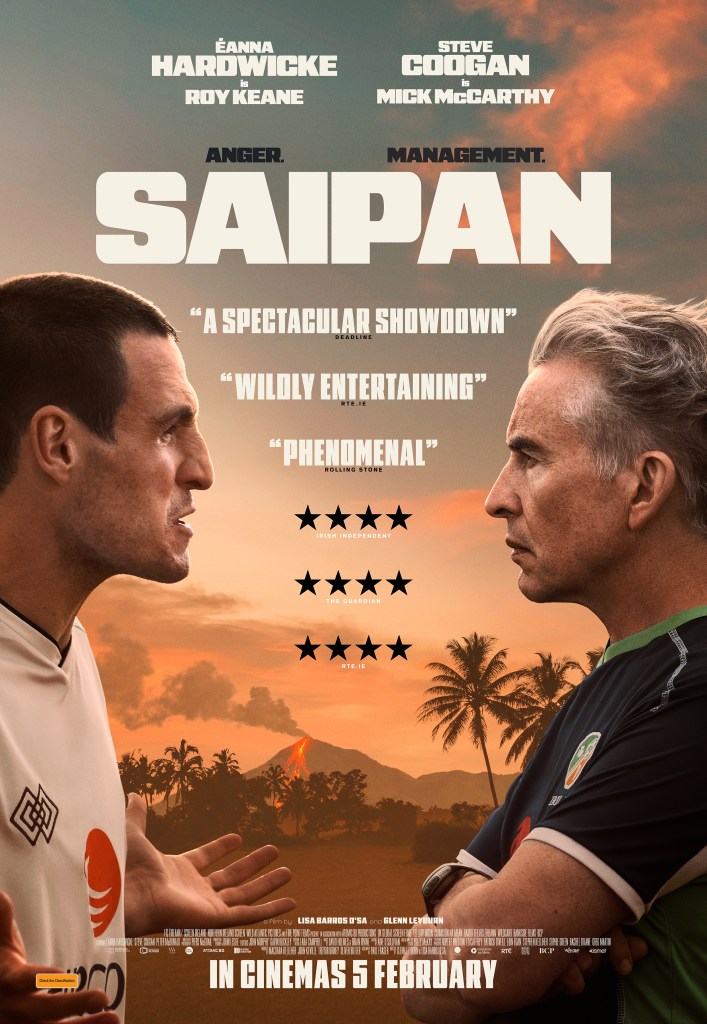
A Review of Saipan by Steve Carey
Saipan (2025), Directed by Lisa Barros D’Sa, Glenn Leyburn
Screenplay: Paul Fraser
Starring: Steve Coogan (McCarthy), Éanna Hardwicke (Keane)
‘Football isn’t who you are,’ Mick McCarthy’s wife tells him: ‘it’s what you do.’ That, in a nutshell, is what separates him from Roy Keane, whose motto might well be Shankley’s: ‘Football isn’t a matter of life and death. It’s much more serious than that.’ Saipan tells the story of The Republic of Ireland’s 2002 World Cup campaign, dominated by the Republic’s best player, Roy Keane and the drama of his departure from the team before the tournament starts. Arriving late after injury, Keane is appalled at the useless facilities provided at the Saipan pre-tournament training camp: a pitch littered with rocks, no footballs, dismal catering. Manager Mick McCarthy admits to the squad that he’s been let down, but Keane isn’t mollified in the least: it’s the manager’s job to make sure the players are given the best possible chance to prepare. (Keane is a TV pundit nowadays, famous for his phrase, ‘Do your job.’) Things go downhill from there, climaxing in a furious, foulmouthed ten minute rant at McCarthy in front of the whole playing squad. Keane flounces out, the Republic are eliminated by Spain on penalties in the round of sixteen, and we’ll never know what might have been had he stayed and played. As it was, McCarthy was sacked before the end of the year. If the film is accurate, Keane is spot on about the facilities, and the officials responsible are shown as drunken clowns, along for the ride. But Keane is far from without fault himself: prickly, a loner, he makes a dreadful captain, and his deeper resentments against an English-born manager are constantly bubbling up to the surface. Keane is not one to hold his tongue, whatever the consequences. Not a great man for knowing the time or the place, is our Roy.
Does any of this matter, and what does it say to us now? Well, one of Keane’s criticisms is that Ireland – the football team, but by implication also the nation itself – settles for its cartoon image as happy-go-lucky 24-hour party people, here for a good time and the craic but never good enough to be in contention for the ultimate victory. McCarthy, in this reading, is following in the footsteps of Englishman Jack Charlton, who brought the Republic success, up to a point, but was quite happy for the celebrations to flow. Keane wanted more victories and fewer celebrations, a formula he was used to under Alex Ferguson at Manchester United.
The country has come a long way since – and not just in sport, where its rugby union team in particular has excelled – but as an economy, with Saipan taking place during the Celtic Tiger years. Socially it has transformed, too, with church attendance plummeting as the influence of Roman Catholicism has evaporated. Its sense of confidence and independence has grown, and in an increasingly divided and polarised world, its warmth and friendliness is perhaps more appreciated now than ever.
Intriguingly, one element that is virtually erased from the narrative is how Keane’s anti-English angst at McCarthy played badly with Keane’s English-born fellow players, such as Clinton Morrison. Keane’s accusation that they were playing for Ireland only because they weren’t good enough for England is a pretty low blow, particularly coming from your captain, and particularly on the eve of a World Cup, but the film steers well clear. Perhaps this is because the protagonists are still alive and might dispute such allegations: last year Coogan’s company Baby Cow Productions settled a libel lawsuit, paying substantial damages regarding The Lost King, a 2022 film made about the discovery of Richard the Third’s remains. In it, Coogan played former University of Leicester official Richard Taylor, who objected to his depiction in the movie. Support for this conjecture comes in a lengthy disclaimer at the start of Saipan, as if to fend off any similar trouble this time around. Though Saipan’s storyline is gossamer thin, with not a hint of subplot in sight, and at 91 minutes no-one would wish it longer, it’s never less than watchable. Its attention to detail, fine use of music and excellent performances from Steve Coogan (Mick McCarthy) and Éanna Hardwicke (Roy Keane) hold attention. Their partners – strong, smart women who understand their men – may not be much more than two dimensional, and the film displays only half-hearted interest in the two men’s own inner lives and motivation: McCarthy has to find time to paint the garden fence at home; Keane used to play football as a kid.
Keane’s volatility is reflected in a temperamental hotel bedroom airconditioner and the flames of a chef at work, but once he’s blown his top two or three times it becomes inevitable, if it wasn’t already, how things are going to end: not with a whimper, but a bang.
A few surreal touches, such as a giant photograph of Keane’s head that is carried in and out as Keane is storming out or returning, Keane’s partner appearing as the row nears its climax, and a truck full of footballs spilling onto grass under floodlights, occasionally lift Saipan above the workaday, and balance out its reliance on old footage to tell us what we’re watching. It comes as no surprise that the film closes with clips of McCarthy and Keane, a familiar trope in biopics nowadays.
Saipan is showing now at selected Palace Cinemas, Luna Palace Cinemas and Cinema Nova.
Steve Carey is Treasurer of Bloomsday in Melbourne
 Tinteán