
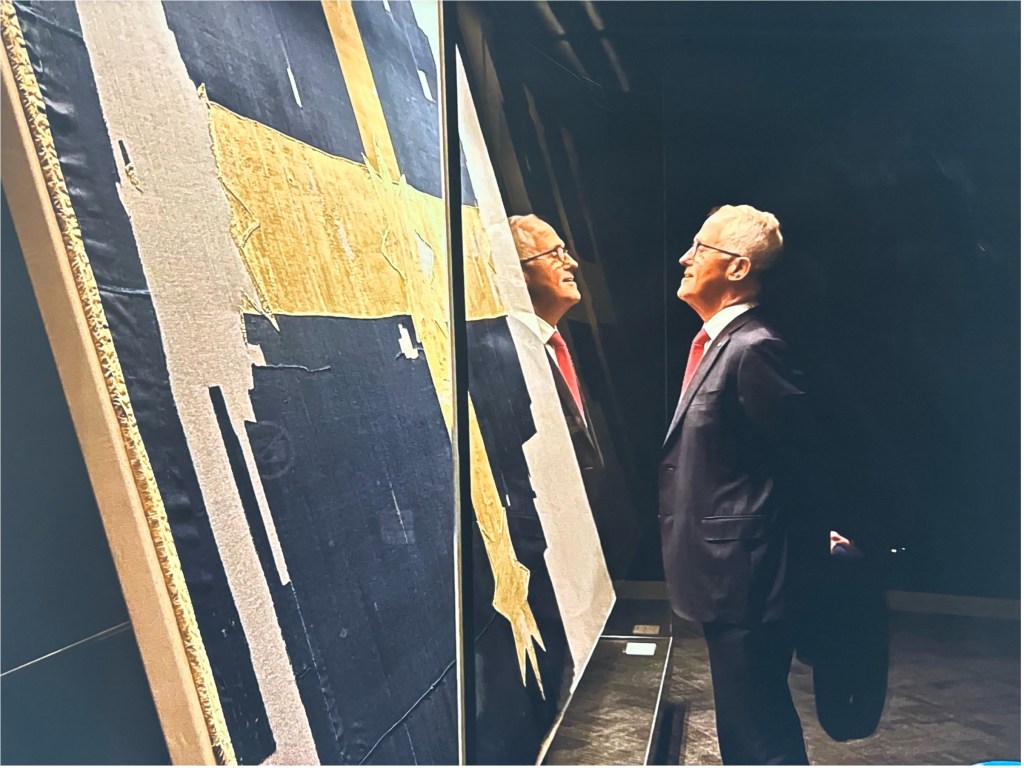
The Annual celebration of Eureka and Australian Democracy in 2025 at Batman’s Hill on Collins on 29 November 2025, and featured Malcolm Turnbull, who accepted the Eureka Australia Democracy Award for 2025. Mary Darcy of Eureka Australia read the commendation.
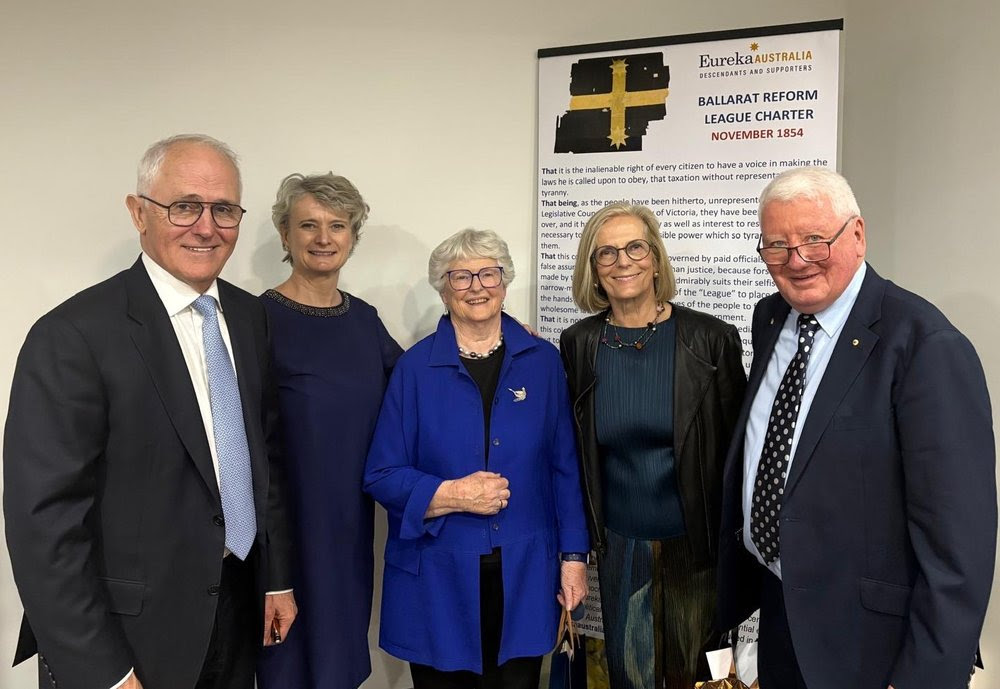
The dinner was attended by the new Irish Ambassador to Australia, Her Excellency Fiona Flood, and by the new Consul-General for Melbourne, Marie-Claire Hughes who each addressed the booked out assembly. Ambassador Flood commented in these terms:
The legacy of Eureka belongs to Australia, but its spirit resonates deeply with Ireland. The demand for a fair go, the insistence that authority must be accountable, and the belief that ordinary people can shape the future—these are values that bind our two nations across oceans and generations.
Today we honour those Irish men and women not because they sought conflict, but because they sought justice. Their sacrifices helped shape the democratic principles Australia holds dear and contributed to the enduring relationship between our peoples.
As we reflect on their bravery, let us also consider what it asks of us today: to uphold the values of fairness, equality, and civic responsibility; to welcome newcomers as partners in building society; and to remember that democracy is not a gift bestowed but a commitment renewed by each generation, or as I heard Malcom Turnbull say last Thursday in Canberra, let us remember that we cannot take any of our democratic privileges for granted.
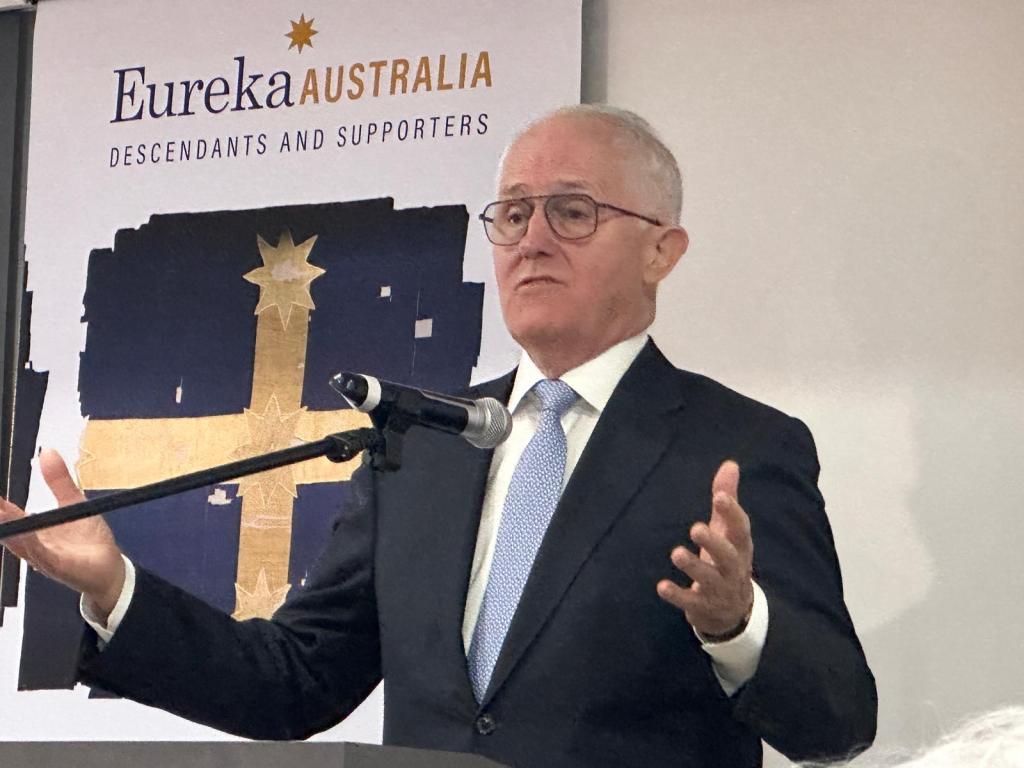
There have been some exceptional speakers at the Eureka Dinner in recent years, and Malcolm Turnbull was a standout. In expansive mood and relaxed and jocular, he acknowledged himself as an ex-Prime Minister, from a different political constituency, but he clearly felt he was in friendly company. He joked about his award and its generous citation as the result of being no longer in politics. He spoke extempore, with no notes, and in terms that resonated strongly with both Australia’s Gallipoli defeat and the Ireland’s Rising: ‘While the battle was lost, the war was won’. He evoked Eureka, then catalogued a list of world ‘firsts’ (or almost firsts in some cases like women’s suffrage) that ensued and, he implied, derived from Eureka: women’s suffrage and the right to stand for parliamentary office, compulsory voting, and preferential voting. He cited the statistic that 97.5% of people eligible to vote were automatically on the electoral roll and followed up with fines if they failed to vote.
Turnbull made much of the tendency to centralism in Australian democracy as a mechanism for avoiding polarisation. He had a pungent term for it: the ‘angertainment’ ecosystem. A topical example he gave was of the Liberal Party’s turn to the right as leading in electoral catastrophe for them. This turn from the centre had given an opportunity to the Teals to come through the centre and capture votes from both of the mainstream parties. He saw centralism as an admirable feature of Australian democracy and urged not taking our system, for this and other reasons, for granted.
I’d hazard a guess that he was invited to talk largely because of his commitment to the Republican cause in the failed Referendum of 1999. He talked candidly about this, noting that the rock on which the Republic foundered was on the issue of how to choose a President. In addressing the failure of the Referendum, he took us back to his prediction then: ‘If you say no, you will end up saying no for a long, long time’, which of course has been the case. He offered some advice:
Next time, I think we need to have a preliminary vote on how we choose the president. And we should thrash that out, and having had that vote whatever the decision is, incorporate that into the amendments for the formal constitution referendum process.
He was optimistic that if the voting public were given a choice of how to elect a president, and that if choice was respected, a Republic could be achieved. He did not nominate a timeline, however. The reason he gave for this was the finding during the referendum that those who supported direct election started high but fell off a cliff. As with all referenda in Australia, non-partisanship is essential to success.
The second half of his speech was devoted to the threats to democracy : rising authoritarian populism (à la Trump) and he warned about loss of sovereignty with the AUKUS agreement and the trashing of the Free Trade Agreement. AUKUS he saw as not unlike BREXIT and a mistake because it made us more dependent on the United States right at a time when the United States has become much less dependable. This is not a criticism of the United States. They are saying [to Ukraine and NATO] ‘You can’t count on us’. Their message to the Ukrainians is ‘You are on your own’.
He energised his hearers by stressing some protections that already exist or are in the making. He urged the audience to take heart from the Trans Pacific Partnership (an achievement of his time in office) and the impending new Free Trade partnerships being forged by Australia with the European Union – moves are afoot that may strengthen Free Trade independently of the USA. He expressed concern about gerrymandering of electorates that has been possible in the USA and praised the Australian Electoral Commission which does not brook political interference.It was an uplifting lecture, which looked both critically and constructively at issues of great political moment to Australian voters. It was great to hear a senior politician sounding ‘more Irish than the Irish’ and observe how he enjoyed consorting with them.
Frances Devlin-Glass
Frances is a long-term member of the editorial collective of Tinteán.
 Tinteán