Book Review by Chris Watson
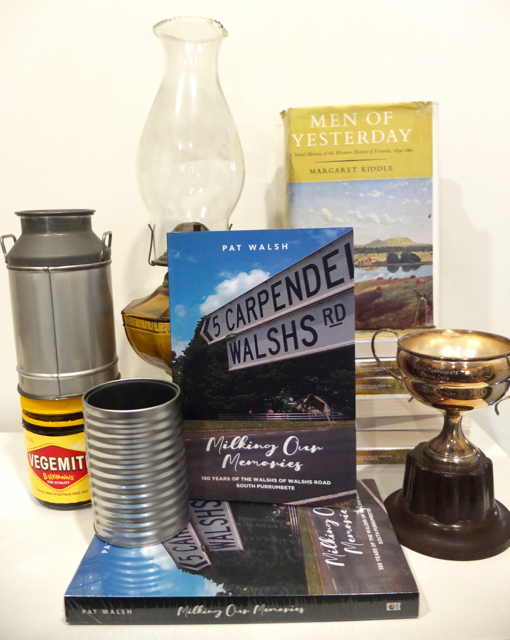
Book Review by Chris Watson
Pat Walsh, Milking our Memories, Pat Walsh, Melbourne, 2025 (third printing).
ISBN: ISBN : 9786024813741
RRP: $30
Available at Blane’s Newsagency, Murray St, Colac and Collins Booksellers, Liebig St, Warrnambool, but also through the author by email (padiwalsh@gmail.com).
When Charles Gavan Duffy, former editor of The Nation, arrived in Victoria, he was impressed by how well Irish immigrants were doing, especially in the district around Koroit – well enough to provide the funds for him to meet a property qualification to stand for, and win, a seat in the Victorian Legislative Assembly. Poorer Irish arrivals in the following years included Maurice and Margaret Walsh. She was one of the Irish girls sponsored by the Earl Grey Scheme, arriving at Williamstown at the site of the memorial to the victims of the Great Famine. Though not as spectacularly successful as some of those earlier Irish, they met, married, and eventually moved to land opened up for settlement by policies sponsored by the same Gavan Duffy, among others. For them, the key to success was dairy farming, with its relentless demands. Pat Walsh, one of their descendants, has written a lively history of the family’s doings, centred on their home in Walshs Road, South Purrumbete, but tracking descendants’ moves to other places. (Request: Could the second edition please have a map of the main places mentioned?)
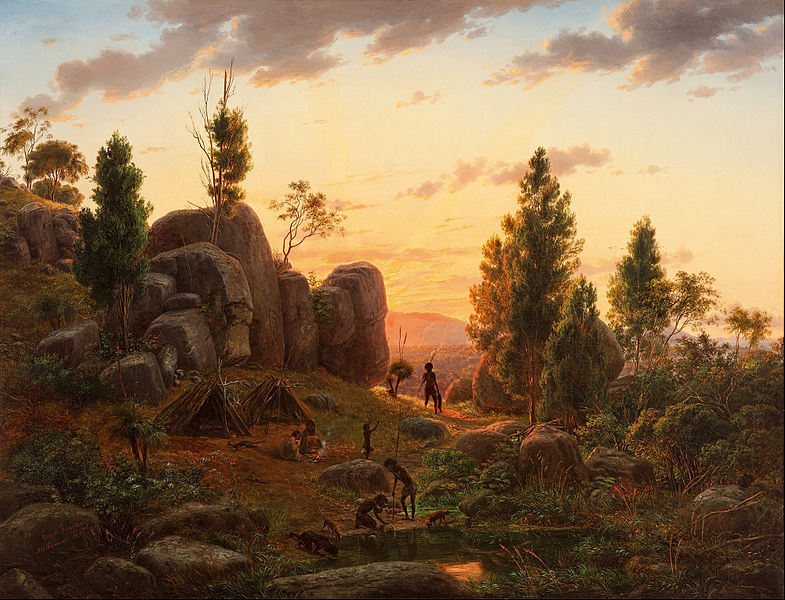
The success of some immigrants also meant the dispossession – and worse – of the aboriginal inhabitants. Walsh acknowledges this earlier history, much of it ignored by “white” society until recently. The Walsh history in Australia starts later than the time of Victoria’s frontier wars, though I wonder if they were so decisively over by this time? Indigenous people were still around. Lenny Clarke is cited remembering indigenous groups enjoying time at a Walsh property.
Like other family histories, having recorded how everybody is related, it tells us about how they lived, more interesting for outsiders, especially when those personal stories are part of a larger picture, sometimes bringing the pleasure of recognition, sometimes that of learning something new. I felt both while reading this book. One I know well was the opening chapter’s description of searching for graves and placing memorials on unmarked ones, culminating in family gatherings and family histories. This seems to be an era for catching up with such services to our ancestors, perhaps a fruit of increased education, leisure and resources.
Thinking I knew very little of the Western District, I was reminded of places where I had been. Piggoreet is one example. Robert McNamara, from my late wife Jan’s family, was drowned in a pool there in 1887. His parents came from Ireland for the gold. More than a century later we spent several hours walking there, imagining what it would have been like for them. Showing us the diggings at Berringa in the 1970s, an older relative shared memories of going down shafts in his younger days, and hinted at a current one that he wasn’t going to show anybody. Until I read this book I didn’t know that there was an active mine there into the 1950s.
Walsh writes of the railways, a vital means of communication, providing a link with Melbourne, which becomes more important in the story as members of new generations begin to move away. (Perhaps some early Walsh journeys were on trains pulled by steam locomotives like the A2 which my grandfather, Larry Fraser, another descendant of Irish parents, drove on that line.) Locally, necessary activities like getting yourself to town or produce to the butter factory required other forms of transport, occasionally leading to mishaps, some of which provide vivid anecdotes here. Likewise, daily life before electricity was readily available, is described in the early chapters.
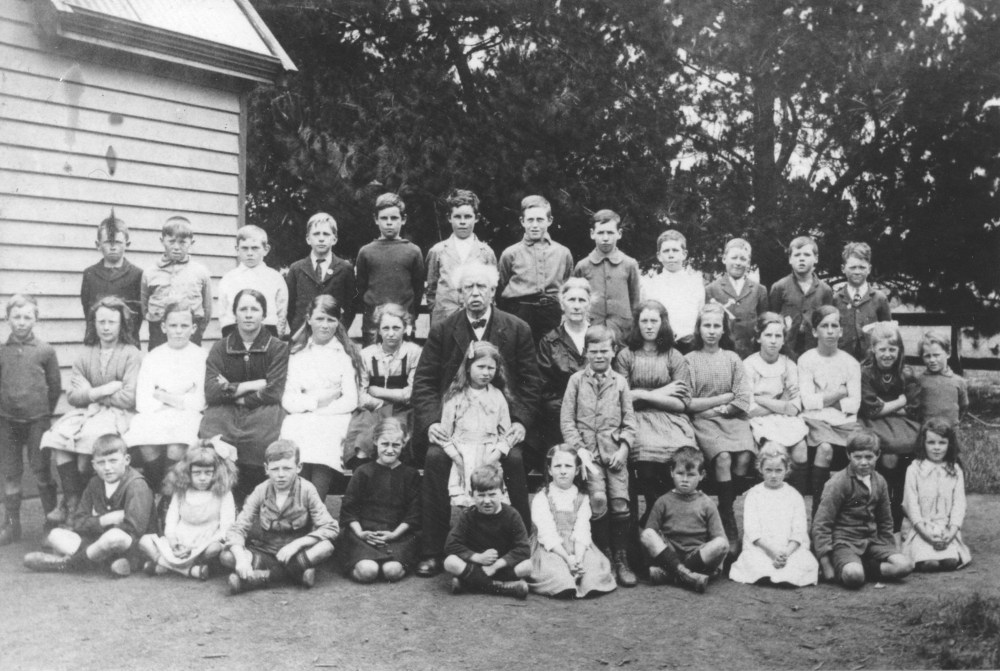
Those familiar with “John O’Brien’s” Around the Boree Log will remember its lively depiction of an Irish Catholic community. I don’t remember much there to suggest that non-Catholics were also around. The Catholic community depicted in Walsh’s book is well integrated into a more diverse community, sharing the same primary school, and sporting activities. Still, it has its distinctive moments, notably on Sunday mornings. The author recalls Ash Wednesday, when Catholic students who arrived late after churcfh “would be put to work in the school garden and not allowed into the classroom.” Walsh says they suspected “a hint of sectarian discrimination”. Compared with the raging sectarianism existing in some parts of Australia, especially Melbourne, this doesn’t sound so bad.
All the same, “mixed marriages” could be a problem, and not only for Catholics; a gun-carrying non-Catholic father visited to “lay down the law” about his daughter Nan and John Walsh. They eloped anyway! Their marital situation was a source of great concern to an aunt, who tracked them down, somehow persuading them to “tie the knot” and have their children baptised. Meanwhile, John’s father discreetly tracked down his son, meeting him on neutral ground to check on how he was. As the family’s story moves well into the twentieth century, the tight grip of the Church rules was loosening. Still, memories of rigorous Redemptorist missions are not too far in the past. Happily, I was spared the chore of being assigned to sit in a car to identify straying Catholics while trying to keep out of sight of the neighbours they need to live with after the priests have gone.
Religious and political issues overlapped heavily in Victoria during the Labor Party split in the 1950s. South Purrumbete was not immune, though the situation in a dairy-farming town looks far milder than in suburban Melbourne, where “safe” Labor seats were involved. Still, having the priest urging support for what became the DLP, and the comment that “no priest is going to tell me how to vote” ring loud bells for this Port Melbourne boy. At South Purrumbete, the Catholic and Presbyterian churches are now closed. Earlier, an old Catholic Church building was transferred to the Walsh property to serve as a shed. Its fate and uses provide good stories at different points in the book.
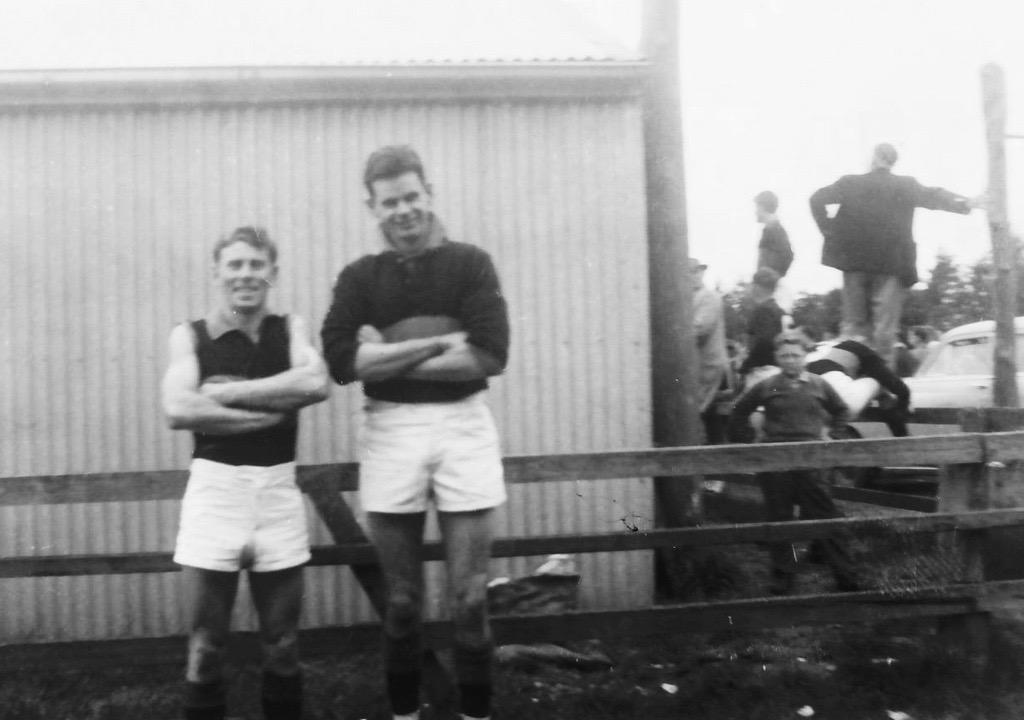
Sport has long been an important part of Australian-Irish culture. In South Purrumbete, the fellowship of the Football club in particular, appears to have overwhelmed potential religious tensions. Horse-related sport gets plenty of attention here, with vivid descriptions of hunting hares and of the conduct of country races, including one where the last race had to be held in the dark because the starter had taken too long refreshing himself at the bar. Later chapters, in keeping with the geographical expansion of the family, describe performances at major race meetings and an AFL Grand Final.
The Walsh family inevitably spread to other places. Like so many of our Irish ancestors, family members ran a hotel at Cape Clear, a place which also welcomed relatives, including the author, who lived there while attending St Patrick’s in Ballarat. His personal memories of Cape Clear are, typically, set in the context of the overall history of the district, with a discussion of this puzzling name for a place far from the coast. The chapter on Cape Clear is also an occasion for placing the family’s story in the context of the Second World War, and later references show ways in which it impinged locally. For the Walsh family, this includes the presence of an Italian POW, Ferrelli Pasquale, who became a much-liked member of the household. “Uncle Cyril”, killed in action over Denmark, gets a whole chapter which, as well as giving a lengthy account of his story and the response of Danish residents to the crash and its aftermath, covers the author’s own and subsequent family visits to the crash site.
The story does go into more recent years, though the earlier ones caught my attention best. The descendants of those who left Ireland “for ever” were starting to travel back to those ancestral roots in the northern hemisphere, a fruit of late twentieth century travel options but also one sign that the family indeed “thrived”. The book’s acknowledgements, with well-deserved thanks to the publisher, a friend in Jakarta, along with passing references to the author’s own absences at key moments, display another sort of geographical expansion, to countries nearer to Australia.
Talk of thriving does not mean a totally smooth story of progress. Losses along the way include sad events like deaths in car accidents. I enjoyed the humorous touches, including the word-play of the title, so appropriate to a dairy-farming family, and the quaint introductions for each chapter, as well as the wry obervations that pepper the story. The introduction to the final chapter includes the provocative remark “it is mostly true.” Perhaps such a warning should shadow anybody who, like Pat Walsh, can tell a good yarn. But, overall, I can confidently believe and enjoy what he has given us here.
Chris Watson
Since retiring as Lecturer in English at La Trobe University, Chris Watson has followed his interests in Irish language, literature and history. He was a member of the Irish Famine Commemoration Group that planned the Irish Famine memorial at Williamstown in 1998.
 Tinteán