Gearr Gonta
Céad Dán le Céad File
Eagarthóir/Editor; Micheál Ó Conghaile
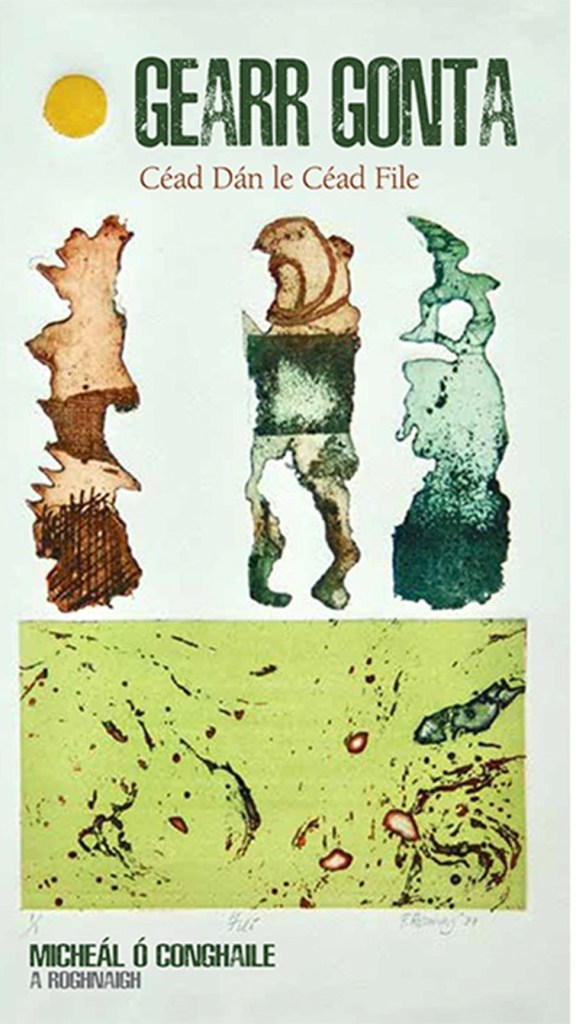
Whether it’s history, culture or literature, anthologies can provide insight into different time periods, viewpoints, and creative expressions. They are galleries of dotted symphonies, with each composition diverting the reader to the unique thoughts and views of each contributor. Gearr Gonta is no exception to this, an Irish language poetry collection, published by Cló Iar-Chonnacht in 2025. A book of 100 poems, by 100 poets. It is littered with varied styles of concentrated gems, poems that present snapshots of writers, serving as a smorgasbord of styles that are full of delights and surprises. Most recently produced anthologies, tend to focus on themes for their collections and in this scribe’s opinion can lead to reader fatigue, but Gearr Gonta – with brevity being its greatest strength – presents bite-sized treats of no more than 12 lines per poet, hence the title Gearr Gonta, (Short and Succinct).
Cló Iar-Chonnacht is an Irish language publishing company, based in the West of Ireland and is dedicated solely to Irish language publishing. Micheál Ó Conghaile, editor of Gearr Gonta, has been at the helm since its inception and this year they celebrate 40 years of business and have hence produced this anthology to celebrate a significant milestone.
Micheál Ó Conghaile, a prolific and talented writer himself, is a Connemara native and established Cló Iar-Chonnacht (CIC) in 1985. As a writer he has published poetry, short stories, a novel, plays, and novellas and has been awarded the Butler Literary Award by the Irish American Cultural Institute. He was also awarded the Hennessy Irish Writer of the Year Award. In1998 he was elected to Aosdána for his ‘outstanding contribution to the Arts in Ireland.’ His own works have been translated into several languages, including Romanian, Croatian, Albanian, Slovenian, German, Bengali, Polish, Macedonian, Arabic and English. He was Writer in Residence at Queen’s University, Belfast and at the University of Ulster Coleraine between 1999 – 2002. His selected short stories, The Colours of Man, was published in English in 2012, and he has received an honorary degree from the National University of Ireland, Galway in 2013.
Gearr Gonta opens with a preface from Ó Conghaile setting the scene for the flavour of the book. He writes:
‘Bhí ómós ag an bhfile agus ag an scríbhneoir cruthaitheach riamh don fhocal, don abairt, don chruinneas, don fhírinne. Soiléireacht a chuartú is a aimsiú, mas b’fhéidir. Criostalú a dhéanamh ar ábhar. Ní roghnaíonn filí a gcuid focal ar nós cuma liom amhail is dá dtitfidís anuas as an spéir isteach ina mbachlainn nó mar a chaithfí amach as béal bobaire ar ardán nó ar an tsráid iad. Is go cúramach cáiréiseach a roghnaítear iad, iad dá gcur trí chóras machnaimh is tástála nó go saothraíonn a gcúinne féin i ndán, ag aimsiú fírinne na healaíne agus fírinne an tsaoil de ghnáth. Uaireanta, fiú, is gá focal nua a chumadh chuige sin agus tá filí ann atá breá ábalta chuige’
‘The poet and the creative writer have always respected the word, the sentence, the accuracy, the truth. To hunt for clarity and to retrieve it, if possible. To crystallise the material. Poets do not choose their words willy-nilly as if they fell from the sky into their laps or were thrown from the mouths of jesters on stages or on streets. It is with care and caution they are chosen, milled through a process of reflection and testing until they earn their own place in a poem, seeking the truth of art or life, usually. Sometimes, even, new words must be composed accordingly, and there are poets who are skilled at this.’
The book contains poetry from many of my favourite poets, Colm Breathnach, with his visceral image in An Ghéag Theasctha; The Severed Limb, reflecting the invisible ‘itch’ or desire one has for a language lost or a language being lost, which may rise from somewhere unknown. Colette Ní Ghallchóir‘s Diúltú: (Refusal/Denial/Rejection) touches on the dogged determination of humans to persist in the face of exclusion/denial or rejection and the need to realign somehow or right a wrong and find some perceived justice. The book also features Australia’s Colin Ryan with one of his many flawlessly formed and concisely presented pieces, Rud éigin: Something:
Rud éigin
Chuir rud éigin an madra ag tafann
i lánaí an mheán oíche:
giolcadh na sciathán leathair
faoi sholas na gealaí
nó an gadaí a bhí ar lorg
na n-úll ar chraobh chrochta
is seodra i seomraí tí
gan tógáil
Something
Something set the dog barking
in midnight lanes:
the squeaking of bats
in the moonlight
or the thief seeking apples
on a hanging branch
and jewels in the rooms of a house
unbuilt
Aistrithe ag/Translated by Colin Ryan
Some other poets include Andreas Vogel, Áine Ní Ghlinn, Caitríona Ní Chléirchín and Dairena Ní Chinnéide, who have kindly appeared as guests for this series of Tinteán’s Agallaimh le Scribhneoirí na Gaeilge/Interviews with Irish language writers. I am privileged to have a poem of my own included, a brief and economical representation of how one can disassociate and disconnect the body from the mind as a mechanism for reducing the impact of trauma.
Dymphna Lonergan writes about the book below.
‘What a wonderful idea this is, a hundred poems in Irish, each one not more than twelve lines. I am only half way through reading them, but already I have fashioned numerous makeshift bookmarks for those poems that brought me delight: Brian Ó Maoileoin’s ‘Cumann’ for its sound sense and intrigue:
Cumaim dán dár gcumann,
Do chumas an dá dhán:
Gach dán lena chéile cumainn
I gcumann dána amháin.
And straight after that ‘Marana,’ a fisherwoman on her hunkers, her rod stuck fast in the sand. The poet, Bríd Ní Mhóráin, then takes us deep into the fisherwoman’s mind and what spiritual enlightenment she might be seeking. I was reminded of some final lines from a poem I came across once, and now thanks to Google, I have found again: Irish poet James Stephen’s ‘The Goat Paths’ ends with
I would think until I found/Something I can never find/Something lying on the ground/In the bottom of my mind.
I loved ‘Éad’ by Diarmaid Ó Doibhlin about the poet’s jealously of the priest who is privy to the poet’s love interest’s most vulnerable moment when receiving communion. I also related to Doireann Ní Ghríofa’s ‘Suburbia’ houses built close together and beyond them cows grazing. Another poem I marked as pleasing turned out to be by our own Colin Ryan. Colin’s poetry takes the ordinary and reveals what lies beneath in a delicious way, sometimes menacing, sometimes playful.
The book would make a lovely present.’
Anthologies of this nature are a treat to read, giving the reader a taste of such a wide variety of authors, some who have books published, some who have not. Hopefully, more Irish language publishers will follow Cló Iar Chonnacht’s lead and create collections of this style and variety in the future.
Tá Gearr Gonta le fáil anseo.
Gearr Gonta is available to buy here.
Julie Breathnach-Banwait/Dymphna Lonergan
Meitheamh/June 2025
On New Turf
By Michael Boyle
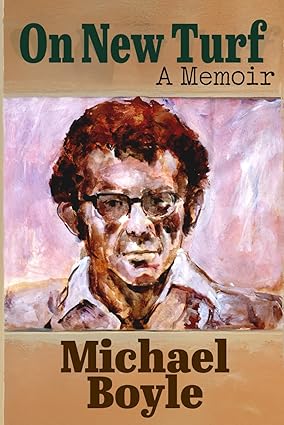
Michael Boyle has been a longtime contributor of poetry and memoir to Tinteán. I was delighted to receive in the post from Newfoundland a copy of his completed memoir, On New Turf, available through Amazon https://www.amazon.com/New-Turf-Memoir-Michael-Boyle/dp/1989109411
Michael (Meehawl) answered an advertisement in 1967 for a ‘principal’ position on Fogo Island, Newfoundland. Answering the advertisement and being accepted for the job turned out to be the easiest part. This 22 year-old from Maghera, County Derry experienced his first hurdle when at the town travel agency the agent was not sure where Newfoundland was. Michael muses, ‘ wondered to myself if it might be easier to book a cruise to Tasmania or a safari to Timbuktu.’ His booking would take him from Belfast to Paris and then to Montreal and from there to Goose Bay and on to Fogo Island. He ends up in Gander, though, not Fogo Island, losing his luggage along the way.
All of us who have left home at a young age can relate to Meehawl Boyle. Those who lived through the 1960s Troubles can empathise with the returning emigrant who has to leave again. On New Turf moves back and forth between Michael’s evolving life in Newfoundland and memories of his childhood: farmlife in the 1950s; how he nearly died after falling down a well; school life in Northern Ireland where they saw maps of the British Empire so different to my own in the South; the poet Seamus Heaney his English literature teacher at university.
Settling into Newfoundland life was helped by regular correspondence from Michael’s mother:
She used a blue biro pen and had numbered the pages on small, plain, lined notepaper…I was pleased to see, sometimes, the smudged ring of a teacup or saucer imprinted on the page. I ould see her in the kichen getting a cup of tea as she wrote to me on a Sunday night.
Michael’s wish in his introduction to On New Turf is that ‘it will be ínteresting, reflective, and enjoyable.’ I can attest that he delivered.
Dymphna Lonergan
James Joyce a life
By Gabrielle Carey
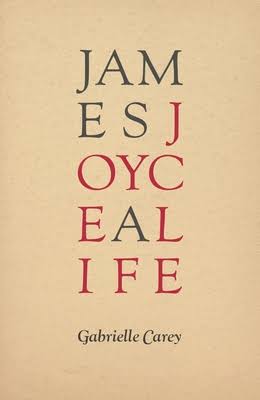
This is the blurb on the back cover of the book:
‘If you know nothing about James Joyce but would like to – without bothering to read him – this is the book for you.
If you know a little about James Joyce and would like to know more but not too much, this is the book for you.
And if you are a die-hard Joycean who has spent your life puzzling over his work but know nothing about his life, this is the book for you.’
I guess I’ll go with the second option. Here’s the not too much that I now know:
-Joyce endured over a dozen eye operations sans anaesthesia. He suffered from glaucoma, iritis, conjunctivitis and abscesses.
-As a remedy, a doctor injected cocaine into Joyce’s eye.
-He had rotting teeth.
-There were courtcases and censorship. Fallen women in Salvation Army reform programs shredded copies of Ulysses for the greater good.
-A handwritten manuscript of the ‘Circe’ chapter of Ulysses was thrown into a fire by a typist’s enraged husband.
– Joyce got around like a ‘morose Jesus’.
-His teeth continued to rot.
-To economise, he and Nora gave up drinking wine at lunch time.
-Joyce became infatuated with German doctor, Gertrude Kaempffer, whilst holidaying in Locarno. The love was unreciprocated. Maybe because of the rotting teeth.
-Jung described Joyce as a ‘half cut worm’. Yeats said of Joyce he was ‘such a colossal self-conceit with such a Lilliputian genius’. (Later taken back.)
So, is this the book for me? Sure is.
Linda Rooney
TWIST
By Colum McCann

This is not my favourite Colum McCann (I’d plump for Transatlantic), but I admired the hands-on research that informs Twist. It’s grimmer than I at first suspected as it deals with issues like global connectivity and its frailties, as well as sub-themes issues of celebrity and the fallibility of expecting personalities to be stable and consistent.
The premise is that the author is suffering from writer’s block and needs some uninterrupted time and a new project. It comes in the form of working on a ship manned (there are no women so my verb is accurate) by highly skilled artisans of many kinds, including deep divers. The ship repairs internet cables which often sink into deep caverns on the sea-floor and get broken by avalanches and floods.
There’s a very intriguing subplot about Conway, the leader of the expedition’s partner, Zanele, a South African actress and something of a celebrity, being seriously injured. It precipitates a crisis in Conway and he turns feral.
The book is thought-provoking. That the world’s communications are conducted under such sub-optimal conditions as those in which the cables operate, and that they are so at the mercy of luck to reclaim once damaged, raises huge security issues. As does the value to humanity of celebrity culture which fuels the internet and motivates, one assumes, such assaults on individuals like Zanele.
Colum McCann is always ploughing new fields and writes a compelling narrative. I recommend this book.
Frances Devlin-Glass
 Tinteán