
Written by Siobhan O’Neill, Irish Famine Orphan Girls Commemoration Melbourne
On Sunday 24 November 2024, a gathering was held for the 26th year at Famine Rock in Williamstown, Melbourne, for the Irish Famine Orphan Girls Commemoration.
The challenge of serious weather warnings necessitated a reluctant one week delay, resulting in a comparatively smaller crowd. Yet, many descendants joined with a large number of people not related to an orphan girl but impassioned about this important story. There was a wonderful feeling of solidarity with the orphan girls and their legacy.
Guest speakers
Mr Sam Roberts, Second Secretary with the Embassy of Ireland Canberra spoke in part to the strong connections of the diaspora, spanning distance and generations. He also noted the importance of sharing our stories and histories.
He noted the orphan girls as pioneers and torch-bearers for future generations, their resilience and bravery, the inspiration of their story, the enduring links they established between Ireland and Australia, and the vibrant Irish-Australian community their descendants have helped to establish.
‘The Great Famine, and its profound, devastating impact, stands out as a defining moment in Irish history. The shockwaves from this immense tragedy have resonated across the decades and, in many ways. you cannot tell the story of Ireland without telling the story of An Gorta Mór, or the Great Hunger’, Sam Roberts said.
‘There are many sobering facts that demonstrate the suffering and loss the Irish people endured during the Famine. Nearly one million people lost their lives, and over a million more left the country. And most remarkably of all, Ireland’s population has still to this day, even 170 years later, never recovered to the level it was before the Famine,’ he said.
The history surrounding An Gorta Mór holds a special place in the rich shared history of Ireland and Australia. Sam Roberts continued:
‘It is so vitally important that we remain committed to remembering the orphan girls, and indeed all of the millions who were impacted by the tragedy of the Great Famine.
‘As with each day, and with each year, these events move further and further into the past, there is always a danger that the memories will start to fade. It takes work, effort and commitment to ensure that this important legacy is not forgotten. Events like today ensure that Australia doesn’t forget its Irish past, and similarly we in Ireland must ensure that the reverse is true – that we don’t forget our Australian past. So thank you to everyone who works so hard to maintain that link that bonds our two countries.
Finally, I want to give the last word to the orphan girls. I think the fact that so many of us are here today to celebrate them, even nearly two centuries later, speaks volumes. The hardship, fear and uncertainty they must have felt as they crossed to the other side of the planet, is almost impossible to fathom.
At this very moment, we are standing more than 17,000 kilometres from Ireland. It is almost impossible to be any further from home than we are right now. We have acknowledged the anxiety and uncertainty that the girls must have felt as they arrived here, on dry land once again. But I truly want to believe that they also came with some level of hope, and optimism.
Because whether they realised it at the time or not, they were pioneers for a new country, the torch-bearers for future generations. They paved the way for so many who came after them. And so we don’t just remember them, but we thank them, and celebrate them.’
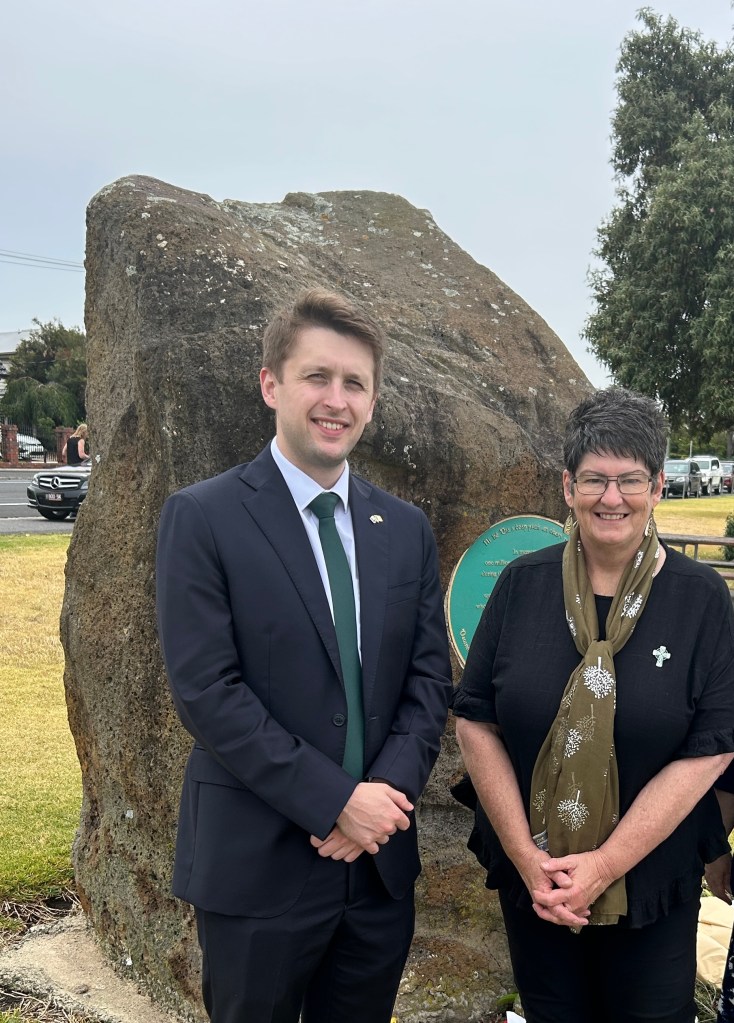
Our second guest speaker was commemoration committee member, Noeleen Lloyd (pictured right), who delivered a presentation titled Shared Histories and Local Champions.
Then just returned from holiday in Ireland, she outlined some remarkable opportunities she enjoyed to meet and speak with people who are also working to share the story of the orphan girls and An Gorta Mór (the Great Hunger) of Ireland.
She had a chance to present in some locations, including Annaghdown in County Galway, from where her 2 x great-grandmother and great grand-aunt (Bridget and Mary Young, respectively) left the Galway workhouse to join the ship Thomas Arbuthnot in 1850.
Noeleen also visited several other workhouses, and took the opportunity to meet managers and staff who are the local champions for the orphan girls’ story.
Traditionally, a guest speaker from the Creative City of Hobson’s Bay would join us, but competing elections and the role of Mayor then to be finalised precluded a speech this year. But the continued and invaluable support of Council, our major supporter enables us to hold our annual commemoration event at Famine Rock.
Special Presentation
Our Special Presentation was titled ‘Jane Troy – ‘Tis a Long Way from Tipperary’. In the piece, delivered by Jane’s 3 x great granddaughter Liz Metcalfe, we imagined how Jane might have shared her story with us. Jane was born in Roscrea, Co Tipperary in 1833, one of four children to Dennis Troy and Dora Whelan, before the Great Hunger forced Jane into the Roscrea Workhouse.
Jane was 15 years old when chosen for the Earl Grey Scheme, and 16 when she arrived in Port Phillip (Melbourne) on 14 May 1849, one of 305 orphan girls on board the Pemberton. She was then one of 36 ‘Pemberton girls’ chosen for travel to Portland on the brig Raven.
Jane would immediately find work at a respectable £10 per annum. In 1852, she married a farmer named George Smith. He was from Wiltshire, England and much older than Jane, aged 44 to her 19 years old. His first wife had died, leaving two small children for whom Jane and George cared before having their own family of 13 children. They were married for 25 years.
The family prospered in the Portland area. George Smith passed in 1877 and Jane would live a further 35 years as ‘the widow Smith’. She passed in 1912 and her family laid her to rest with her husband in Dartmoor, Victoria.
At the end of the presentation, we took the liberty of imagining what Jane might have shared with us today: ‘By the grace of God, we orphan girls survived famine and the workhouse, travelling across oceans to find a new life in a new world; building families and homes along the way. I hope we are remembered by the generations who follow us. We held home in our hearts and hope in our dreams – ‘tis a long way from Tipperary, indeed’.
Tradition
The event ended with the traditional reading of Orphans and Descendants lists, this year led by Heather Northwood, a descendant of Ellen Desmond (Eliza Caroline).
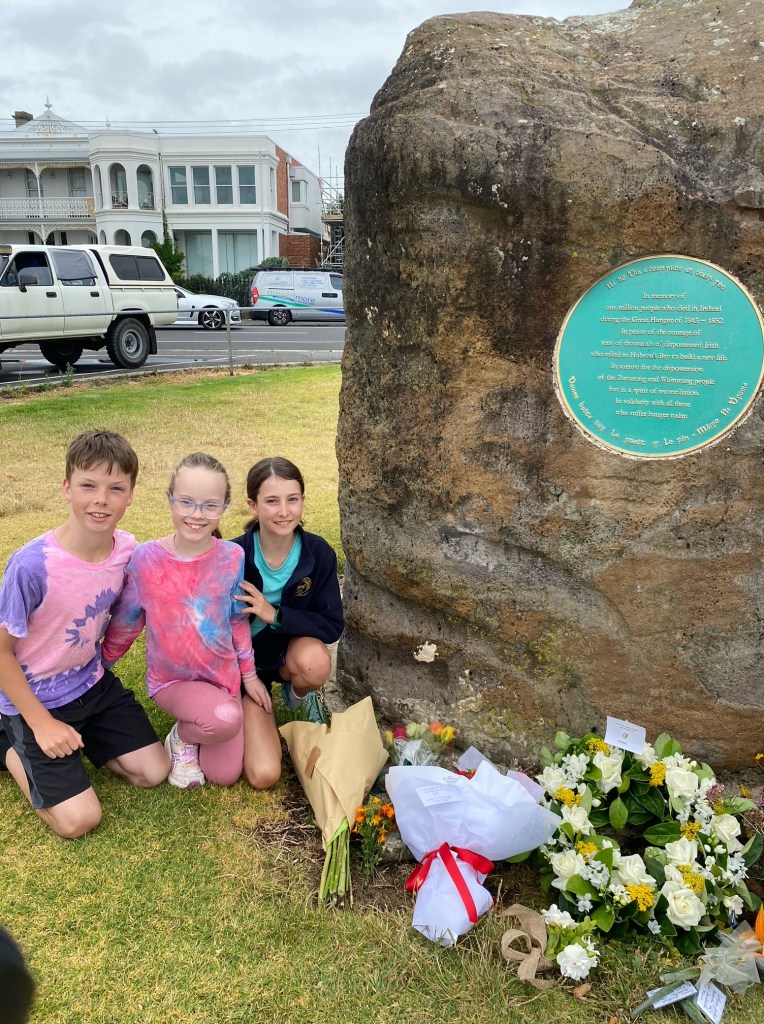
As usual, the Laying of Flowers ceremony was accompanied by uilleann piper Leo Kelly, and saw multi-generations lay the largest floral tribute we have seen at Famine Rock for many years.
Legacy
It is an honour to remember the brave teens of the Earl Grey Scheme, and join with descendants and supporters to pay tribute to those young trailblazers. To learn more about this remarkable shared Irish-Australian story, please visit us on Facebook – Irish Famine Orphan Girls Commemoration
 Tinteán