le/with Julie Breathnach-Banwait
Colette Ní Ghallchóir

I have had the pleasure of engaging with Colette Ní Ghallchóir for Tinteán’s current feature for Agallaimh le Scríbhneoirí Gaeilge/Interviews of Irish language writers. A number of years ago, whilst flicking pages, I clumsily stumbled across one of Colette’s poems in a book that was given to me by a friend. This was the first poem that I had read of hers. A few short lines with the most evocative emotionally rich images. As a lover of such intense emotions, I needed to explore more.
Rugadh mé ins na Gleantaí i gCondae Dhún na nGall. Oileadh mar mhúinteoir mé. Rinne mé Céim BA in Ollscoil Uladh agus Diplóma ins an Oideachas Feabhais in Ollscoil Luimhnigh. Scríobh mé ceithre leabhar filíochta. Dhá cheann foilsithe ag Coiscèim agus dhá cheann ag Arlen house.
Colette is a native of County Donegal, born in the picturesque Blue Stack Mountains, a place revered for its rugged beauty, sweeping vistas, and rich biodiversity. A landscape of changing hues of blue and purple, green and gold. The Donegal highlands are shaped by dramatic peaks and troughs of valleys and rolling curves of hills. Bogs, heathlands, wildflowers, lakes, flowing streams, with the expanse of the Donegal Bay to be awed on a clear day. It is little wonder thus, being surrounded by such beauty, that Colette’s poetry is peppered with such images. She is an emotionally literate writer, and her poetry is deeply rooted in the landscape and heritage of Co. Donegal. Her work has been translated widely, and she has read her poetry across Ireland and internationally. To date she has published four volumes of poetry:
An Guth Aduaidh (2021) The Northern Voice
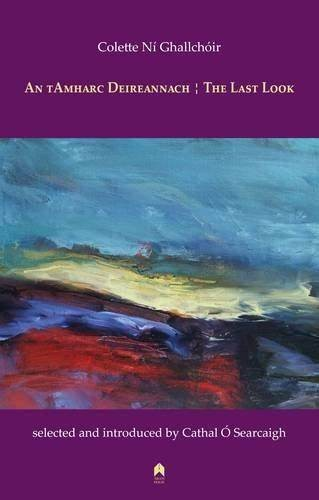
An tAmharc Deireannach: The Last Look (2014)
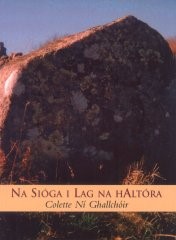
Na Síoga i lag na hAltóra (2005) The Ghosts at Lag na hAltóra
Idir Dhá Ghleann (1999) Between two Glens
The Last Look (2014) is Colette’s only bilingual collection to date.
Recently, I have had the pleasure of speaking to Colette about her poetry and what has shaped it.
On why she writes:
‘There’s something within me that wants to come out. I was always interested in poetry, and I probably write about my emotions and my life. Sometimes there are things that you have to write about, that you have to get off your chest, that why, it’s a release from my thoughts. I have always written, since secondary school. I was at a Catholic boarding school, and I wrote an essay at primary, and my teacher, a famous teacher in Donegal, Johnny, he said to me, ‘tá bua na scríbhneoireachta agat.’ (You have the gift of writing). I saw an advertisement by Máire Mhac an tSaoi in a paper, so I sent poetry to her, and she liked them very much. She wrote back to me and then I started contributing to journals. I was very active in writing poetry in my class as a teacher too. ‘Mise Éire’ is a poem I wrote when I was at a workshop with Cathal Ó Searcaigh.
Colette has made significant contributions to Irish literature and received the Pushkin Creative Arts in the Classroom Award. Her work is known for its lyrical style and strong ties to the Irish language and culture. She addresses emotional and controversial issues, including clerical abuse in the Catholic Church and the trauma felt by the Irish people. The imagery she creates evokes a profound sense of grief and historical pain. One of her most powerful poems is Mise Éire/I am Ireland, is published here with her permission. This poem connects trauma to national identity, making it an impactful piece of art of cultural and emotional importance.
Mise Éire
Ní maith liomsa
Boladh na gcoinnle
Ná an lasóg
Ná ní maith liom
Gabháil isteach
In áit na gcoinneal
Áit na péine
Na tríoblóidí
Áit na ngasúr
Áit an áir
Áit mhúchta an tsaoil
Áit mhúchta na beatha
Áit duáilceas na nduáilceas
Áit an uaignis
Agus na péine
Pian na n-aithreacha
Pian na máithreacha
Na gasúraí crochta
Na gasúraí marbha
Na gasúraí báite
Na gasúraí caillte
Gasúraí na ndrugaí
Gasuraí na dí
Gasúraí na mbríoscaí milsa
Gasúraí a d’fhág an saol
Ar altóir na péine
Sa seomra gléasta
An tsoineantacht crochta
Ar chrann na Páise
Ligeadh saor Barabbas
Ach crochadh iadsan
Ólfaidh siadsan
An fíon goirt
Go deo na ndeor
I am Ireland
I do not like
The smell of candles
Or the flame
Nor do I like
To go into
The place of candles
The place of pain
The troubles
The place of children
The place of fear
The place of world extinguished
The place of life extinguished
The place of most joyless
The place of lonliness
And the pain
The pain of fathers
The pain of mothers
The hung children
The dead children
The drowned children
The lost children
The children of drugs
The children of drink
The children of sweet biscuits
Children that have left life
On the altar of pain
In the dressing rooms
The hung innocence
On the tree of crucifixion
Barabbas was set free
But they were hung
They will drink
The bitter wine
Forever
On her own work:
I like the Johnny Doherty poem in particular, ‘The Fiddler’, as it tells of when I was very young and we were out making hay and our grandmother called us home and when we arrived, Johnny Doherty was sitting outside the door, making tins. I sat watching him, I must have been an observer even then, about when I was 10. This Tinsmith and fiddler made tins for milking and went round the farms, and he played the fiddle all night and people went out dancing on stone floors. We left that area soon after that, it was a once-off thing that always reminds me of when I was a child, how we had dancing and there was a fiddle on the wall and everyone who came in, seemed to be able to play.
AN FIDLEOIR
Chraith mo mháthair mhór an braillín geal
le hinsint dúinn pilleadh abhaile.
Bhí sé ina shuí ansin
ag béal an dorais
ag múnlú na gcannaí stain.
Bhí grian gheal an tsamhraidh
ag déanamh scáthán de na cannaí.
Bhuail sé iad go héadrom leis an chasúr,
casúr na sióg.
Nuair a bhi na cannaí déanta,
isteach leis.
Tharraing sé air an fhidil draíochta sin.
Tháinig Vincie aníos an tsráid,
é ina bhuachaill óg scafánta,
a fhidil faoina ascaill.
Bhuail sé leis an mháistir.
Cloisim go fóill an ceol
‘s torann na mbróg ar na leacacha.
Idir sin agus maidin
thit páistí ina gcodladh.
Nuair a mhuscail siad
bhí an lá ag bánú.
Bhí deireadh go deo leis an bhrionglóid.
THE FIDDLER
Grandmother waved
the white cloth.
Home.
By the door he sat,
tin shining in the summer sun.
Can-form he shaped it,
tapped with his fairy hammer.
Inside,
after the cans were made,
he took the fiddle.
Vincie came up the street,
a young man then,
fiddle under his oxter.
Encountered the master.
Until daybreak,
the song of the fiddle,
could be heard,
the tap tapping of shoes
on the floor.
Children fell asleep.
Wakened to
a vanished dream.
Translated by Celine McGlynn
What she likes to write about and what she would tell other writers:
I like to write about something strong that I’m drawn to, some event or feeling. I lived in the mountains first, the Blue Stack, and then moved to Gweedore, near the sea. It was a big move then, our company and our neighbours and all were all different. We moved into the Irish speaking area. I would say, just write from the heart and what you think moves you as I mainly write about things that happen.
On other Irish language poets:
I read Seán Ó Riordáin and Patrick Kavanagh, because I could understand what he was saying, for example, Seán Ó Riordáin’s ‘Adhlacadh mo mháthair,’ and when my own mother was being buried, over 40 years ago, when the priest got up, he cleaned the soil from his knees, the same as in the poem. I like ‘An tEarrach Thiar,’ by Máirtín Ó Direáin, he has brilliant Irish and can say so much in so few words.
Colette’s books are available from the publishers and at various outlets online.

Julie Breathnach-Banwait
Julie has been a regular contributor to Tinteán for many years and has recently joined the Editorial Collective. She is an Australian based Irish language poet and writer. To date she has published four collections of poetry. Dánta Póca and Ar thóir gach ní are Irish language poetry books published through Coiscéim (Dublin). Bobtail Books (Australia) have recently released two bilingual books of hers: Cnámha Scoilte/Split Bones – a bilingual book of prose poetry and Ó Chréanna Eile/From Other Earths – a bilingual book of poetry, co-authored with the Australian Irish language poet and writer Colin Ryan. Both are available at http://www.bobtailbooks.com.au
 Tinteán