
I like my fiction and my fact kept apart, and for that reason, I’ve never been a fan of historical fiction. Still, in my local library, I was drawn to a Hilary Mantel book that was on display. Her name was prominent in white, and I know of her work, but as I came closer, I saw in smaller font, in green on black the words A Memoir of my Former Self, and underneath in smaller font again, in white letting A Life in Writing. So, while I’m not a fan of historical fiction, I checked this book out because I am a big fan of memoir and writers writing on writing. When I looked at the contents, then, and flicked through the book, I could see that it was more than the usual memoir. There were commentaries and also film and book reviews. Perfect fare for bedtime reading.
I did not know that Hilary Mantel had Irish ancestry, so it was surprising to read about this quite late in the book. Mantel’s maternal great-grandmother was Catherine O’Shea from Portlaw in County Waterford. I was struck my this women’s saying that has come down through the generations: ‘The day is for the living, and the night is for the dead.’ It made me wonder if any of my own family sayings would pass down the line after me: ‘Back the same day’, my Dad would say on pulling into the driveway after a Sunday spin over the Dublin mouuntains; ‘you’ll take someone’s eye out with that’ and ‘it’ll all end in tears’, from my mother.
Hilary Mantel A Memoir of my Former Self is divided into seven chapters and in each chapter there are individual items covering a variety of topics, e.g. ‘Once Upon a Life’ has ‘I Once Stole a Book’ a memory from childhood, and ‘The Princess Myth’ an attempt to explain the ongoing fascination with Princess Diana through literature.
Then there are reproductions of lectures on writing Mantel gave in the 2017 Reith Lecture series; a review of John McGahern’s That They May Face The Rising Sun followed immediately by a discussion of the death penalty in the US. Another film review is of When Harry Met Sally, ‘a Christmas treat’ scripted by Norah Ephrom. Jane Austen and Annie Proulx are other writers discussed.
‘Bryant Park’ is a memoir of watching the Trump 2016 campaign and of Hilary Clinton becoming aware ‘of something brutal hovering’ invading her space. Mantel wished that Clinton would have raised ‘her arm like a goddess’ and sent him back ‘to his own space, like a whimpering dog’.
‘Bedtime reading’ is what I was looking for in Hilary Mantel’s A Memory of My Former Self, but this book is so much more. I will be renewing it.
Dymphna Lonergan
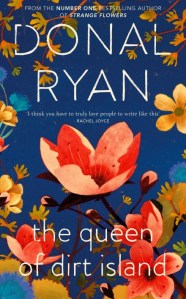
When I first opened the queen of dirt island, I immediately noticed the list of chapter headings spilling over pages. There are 121 chapters. Upon further investigation I learned that each chapter is exactly 500 words. By conforming to this structure, Donal Ryan’s economy with words displays his rich ability in craft of storytelling.
The novel starts with an end, and ends with a beginning. It is the story of the Aylward women, who for the most part live under the same roof in Nenagh, County Tipperary (geography the author is very familiar with, as he was born there). These are sassy women, there is a lot of cussing, straight talking and witty parley. Relationships amongst themselves and others are often fraught with contention, sometimes argumentative, sometimes violent. Each of them has her fair share of trauma, but their home is their sanctuary, they exist in harmony, have a deep loyalty to one another which is fuelled by their love for each other.
Each little chapter is so dense. A little snippet, a snapshot, insights that convey so much. A sentence that describes one man’s grief ‘Chris, his poor heart smashed…’ is an example of how much emotion is expressed in so few words.
It really is powerful storytelling. The queen of dirt island, the subject of the work and the actual novel, have left a lasting impression. I’m impressed.
Linda Rooney
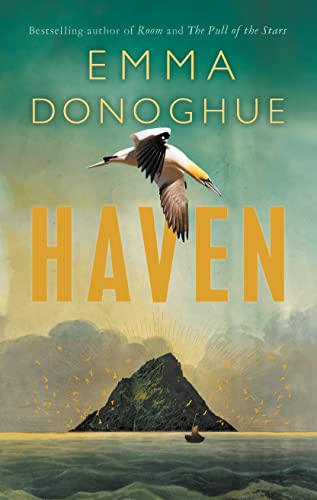
This novel performs the uses of hagiography for teaching Christian morality and theology well, though it was not fresh or new to one who grew up steeped in it. To another generation, not as over-exposed, it may prove informative and perversely instructive, but I’ll return to that.
This is a historical novel set in the Dark Ages (around 600) and powered by the excessive reverence of young monks for their Abbot as the source of all wisdom and authority. It involves a journey by an austere Abbot and two chosen monks from Cluain Mhic Nóis (Clonmacnoise) to the farthest westerly reaches of the South Atlantic and the most forbidding monastery in Ireland, Skellig Michael (referred to in this novel as the Great Skellig). Emma Donoghue meticulously and imaginatively adds detail upon detail to build understanding in a modern reader as to what it took these three men to not only build on the barren, rocky, inaccessible heaven-aspiring island but to survive there. Archaeology suggests they may have wintered on the mainland, but the Abbot of Donoghue’s imagination is simultaneously heroic, and fascistic, insisting that God will provide. God doesn’t; his subalterns do. It takes most of the novel’s length for the revolt against the monks’ commitment to obedience to build. It took starvation and worse to get there.
One of the sheer delights of the novel is the slow build of irony and the handling of the hagiographies. There’s an older monk, Cormac, very experienced in the ways of the world, who irritates the others by being an endless regaler of stories, mostly those of the saints. And bit by bit these narratives empower the submissive monks to confront their body-hating oppressor. I’m avoiding plot-spoilers here. But the hagiographies, particularly the deeds of Holy Mochaeoi, play a significant part in how Donoghue tackles her (very satisfying) resolution.
If you are curious about Irish prehistory or how the Church inculcated its penitential ideals, this is a writer who one can be confident has done her research. One of the few consolations she offers a reader is the pleasure Trian, the younger monk, takes in the natural world of the Skelligs – its one surviving Rowan tree hanging on by a filigree root, its bird and fish life, and his little musical instrument. It’s much harder for this reader to accept the autocracy of the Abbot and his absolute power that corrupts absolutely.
Frances Devlin-Glass

I am very excited, if not a little late to the party, on sharing this book. I am a lover of languages and understandings thus I find bilingual books fascinating. Some translations cut close to the original, others stray so far beyond, morphing into a new form, that they seem barely related. Both styles are equally interesting for me, being a bilingual writer myself, with a keen interest in social constructionism and how languages shape our perspectives and worlds. Shifting between languages can enrich any reading experience immensely, particularly those that are not so closely related. With such a variety of translators this book is versatile in many styles.
For me personally, simple poetry that can hit the spot with few words is the most beautiful and most effective and the style I am drawn to the most. Some poets achieve this beautifully, Michael Davitt or our own Colin Ryan for example, Áine Ni Ghlinn is another – a poet Tinteán recently engaged with in our series on Irish language writers. Weaving words into tidy concise pieces of art is quite a skill, and Colette is a master of this style, moulding minute tapestries that are a balm for the heart and soul, oozing in tenderness and delicate in form and style. This collection ‘An tAmharc Deireannach: The Last Look’ features poems in Irish with English translations by various other poets, including Máire Mhac an tSaoi, Nuala Ní Dhomhnaill, Joan Newmann, Kate Newmann, Frank Sewell, Celia de Fréine, and Gabriel Rosenstock.
The human experience is what Colette explores. Life, death, love, loss, the passage of time. Her poems dance with lyrical intensity and introspection, with her native Donegal being the backdrop. Tinteán is excited to be including Colette in our series of ‘Agallaimh le scríbhneoirí gaeilge /Interviews with Irish language writers,’ over the next few months where we can taste more of her soft words and delve a little deeper into some of the stunning poetry in this book.
‘An tAmharc Deireannach: The Last Look’ is available online and is published by Arlen House, Dublin.
Julie Breathnach-Banwait
 Tinteán