A Book Review by Dymphna Lonergan
Ó Chréanna Eile From Other Earths Julie Breathnach-Banwait and Colin Ryan
Bobtail Books 2024
Paperback ISBN: 978-0-6457489-4-9
Hardback ISBN: 978-0-6457489-3-2
ebook ISBN: 978-0-6457489-5-6
RRP: Hardback $29.99 Bobtail Books
RRP: Softback $24.99 Bobtail Books
ebook Amazon for Kindle $10.54
They say you shouldn’t judge a book by its cover, but sometimes a cover reflects a book’s content in a remarkable way. This has been my experience with the bilingual poetry collection Ó Chréanna Eile From Other Earths by poets Julie Breathnach-Banwait and Colin Ryan.
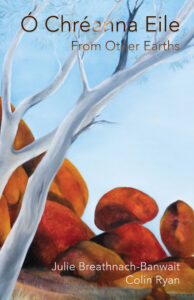
Perhaps my response to the book cover design (cover art by Lucy Murfet) reflects my reading over several days sitting in an armchair by a window, the light revealing different aspects of the design throughout the day as I picked up the book and put it down.
The startling blue of the sky, the cool white of the ghost gum branches, the plump burgundy rocks evoke the book’s contents, rich poems in Irish with English translations reflecting the unique style, background, and world view of each poet: one born in Ireland and writing in Irish in Perth, the other born in Australia and writing in Irish in Melbourne. In the middle of the word Chréanna in the book title, the letters an take on a rose-gold hue. Out of these different earths, Ireland and Australia, different languages, Irish and English, comes something new and special. It is a first in Irish language poetry publication: two acclaimed Australian-based Irish language poets demonstrating the treasure trove that a bilingual approach to poetry can unearth. The publisher is Australian: Bobtail Books ‘an Independent publishing house, passionate about supporting poetry and prose in both the Irish and English language.’ Their ‘aim is to ensure that the material we print is unique and supports artists who are challenging current genres and labels in literature.’
The collection is in two parts: the first, twenty of Colin Ryan’s poems; the second, twenty-one from Julie Breathnach-Banwait. Featured on the back cover of Ó Chréanna Eile From Other Earths is Colin Ryan’s poem about Australian cockatoos (pp 42/43).
Cocatúnna
Féach! A dúirt sí de chogar:
Cocatúnna!
Is an táin bhán ag éirí
d’aon ghuth garg
i ngoirme an fhómhair
Cockatoos
Look! She whispered:
cockatoos!
and the white horde rising
with one harsh voice
in autumn’s blue
Here we have a contrast between the reverential whispering of the birds’ name with the harsh cry of the cockatoos rising. Also, Ryan uses the word táin for ‘a horde,’ evoking the epic Irish poem ‘Táin Bo Cúlainge’, the centrepiece of the famous eighth century Irish mythological collection the Táin.
Colin Ryan’s poetry often uses contrast to great effect: speaker and listener, light and dark, talk and silence, and presented in an economy of words as in the poem ‘Crann/Tree’ (22/23)
Crann
Faoi sholas séimh
i bhfuinneog
ag feitheamh le rud
nach bhféadann focail
a chur in iúl
rud nach bhféadtar
a dhearmad
Tree
A tree
in a soft light
in a window
waiting for something
that words
can’t say
something that can’t be forgotten
Both poets capture moments of retrospectivity, Ryan’s ‘Siúl/Walk’ (6/7), solitary, contemplative
Siúl
B’in an bóthar a shiúil tú
san oíche
an diabhal ar do chúl
tafann an mhadra thiar
an abhainn romhat amach
ag rtih aniar ó chríoch aineoil
chun eolas na farraige
Walk
That was the road you walked
at night
the devil behind you
far barking of the dog
the river before you
running from unknown country
to the sea’s knowledge
Breathnach-Banwait’s ‘Lonnair gan bhunús/Baseless Gleam’ (70/71), charged, sensual.
Lonnair gan bhunús
cúr smugairle –
smeartha ar phíosa
airgid le d’ordóg
gur léim dathanna
bréige om bhaithis
Baseless Gleam
You polished me like saliva –
foam of slaver –
smeared on a silver coin
with your thumb
so false colours
leapt from my crown
Both poets also provide musings that may be particular but reveal a universality. Ryan’s ‘Deisiú/Repairing’ (16/17) is a concrete account of repair underway, perhaps after some disaster, but the ending suggests futility and the inevitablility of history repeating itself.
Deisiú
Rinne siad deisiú gan stad
is na tithe ag titim
na díonta ag ligean
mhírín na spéire isteach
na hurláir ag nochtadh
uaigheanna seanchogaidh:
chuir siad i leataobh
an sábh is an casúr
is d’imigh gan filleadh
trí dhoras nár dhoras é
ach cuimhne
Repairing
They endlessly repaired
while the houses were falling down
the roofs letting in
the sky’s ill will
the floors exposing
graves of an old war
They set aside
saw and hammer
and left without return
through a door that wasn’t a door
but memory
Breathnach-Banwait’s’ Na páiste doirte/Spilled Children'(44/45) may be a physical and personal loss for the narrator but also, perhaps, the creative struggle for poetic expression. The form of the English version, unmatched by the Irish, is intriguing.
Na páistí doirte
Doirteann siad asam, locháin linbh
Gan corp ná cruth, guth ná beocht
Iadsan nach féidir a bhfás a bheathú
Atá ag spochadh mar
Agóid utalálach i mo bhroinn
Teitheann siad i ndubh na hoíche
Gan rabhadh, focal, smid ná trácht
Chun insint dom nach mé atá uathu
lena mbailte a dhéanamh
i mbroinn máithreacha níos boige
The spilled children
They spill forth, pools of babies
Bodiless, shapeless, voiceless, lifeless
Those whose growth I cannot nurture
That spar like
A fumbling protest in my womb
They flee in the black of night
Without warning, word, puff or trace
To let me know that I am not for them
To make their homes
In the wombs of softer women
On reading this poem, interpreting it as an account of the poet’s struggle to capture the precise word, I was reminded of seeing drafts of Seamus Heaney’s poems last year in an exhibition in the Bank of Ireland: the crossed out words, the inserts, the discards behind the creative veil in full view under a glass pane. It was a privilage to see Heaney the poet at work.
Breathnach-Banwait’s poem ‘Blás ár ngrá The taste of our love’ (50/51) brings home the difficulty in capturing words that represent the intensity of new love. This poem is an effusion of imagery and possibilities of what love is. In part, here, from the English version:
Is it like a rainbow
Complex, kaleidoscopic, infinite?
Crackling at times like a sweet on a child’s tongue
Or dark like galaxies…
…Indulgent like a diamond throne in a golden palace.
Colin Ryan’s memorial poem ‘I gcuimhne ar FH In memory of FH’ (30/31) is an arresting image of that person walking out into the desert ‘in the company of stars’, ending with ‘the body becoming dust/and the heavens descending/to meet him.’
Ryan’s poems tread lightly across the page, imagery gently supporting thought. They resonate like a sacred bell.
Breathnach-Banwait’s poetic weave is often rich in alliteration and assonance, especially in Irish. In the poem ‘Mangróbh/Mangrove’, the Irish words sound like a creature scavenging in the density of the mangrove branches: ‘Déantar forghabháil/ghabhálach, go glamach/rutaí ag rangaraicht'(74/75). Alliteration further develops the image: ‘lubra lúbtha trína chéile/casta cniotáilte/fite fuaite le fána’. You can almost taste the succulence and hear the munching and chewing!
Bilingual poetry such as this collection affords us the opportunity to appreciate both languages. The English translations are by the poets themselves, and represent a commitment to making them poems in their own right. This means that even if you do not read Irish, you can appreciate the themes, thoughts, metaphor. and imagery in this collection.
From the cover design to the eighty-nine pages of content, and Irish and English presented side by side, Ó Chréanna Eile From Other Earths is a wonderful example of Irish language poetry sprung from the red earth of Australia. Molaim an cnuasach seo. I recommend this collection.
Ó Chréanna Eile From Other Earths is available from Bobtail Books https://bobtailbooks.com.au/
Dymphna Lonergan is a member of Tinteán’s editorial collective with academic status at Flinders University. She has published two collections of short stories in Irish with English translations As Gaeilge and Scéalta Arís, available at An Siopa Leabhar in Dublin and from https://immortalise.com.au/
 Tinteán